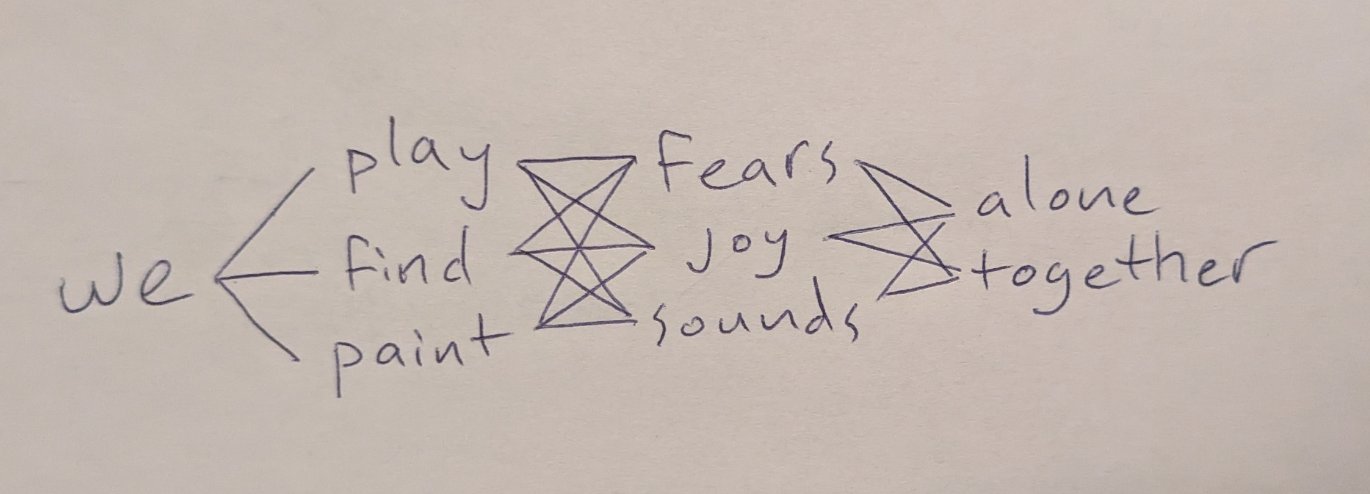
Usually when I write I’m scared. Scared of getting enough done, scared of how long it’ll take, scared I’m not good enough or funny enough or fast enough. It’s like that game where kids carry an egg on a spoon and try to walk faster faster but my egg is already smashed. Smeared on my spoon. Clear and yellow pulp crunchy with eggshells. And any moment someone will notice I’ve always already failed.
I wish when I wrote I was talking to you. I wish we were together at the lake with the first hints of the storm ruffling the surface, and maybe we’ll go in soon, before the rain really hits, but for now you say I keep thinking about the horror of having a body and I say I think about broken bones, the way they twist, the way all bones are broken bones that haven’t broken yet and you say I read this essay from a mortician who’d held a skull that day, a complete skull, cooked clean by the cremation chamber, and she was looking at the skull, holding this which used to hold a person, though now it was covered in ash and scorch marks and she was thinking about how sometime every part of her will be something that somebody else holds, and she’ll come apart, and she realized it’s important to sit sometimes with the fact that none of us are the center of the story, or at least not the center of the story for very long, and while we might be stardust, the iron in us literally made in the furnace of stars, we are also borrowed stardust, we are iron that was earth or roots, that was something else, and will be something else and I say wasn’t that Caitlin Doughty and you say yeah, I think it’s in Smoke Gets In Your Eyes and then you pause and you say the rain’s really starting to come down. And for a little while we’re sitting there, you, me, and Caitlin Doughty, all ghosts, all together, this together we’ve made as the surface ripples a reflection of the clouds and the trees.
Tag: books
451: “As Long As It Helps Us Hope” (Weiwei & Stamboulis)
“I think that it doesn’t matter whether poetry is good or bad… / …as long as it helps us hope.”
-Ai Weiwei and Elettra Stamboulis, Zodiac, p. 154
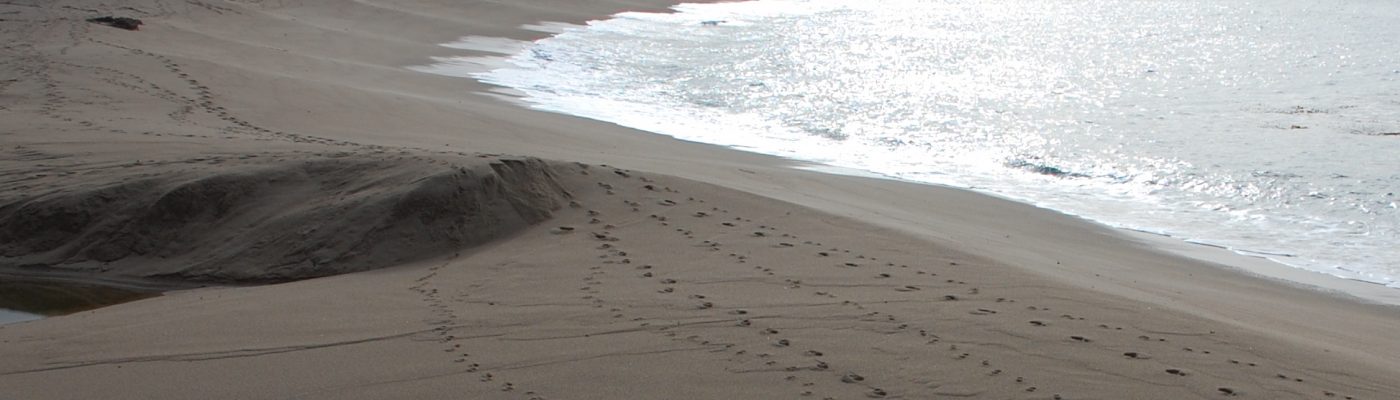
Sometimes I sit and listen to the resonance between experiences. Between these three, for example: 1) When I taught high school poetry in the twenty-teens, one of my favorite practices to do with a class was “short order poetry. Each student asks another for a poem (“about the first day of school,” “about a cracked windshield”). Then in ten-ish minutes each writer makes a poem to give back to the asker. This practice positions poetry as community, a gift between friends. The time limit can also help me stop worrying about “how good” the poem is and focus on putting lines together. 2) Some years after those classes, a mentor and I started talking about a teaching moment when you let go of worrying “how good” your classes are, recognize students’ work and interest as so much larger than you, and focus on offering what you can and supporting your students’ work how they ask you to. After that moment, paradoxically, our classes felt “better”—but something else had shifted, too. 3) During the worst years of feeling farther and farther away from my writing, writing felt more and more like a place where I had to perform expertise and less and less like the reach toward community that made me want to write. In the middle of those years I started writing flash fiction. Tiny paragraph- or page-long stories that touched one moment of connection, movement, need, loss. Writing those came to feel—well, like walking down to the beach every day to splash my face with the water. Or like letting the ocean wash its face with me.The practice helped me start finding my way back toward what I love in writing.
When I finished reading Zodiac, I sat for a while, listening to the resonance between Ai Weiwei’s thoughts and so many of my (shared) experiences and relationships. I think the sitting—the quiet—was a way to turn towards and understand how the question “how good is this?” gets planted almost everywhere around me. And recognizing that planting is also a chance to stop planting, to focus instead, perhaps, on the ground the question grows in. The ground of what we’re doing, together. Of how what we’re doing together weaves our lived experience. How that doing makes it easier (or harder) to hope actively, playfully, courageously, communally.