445: “Each Player” (Uwe Rosenberg)

“Each player takes a quilt board, a time token and 5 buttons…”
                –Patchwork rulebook; game designed by Uwe Rosenberg

                I don’t have a “finished” thought today. Maybe, instead, I have a kind of game.
                The board game Patchwork is pretty new to me, and I keep thinking about the way it mixes two game mechanics I’ve played lots of times. Part of it is arranging blocky shapes on a grid—like Cathedral when I was a kid, kneeling on the carpet, or Tetris. Part is “engine building” by creating a collection that earns you increasing “income”—a core mechanic for so many things, from Spice Road to Res Arcana to Monopoly. Patchwork simplifies both ideas and puts them on top of each other. I start playing and think I’ve played this before. And I think no I haven’t.
                So for a few months now I’m going around and around, interested in the kind of newness that happens when two familiar things sit on top of each other in an unfamiliar way. The game equivalent of a kimchi quesadilla (new to me, at least, and delicious)? Maybe: but it feels more like the time a coworker and I played frisbee golf inside the empty high school as a break from grading finals. Spaces we often walked through, games we often played—and now we’re wondering, wait, what is this? And I’m wondering, what would you put on top of what?
444: “Walk to the well” (Rumi)

“Walk to the well. 
Turn as the earth and the moon turn,
circling what they love.
Whatever circles comes from the center.”
                -Rumi, translated by Coleman Barks, The Essential Rumi p. 279

                This evening I had the wonderful chance to walk with my friend Roger. That’s part of how we became friends: long rambling walks, through the woods of Amherst, MA, to the ponds where little lives glowed at the kiss where earth met water, to the hill where stars scattered, and back beneath the trees, limbs creaking. Shadows alive. We became friends on long walks and in conversations that felt like long walks, circling through hopes and dreams, ideas and curiosities, and back to shared silence. Pauses that felt like long drinks of cool water. Circling back to each other. 
                Today we walked with each other through a phone call. Less good? Perhaps. I certainly wish we could walk together in person more often. Like so many of my friends, we’ve moved away from each other with jobs and degrees and all the steps that felt necessary. But tonight, sharing voices, we felt close again. And instead of saying we moved away from each other, I thought, we’re walking to the well. Circling what we love. I think I love walking because of its stillness and its movement. Running, or driving, or riding a bike—I feel the rush, the excitement. And stretched out on the grass I feel at ease. Although, in another way, that’s not true at all: in the middle of running I sometimes find a moment where all there is is breath, stillness, and in lying on the grass I sometimes feel roots digging, sun pouring down, blood circling. 
                Walking with a friend has a way of bringing me back to the kind of center that can stretch all the miles from here to there, that can live inside a phone call. I’m so grateful, and so glad. Walking to the well, and sometimes walking is its own drink of cool water.

443: “What do you think games do?” (Yoon Ha Lee)

                “[…] what do you think games do? What are they about?” [asked Jedao.]
                The flippant answers weren’t going to be right, but [Captain Kel Cheris] had no idea what he was after. “Winning and losing?” she said. “Simulations?”
                -Yoon Ha Lee, Ninefox Gambit

                Years ago, in college, I started playing pool–and ended up liking it!–because “Do you want to play pool?” seemed like a more socially acceptable question then “Do you want to hangout and see if maybe we’re friends?” In graduate school I’ve played a lot of board games for a similar reason: I like the games, and I especially like the space they make to spend time with people. Although that’s not all they do: they also end up frustrating. Sometimes they encourage a kind of competition that ends up changing my interactions in ways I don’t like. Although that’s not all they do: they play out little versions of reality. What if we were kids trying to crack someone’s codes (The Initiative)? What if we were a group of explorers lost below ground (Sub Terra)? And of course, that kind of “what if” also isn’t all games do.
                I love Yoon Ha Lee’s playful (and in context, deadly serious—if you read the book you’ll see) explanation of games because it opens into answers behind answers. What a game does, what it’s about, depends on how we engage with it. How we pick it up. I’ve been thinking about that today because I’ve been playing games on boardgamearena.com and just getting more frustrated. But then again, the way I’ve been playing, I wasn’t enjoying the time with other players. (In 2020 boardgamearena.com was a wonderful and bizarre way to share twenty minutes with people social distancing all over the world). The way I was playing, I wasn’t relishing how a simple set of rules makes different strategies possible. I was playing as I worried about the other tasks I had. Playing as a kind of pretend avoidance, or as the pretense of doing something while I worried about being productive. Yoon Ha Lee reminds me that “playing a game” isn’t always an answer for what I’m doing. It’s also the beginning of a question: what’s that “doing” about? What are all the different things that “doing” might do?

442: “Thursdays” (Douglas Adams)

“This must be Thursday. I never could get the hang of Thursdays.”
                -Douglas Adams, The Hitchhiker’s Guide to the Galaxy

                Since starting this blog — 441 weeks ago! — I’ve noticed something bewildering. I’m not sure if you’ve noticed the same thing. I’ll finish a post, revise it, get it to a place I like. I’ll post it on Wednesday night. And then the very next week, Wednesday comes along again.
                Remembering back to Adams is a lot of fun. He’s been part of my head for — twenty years? More. And here he is, celebrating the fundamentally mysterious in the blatantly obvious. I’m having trouble getting the hang of Wednesdays, myself. And the funny thing of being a me who remembers me but the other mes agree and disagree on different things, and want different things, and memories blur them together. And trying. That’s a weird one. I’ve been rock climbing more, and sometimes it’s hard to tell when I’m really, really trying, pulling on the rock with everything I can, and when I’m kinda sorta trying. A few days ago I didn’t get the hang of that and came home with a bruised hand. Or dishes! Has anyone gotten the hang of dishes? Or mornings? Or evenings? Or eating a last chip but only after the chip bag’s closed so you don’t get another last chip, but how can you close the bag properly when you’ve got a chip in one hand?
                I spend a lot of time thinking. Learning. Working things through. Adams makes me chuckle with the thoughtless, the perfectly possible but somehow always impossible, the spilled, the confused. I never could get the hang of Wednesdays.

441: Talking About Shadows (Shima Shinya)

“You don’t talk about the shadows with your classmates, right?”
“Right. I think a lot of kids in my class can’t see them.”
                -Shima Shinya, Glitch (Volume 1)

                A few days ago I had one of those moments where I wondered, really wondered, about some kind of common natural process that I usually take for granted. It wasn’t what happens inside a lightbulb to emit the light, but it was something like that. A foundational “how does that work?” while looking at the world. I can’t remember what it was because I thought about it for a moment and let it go. Reading Shinya, I start thinking more about some everyday mysteries — about the ones I see, the ones I don’t. And about how easy it is to stop talking about them, especially when I’m not sure anyone else is “seeing” them. Or when I can so easily stop seeing them myself.
                Years ago, in undergrad, my friend Ryan and I fell into an excited conversation about some famous philosophical problem. (The Ship of Theseus, maybe, or Leibniz’s thought problem about a brain the size of a windmill so you can walk inside). It was a lovely conversation. A few days later I brought it up with Ryan and some other friends. I turned to Ryan to help explain whatever the philosophical problem was. Ryan smiled — interested, but not taking the lead. They said something like: “I’m not seeing it right now. Can you help get me started?” At the time I was surprised—just two days ago we’d been excited about this together, and now they didn’t understand? Looking back, I’m struck instead by how my own interest — my ability to see, and to connect, and to wonder — changes day to day. And by Ryan’s gentle recognition that they weren’t connecting, and that, through the right conversation, they might start seeing something that caught their eye.

440: “In Just Three Words” (Mirinae Lee)

                “You genuinely believe a person can sum up her life in just three words?” -Mirinae Lee, 8 Lives of a Century-Old Trickster

                My sibling Maple’s visiting, and lately we’ve been talking about the way stories say and don’t say things. I’m coming off a couple-year kick of being pretty frustrated by how the stories I write seem, in my mind, to make lies: they arrange moments and experiences into a sequence that ‘makes sense,’ that ‘has a direction,’ but that sense and direction is imposed by the story making. The writing (I’ve been feeling) draws lines that weren’t there in the living. My sibling resists, insisting that they appreciate stories — and music, and photography — precisely because all these help them understand what they’re feeling. All these are different camera lenses turned toward a piece of life, and showing something.
                One of these talks happened while we were waiting at the laundromat. Our clothes went round and round. So, I suppose, did we, playing through how our ideas curled and flopped. Maple is also a wonderful photographer. They wouldn’t say that: they would say they like looking through a camera, and they love how that practice changes the way they see light. Then today they turned around their laptop to show me a picture I love. It’s a sink, half in shadow, half in bright sun.  “Where’s that?” I asked. “At the laundromat,” they said. And I know the sink they must have been looking at when they took the picture. I’ve seen that sink, and used it. And I missed something about its fullness until I looked at it in Maple’s flat picture.
                So I don’t think that anyone can sum up her life in just three words. I’m frustrated by stories. I’m also excited about how words (and pictures) show something beside what they’re showing. How, in this moment, my window (which mostly reflects the kitchen) shows also a street lamp outside, the suggestion of a tree, a world I mostly can’t see but can’t stop feeling here.

439: Acknowledgements, Gratitude (brown, Parker-Chan, and Whitehead)

                “Thank you to my woes, dear friends, beloveds, and lovers, who have walked toward pleasure with me, refusing to settle.” -adrienne maree brown, “gratitude,” Pleasure Activism (on the page another book might call “Acknowledgements”)

                “What a difference a community makes.” -Shelley Parker-Chan, “Acknowledgements,” He Who Drowned the World

                “I am always reaching for your fingers.” -Joshua Whitehead, “Acknowledgements,” Making Love with the Land

                I’m working on draft twenty-nine of my novel — a draft I’ll send to publishers — and today in the shower I was writing an acknowledgements page. There are so many people who carried water to grow this book. Whose questions inspired these characters. Whose laughter lives in their voices. My voices. Our voices, I hope.
                I think something like an acknowledgements page — that act of gratitude — is a lovely exercise for more than just books. A naming, incomplete, more loving gesture than polished list, of the communities I’m part of. When I started writing this post, I thought I might include a fragment of my list, but I realize that’s not what this post is about. This is about how adrienne maree brown, Shelley Parker-Chan, and Joshua Whitehead all invite me toward practices of connection. This is about how I’ll lie in bed tonight, drifting through some of the interwoven moments and interactions and relationships that are the music I sing with. One friend’s poetry. A game played with friends some ten years ago. A rock I picked up on the beach. My siblings, one of whom I’m about to pick up from the train station. It’s lovely to make space to focus on these relationships, and think how they interact. It’s lovely to feel that space all through me.

438: “As If Forgetting” (Annie Liu)

“Why document this, as if forgetting were the worst thing?”
                -Annie Liu, from “The Story,” Border Vista
“and what happens next / I don’t remember yet.”
                -Annie Liu, from “Memory in a Foreign Language,” Border Vista

                I usually inhabit a kind of productive logic in which everything is supposed to have its use. Year by year, we’re supposed to be smarter. More capable. Or to put it another way, I was watching The Great British Bake Off, and the contestants were talking about how you had to multi-task and schedule out every minute— while this is mixing, that is setting; while that cooks, this cools. I got excited about all that careful attention to using every minute in six or seven ways. Then I got sad about it. I wanted to bake with the bakers who do one thing at a time, sometimes staring out the window, sometimes forgetting the recipe, sometimes lapsing into a long memory of someone they only kind of knew. Maybe that immersion in a moment, unscripted and undocumented, makes the act of baking a cake a bit more like tasting a cake—butter and chocolate and spices—or like sitting, afterward, with friends, the taste fading.
                and what happens next / I don’t remember yet. Reading Annie Liu’s book, I feel a different kind of time, a different kind of sinking into now and next, memory and forgetting. In “The Story” Liu leaves blank lines for a story she hears: the space is there, and empty. It’s not gathered into something concrete, though it’s also not erased. She refers to it, even if we don’t see the “it” she’s referring to. There’s something here even as something’s gone. So I think about baking: the heat of the oven and the smell of the cake. The way both slip away. A blurry moment after mixing the batter together and before—who knows what?
I want to live more in time like that.

437: Caves and Instruments (Hilary Brady Morris)

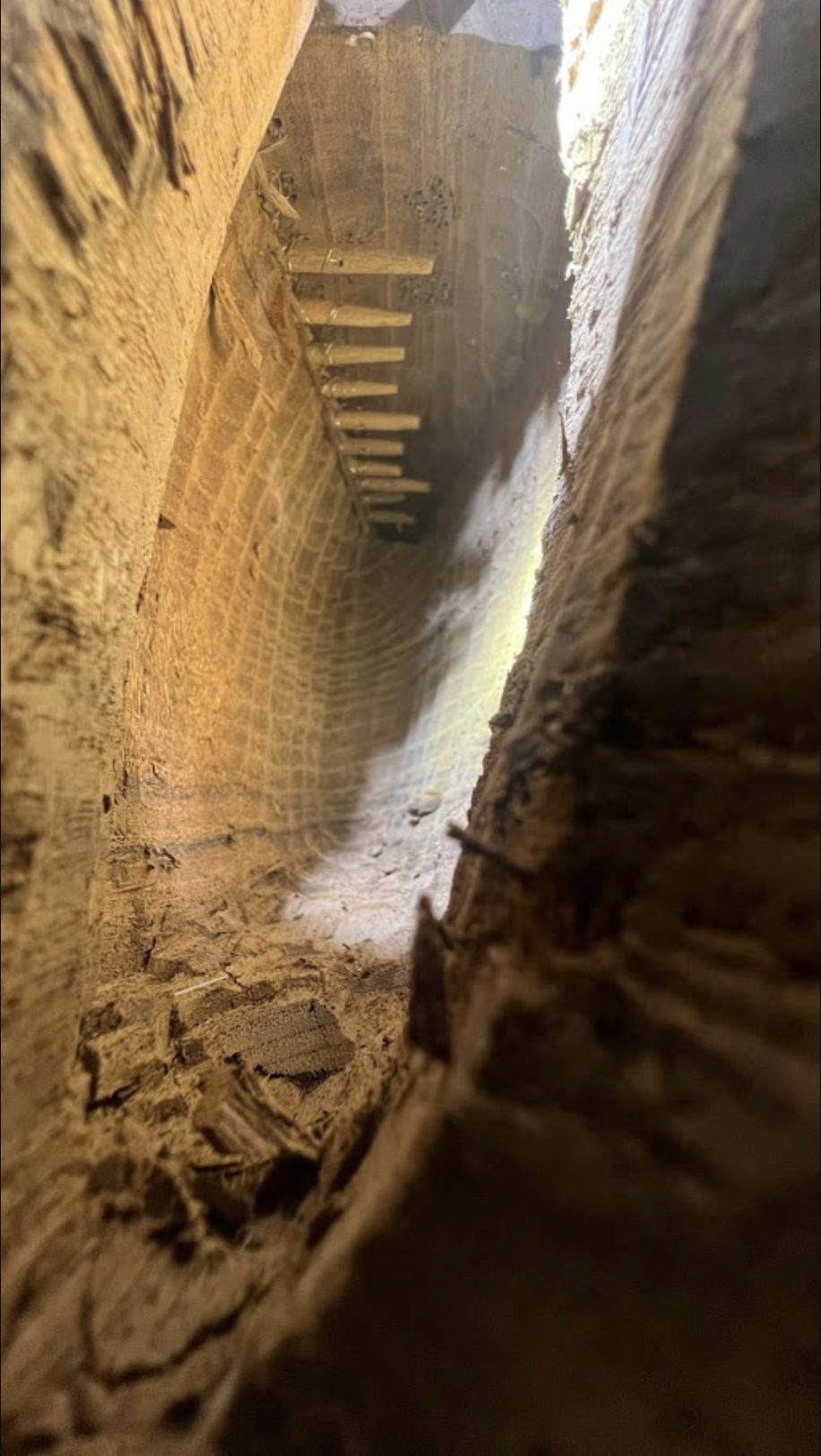
-the interior of an Afghani rebab, photographed mid-repair by Hilary Brady Morris, @thisishowwelearn

                Hilary showed me this picture a few weeks ago. She’s a maker, hands alive with a maker’s knowledge, and she fixes all kinds of instruments at the Music Inn in New York City. Some of them are instruments she’s never worked on before. Lots of the repairs, like this one to replace the goat skip top, mean working with a variety of materials. Wood. Metal. Skin. Bone. Hair. That means she needs to keep learning, and keep a gentle grip on what she knows. Following the way another maker balanced weights and forces, and the way these materials change and stay steady.
                When Hilary showed me this picture we both went silent, looking at the wood, the way it’s been carved away, the peg ends that anchor the sympathetic strings. It looked like a place I could go. Like sandstone canyons and caves I’ve walked through in Cedar Mesa and Escalante Canyons. I fell silent a lot in those places, too—with wonder, with curiosity, with delight, with a sense of my own smallness as I climbed these thin ribbons of air down into earth. I love Hilary’s picture because, in it, I see a hint of how worlds cohere. How they play together on music, lean together with rock walls, weave together as we talk and share. How details come together into one version of here. There’s a sense of connection—fingers on wood, breath in the narrow breadth of a sandstone canyon—that doesn’t explain everything, but that instead draws close enough to touch. Wood. Stone. Skin. Bone. These pieces joining together into a world where, for a little while, we walk.

436: “Places” (Doreen Massey)

“…places do not have single, unique ‘identities’; they are full of internal conflicts.”
-Doreen Massey, “A Global Sense of Place”

                These days, my work desk is also our breakfast table, the one I share with my partner and plates of eggs and afternoon board games with friends. In the last few weeks I started thinking it was hard having one place that played all these roles at once. Sometimes I’d go to set down my books and my laptop, and find last night’s dinner plates. But then I started thinking about Massey, and about going back to Amherst College.
                The last time I went to Amherst I was lonely. Most of my friends had graduated. All the little groups on the quad weren’t groups I knew how to join. At the time I remember thinking, “this isn’t home anymore.” Reading Massey, I start thinking instead how Amherst always was and wasn’t home. Or how calling somewhere “home” doesn’t cover up the connection and loneliness that both live there. Since graduating I’ve talked with lots of people about our time —some experiences like mine, and some so different—and those conversations lead off into so many ways that belonging and how one belongs is threaded through with questions of class, race, gender, sexuality, dis/ability, and so much more. Amherst College was never one thing. 
                Sitting at my breakfast table, I think about ideas of “knowledge” that position it in the library—and away from the kitchen, the mess of last night’s dinner and the making of this morning’s breakfast. I think about the expectation that where I work and where I cook and eat with my partner should be separate places. I think about my internalized expectations of productivity, responsibility, and success, and how those interact with my internalized ideas of joy, connection, community, rest. Scrambled eggs. I don’t think I’m struggling with one place that is all this. I’m struggling with how all this is “supposed to be” separated out, arranged neatly, and how this separating out, this weighing, is often in the service of creating a hierarchy. An ordering of importance, and time. “I’ll cook when I’m done writing,” I often tell myself. And places are many things at once. Today I think and yawn and stretch while cooking my partner breakfast. It feels strange to call this place “mine.”