464: a home is “active, emergent, in relation” (Sarah Keeton)

                “…we do not initially come to learning, to being, to knowing, as passive recipients, absorbing the gift of the expertise or “teachers” around us (Freire), but rather we come to knowledge, active, emergent, in relation, co-constructing our reality (LeMaster “Fostering,” Sprague “Expanding,” Toyosaki “Praxis-Oriented”), like my niece, my sister-in-law, and my brother, finding ways to communicate within our respective realities.” -Sarah Keeton, “Tracing the Past to (Re)imagine the Future: A Black Queer Pedagogy of Becoming” 

                My partner and I sometimes tell each other, “You’re my home.” (I like that more than lots of the short descriptions for love that I hear in songs and TV shows: you’re my world, you’re the most beautiful I’ve ever seen, and all like that). A home isn’t where we spend all our time. A home, the kind I want, is part of a wider community of collaborating, of coming and going, of walking to work in nearby gardens and having friends over to tell stories all together. And I suppose, in that community, the home I want to help build is a refuge and a delight, a kitchen for cooking food we share, a couch for resting, a table for laying out games and questions and conversations. A home is where I can invite you to spend a few nights next time you’re nearby.
                Today my partner and I are starting the process of moving into a house that will become our home. And I’m thinking about homes as something we learn: a way of being around each other, caring for each other, laughing with each other and noticing what our different laughters and quiets and pauses mean. I’m thinking about homes as something that absorb the time and energy and intent they help shelter. The wood alive with voices just as it’s alive with the sun’s voice. I’m thinking about homes as emergent, alive in the breath of our interaction, a collaboration between builders and painters, neighbors and squirrels, trees and moths, families and friends. A touchpoint between so many lives..

463: “Research is my saving grace” (Shelby Criswell)

                “Research is my saving grace, and it led me to every person who inspires me in this book.” -Shelby Criswell, Queer as all Get Out: 10 People Who’ve Inspired Me

                Sometimes I think about the many different things research can be.
                Most of the undergraduate students I teach don’t like “it.” Research papers feel like a threat. Or maybe I’m projecting, because for me, “research papers” often felt like a threat. There was a right way to do it, though people wouldn’t tell you—they’d just tell you what you did wrong. There was a place you were supposed to find in the pile of encyclopedias, library books, search engines, online journal databases. It was like trying to find the right grain of sand on the beach.
                In my classes I’ve started playing two games. The first is a common wikipedia game, the one where you start with some page (this one, for instance) and try to get to a common page (this one, for instance) in as few clicks as possible. (Or as quickly as possible). Then you can play around by talking to people about the different “paths” people took through information. The second is starting with some random page and then clicking along until you find your way to something that interests you. I like hearing people describe their experiences with these two games. Some people say the first is fun, because someone wins: there’s a goal, a finish line, and in a group someone does it the fastest. That gives the game momentum. Some people say the second is fun because there isn’t a goal, a finish line, and in a group no one has to do it the fastest. I get both. And I wonder about what I mean by research, or rather, the many things I could mean, and all the different ways to walk into or excavate or link or challenge or weave together or build with or sing along to the so many ideas washing around us. 
                So it’s fun to stumble across perspectives like Shelby Criswell’s. There are plenty of times I still don’t like “research.” Times I feel intimidated by it, or frustrated by what voices the research-assigner counts as “legitimate” or not, or realize I’m more interested in some question besides the one I’m “supposed” to be focused on. And sometimes I love it. Or even find my way to love through it.

462: “The Height of My Ambition” (Katherine Addison)

                “The height of my ambition at the moment is to make it into bed.” -Katherine Addison, The Angel of the Crows

                I read somewhere that snoozing in the morning doesn’t actually help you get up more rested. I can’t remember the source (probably somewhere I wandered online, and probably not reliable), but the idea was that slipping in and out of sleep doesn’t bring you into REM for that deep rest. So I set out to stop snoozing in the morning. To get up as soon as I woke up. A few years later that changing habit came up in a conversation with my therapist, who said, “Well, but I love that time in the morning. Especially with my partner.” And I was like, huh. I love that time too. The warmth. The skin. The half-awake togetherness, dreams messing around nearby like kids who know it’s time to stop playing but also know it’s still time for playing.
                So I like Katherine Addison’s play with ambition. The ambition to make it into bed. To stay there for a good long time. My to-do list for tomorrow is long-ish, and today’s was long-ish, but maybe I’ll add in a “height of ambition” that’s playing veo veo with my partner (“I spy with my little eye,” in Spanish) or saying hello to the bushes I hurried by today. Touching their textures. Ambitions of a moment, an hour, an afternoon. Some friends and I once spent several years compiling a list of words that are animals and actions (fly, of course, and badger, ferret, duck, ram, wolf—horse if you allow “horse around,” and we disagreed on “shark”). We could’ve googled it but that’s cheating. What a lovely ambition of the moment that was.

461: “Whom To Ask” (Katherine Addison)

                “So many things are a matter of knowing whom to ask.” -Katherine Addison, The Angel of the Crows, p. 305

                One of my favorite things about being in graduate school (and running away from graduate school to meet organizers, activists, librarians, gardeners, poets) is talking to so many different people who think so deeply from so many different perspectives.
                I wonder if one of the reasons scholars/experts get a bad rep in the United States is that there’s this cultural assumption, this pressure, that an expert should see everything. Understanding everything. Like Sherlock in The Adventures of Sherlock Holmes or House in House MD or (yeah, deep cut) Vin Diesel’s Riddick in The Chronicles of Riddick. A bunch of wild unpredictable shit happens, and then Riddick says, totally seriously, “That was my plan.” In the movie we’re supposed to believe him. In real life someone told me “There’s no one stupider than someone smart and sure of himself and outside his understanding.” I believe that more than Riddick. I’ve met lawyers with the most bone-headed takes on linguistics. Linguists with the strangest misunderstandings of language teaching. The list goes on and on. I don’t mean that you can’t learn about linguistics by studying law. I’m sure you can. But anytime someone is sure that their perspective captures and overrides everything, I think back to Riddick.
                So then there’s this delight. The delight of looking at a community garden and talking to an ecologist, and another time a farm organizer, and a gardener, and a birder, and an entomologist, and a local poet, and a painter, and people who are so much more than their one profession. Asking what they see. Sitting with it, and sharing our questions about what our eyes still hide from us.

460: “We” (Brontë, Groot, & Vaid-Menon)

“I am Heathcliff.” -Emily Brontë, Wuthering Heights
“We are Groot.” -Groot, Guardians of the Galaxy
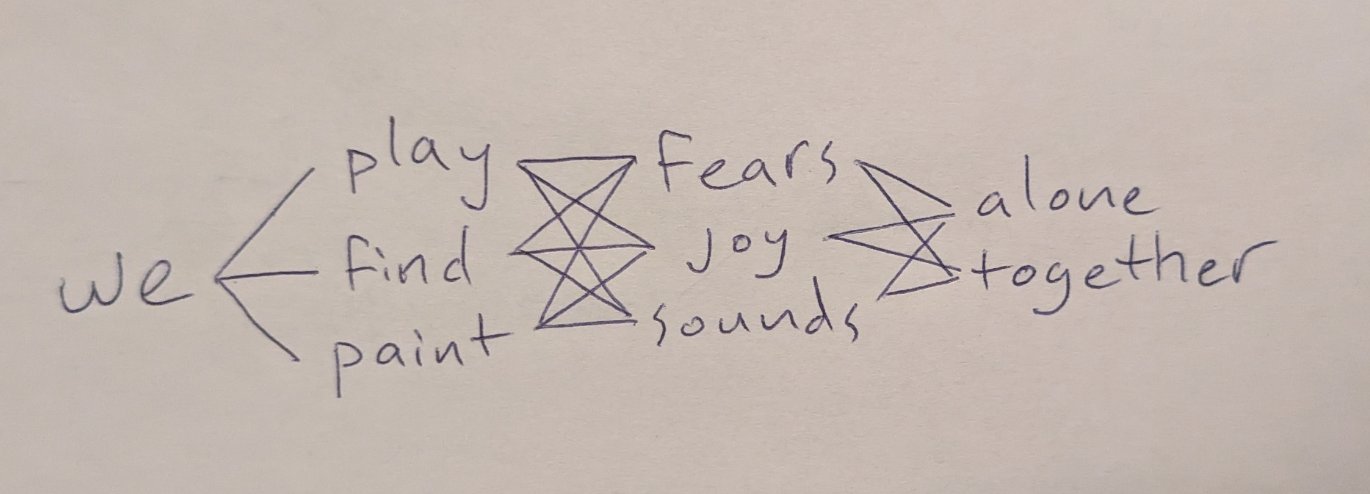
“Becoming ourselves is a collective journey.” -Alok Vaid-Menon, Beyond the Gender Binary

                One of my very close friends is moving to Colorado tomorrow. I’m wonderfully happy for them: it will bring them closer to their partner, to the life and work and community they want to grow. And of course I’m sad. Our routes walking to campus were similar, and from now on, when I see someone walking beneath the magnolias on Oregon Avenue and wonder is that Dusty the answer will probably be no, they moved. They’re walking through other trees now.
                I’ve moved a lot, which means I’ve moved away from a lot of wonderful friends. I’ve had a lot of wonderful friends move away from me. And sometimes we stay in touch. And sometimes we drift apart. But sitting here, tonight, putting together the wonderfully silly collection of Brontë and Groot and Vaid-Menon, I’m struck by how I am my friend. I never thought about Emily Brontë’s line that much (and I’m still not sure about it, sitting how it does in a romantic relationship), but I’m a bit of a gardener in part through gardening with Dusty. I’m a bit of a forager, with plans to visit the redbuds and the magnolias (both delicious!), with Dusty. And while “I am Heathcliff” seems intent on individuals, on separate selves who can be connected or identical, I like Groot’s “we.” We are what we’re becoming together. We are walks through Urbana, following Boneyard Creek through town, pulled along by how the water flows. We are the taste of magnolia blossoms (gingery!) and the thought that my partner and I might plant one, now, and tend to it. Dusty suggested we might. Becoming we.

459: A Relationship Between Writer and Reader (John Duffy)

                “To say writing involves ethical choices is to say that when creating a text, the writer addresses others. And that, in turn, initiates a relationship between writer and readers […].” -John Duffy, “Writing Involves Making Ethical Choices,” Naming What We Know p. 31

                As a freshman in undergrad, I took Professor Kim Townsend’s class called “Friendship.” I think I picked it because I liked the reading list, and stayed with it because I really liked him. But I was surprised to see that title. At the time I might’ve thought something like, what’s there to study about friendship?
                Although maybe that’s not quite fair to my young me. Two years earlier, my Spanish teacher Bill Churchill commented there was something strange in how people from the USA used the phrase “my best friend.” He said something like, “You’ll ask them, and they’ll say, ‘Oh my best friend lives in Colorado, my best friend moved to New York, I see them once a year.’ But when I say mejor amigo I usually mean someone I see or talk to every day.” Listening, sixteen year old me wasn’t sure what to make of this. I thought about all the different connections that could be understood as “friends.” I was just starting to think about how the USA’s specific cultural setups made space (or did not make space) for adult friends who see each other.
                Today, reading John Duffy, I’m thinking about all the different ways I suggest a relationship between people. So many of them are written (in texts, in emails) or recorded (in the YouTuber’s “Like, comment, subscribe!” or my “It’s been too long!” on a voicemail, suggesting we might get back in touch). So many of them are in person—the different variations of my “let’s go for a walk” (where Dusty and I pose friendship as meandering punctuated by trees, by squirrels) and Ishita’s “I’ll bring eye pens!” (where Ishita and I pose friendship as a play of colors, lines, makeup) and my “I just want to lie on the floor” (where Dani and I pose friendship as an exhausted quietness, side by side as semester’s end shuffles by). I’m glad young me didn’t know all the things friendship might be. That I felt a quiet wow at the possibilities, like looking down into deep water, and still feel that sometimes, before I write or walk or sit down with the eye pens or lie on the floor, hush, lets listen, sinking into hardwood, together.

458: “There Will Be A Name” (Marcelo Hernandez Castillo)

                “Because the bird flew before / there was a word / for flight / years from now / there will be a name / for what you and I are doing.”
                -Marcelo Hernandez Castillo, from “Cenzóntle,” Queer Poets of Color

                The birds have been singing in my neighborhood, and I love it. And I know, yes, that’s the kind of thing that people say is cliché—the birds are singing—but it’s delightful to let myself be delighted with all these things that are sometimes called clichés.
                Marcelo Hernandez Castillo helps me here. I love how Castillo (and poetry, and love, and Castillo’s loving poetry) plays back and forth with the meaning of things, and for me, the rhythm of that play washes me at least two different ways. There is the idea I read: how there was flight before the word “flight,” how what we do will become a linguistic possibility because we’ve done it. What you and I are doing becomes a word, a thing we can say. We name we’ve taken up to live with.
                And another way. I can say “the birds are singing,” that old cliché, but the cliché isn’t the specific birds who are right now outside my window. The birds who might be the same ones who sang to my friend and I yesterday evening, as we lay in the grass outside. Those good neighbors. Or maybe they’re new birds, new neighbors. And though I say “the grass outside” don’t think it was only grass, or don’t think grass is simple (a mistake I sometimes make), because as we lay there we noticed so many different leaves, so many different shades of green, so many growing joys in what I could simply call a “field.” There is so much more abundance, so much more life, than my simple namings. And while there will be a name for what we do, another side of that same thought, for me, is that the name for what we do will be part of our doing—maybe a celebration of it, or a reminder, or an invitation—without being all of our doing. Without being the birds or the songs that they’re singing. Which is lovely, isn’t it?

457: “A Lot of Trust” (Joy Harjo)

                “Sometimes when you go into a creative project there’s a lot of trust.”
                -Joy Harjo, in conversation with Jenny Davis at a CultureTalk on April 23, 2024 

                One of my favorite memories from my teenage years is walking through the forests of Oregon at night. We walked through tall trees. The boughs drinking starlight and moonlight. Filling the forest with a perfect darkness and playing tricks with our eyes. The brown needles carpeting the edge of our thoughts, and our little group following a dirt trail by the feeling of our barefoot feet. I did this once a year for seven years or so. Sometimes we lost the trail, and I would crawl on my hands and knees, feeling for smooth dust and the path that led through creaking tree trunks to a creek and then a river where the sky washed down and the water told long stories. I think, for me, that walking where I couldn’t see was a way of practicing—celebrating—growing into—resting into—trust.
                Creative projects are a wonderful place to grow that way. Lately I’ve been working on a novella I started in 2018. I started it as another kind of walking into what I couldn’t see, another kind of feeling for paths that lead toward river stories. In 2018 the project started as a kind of delighted what’s here?, a curiosity that was strong enough (easily!) to wrap roots around the rocks of worry and uncertainty and keep growing. Can I follow this? Find my way to listening a little more? Returning to the project, now, the can I often feels more frightening. I did an MFA. More of my professional life, more of my career, is tied to this idea of being a writer. That means the feeling of losing a path, of fumbling around for smooth dust in the prickly pine needles, is even scarier. “Can I follow this, learn from this?” can become a threat instead of an invitation. Joy Harjo reminds me that this project (like my love for Harjo and Davis’ poetry, their teachings) started with a lot of trust. And with a practice of trust that is a delight, and that gains even more delight through its strong roots, through the long slow growing and creaking of its tree trunk.

456: “Missing Out On The Chance To Be Frivolous” (Jack Halberstam)

                “Being taken seriously means missing out on the chance to be frivolous, promiscuous, and irrelevant.” -Jack Halberstam, The Queer Art of Failure

                In the last years, I’ve done a number of community facilitation projects, and one of the questions funders often ask is how many people is this reaching. And it’s a good question. It’s important. But in systems where I’m taught to want more and more views, more and more likes, more and more influence, I also find myself thinking about the chance to make something with and for these fifty people here. Sometimes making something for “a wider audience” is missing the chance to make and live and share and let go of something with a little group, here.
                So to put it one way, Halberstam has me thinking about all the “goals” or “characteristics” I pursue because I learned somewhere that I’m supposed to—and about all the sillinesses or particularities or otherwises I could be pursuing. Or not pursuing. Lounging into. Growing. No longer resisting. To put it another way, I try to be responsible, but I also like the irresponsibilities of a bouncy ball parading down the stairs. I’ve been carrying a bouncy ball everywhere for a while now. My niece and I decided it was our friend, though in all my seriousness, I’ve forgotten what name we gave it. Am I so sure I want to miss out on being silly?

455: “Sometimes You Just Miss” (Ross Gay & Jericho Brown)

                “One day last July, feeling delighted and compelled to both wonder about and share that delight, I decided that it might feel nice, even useful, to write a daily essay about something delightful. I remember laughing to myself for how obvious it was. I could call it something like The Book of Delights.” -Ross Gay, in the preface for The Book of Delights

                “Sometimes you just miss.” -Jericho Brown, in a talk at the University of Illinois Urbana-Champaign, November 13th, 2021

                I meant to write my uproar post this morning, and ended up writing a piece of my PhD dissertation and then lying on the couch instead. By which I mean, would you like to try a practice with me?
                One of the lovely things about a practice (Uproar posts once a week, for instance, or a year of daily essays about something delightful) is that they don’t go how I intended them. Jericho Brown is responding to an audience question, maybe “How do you feel when you’re working on a poem and it just doesn’t work” or something like that. He laughed and asked if the audience member ever played basketball. “Sometimes you just miss.” 
                Ross Gay makes it clear in The Book of Delights that the daily essay thing stopped being “daily” pretty quickly. He missed a day. Then another. My own practices are like that: lots of missing the basket, lots of missing a day or three. And the practice makes it clear that this missing isn’t the horror that all these work-habits tips would have me believe. Missing is lovely. It’s another hour in bed. It’s pages of my PhD dissertation that, no, I’m not going to share here, but I might share sometime, and there they are tumbling. Five years ago when I started riding a kick scooter for my commute, I didn’t think about the days I’d be soaked in downpours, the days the wheels would jitter across icy, the snowy days I would carry the scooter instead of the other way around. All those were missing. And finding. And part of it in a way that grew delight. 
                So I’m not inviting you to try out the practice of writing a short daily essay (unless you want to). I’m not even inviting myself to try that, if “inviting” is somehow code for “setting a goal” which starts feeling like “setting in stone.” I’m saying: what’s a practice you’re growing into, a practice different from what you once thought it might be? How do you walk that practice? What do you find, what do you miss, and where (beyond the finding and the missing) do you end up, soaked through with rain or laughing about basketball?