459: A Relationship Between Writer and Reader (John Duffy)

                “To say writing involves ethical choices is to say that when creating a text, the writer addresses others. And that, in turn, initiates a relationship between writer and readers […].” -John Duffy, “Writing Involves Making Ethical Choices,” Naming What We Know p. 31

                As a freshman in undergrad, I took Professor Kim Townsend’s class called “Friendship.” I think I picked it because I liked the reading list, and stayed with it because I really liked him. But I was surprised to see that title. At the time I might’ve thought something like, what’s there to study about friendship?
                Although maybe that’s not quite fair to my young me. Two years earlier, my Spanish teacher Bill Churchill commented there was something strange in how people from the USA used the phrase “my best friend.” He said something like, “You’ll ask them, and they’ll say, ‘Oh my best friend lives in Colorado, my best friend moved to New York, I see them once a year.’ But when I say mejor amigo I usually mean someone I see or talk to every day.” Listening, sixteen year old me wasn’t sure what to make of this. I thought about all the different connections that could be understood as “friends.” I was just starting to think about how the USA’s specific cultural setups made space (or did not make space) for adult friends who see each other.
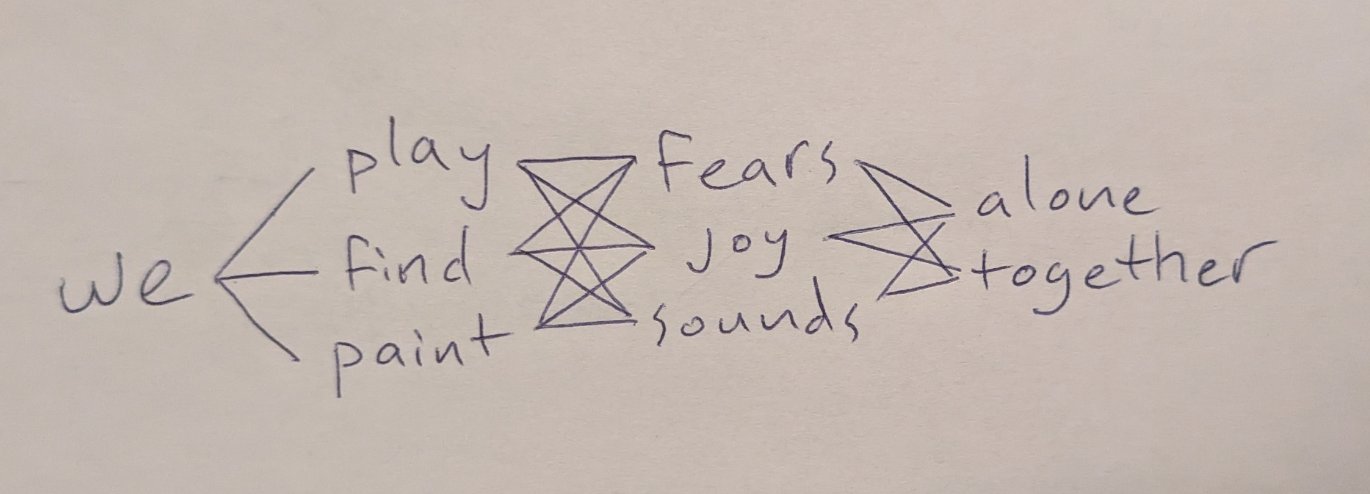
                Today, reading John Duffy, I’m thinking about all the different ways I suggest a relationship between people. So many of them are written (in texts, in emails) or recorded (in the YouTuber’s “Like, comment, subscribe!” or my “It’s been too long!” on a voicemail, suggesting we might get back in touch). So many of them are in person—the different variations of my “let’s go for a walk” (where Dusty and I pose friendship as meandering punctuated by trees, by squirrels) and Ishita’s “I’ll bring eye pens!” (where Ishita and I pose friendship as a play of colors, lines, makeup) and my “I just want to lie on the floor” (where Dani and I pose friendship as an exhausted quietness, side by side as semester’s end shuffles by). I’m glad young me didn’t know all the things friendship might be. That I felt a quiet wow at the possibilities, like looking down into deep water, and still feel that sometimes, before I write or walk or sit down with the eye pens or lie on the floor, hush, lets listen, sinking into hardwood, together.

457: “A Lot of Trust” (Joy Harjo)

                “Sometimes when you go into a creative project there’s a lot of trust.”
                -Joy Harjo, in conversation with Jenny Davis at a CultureTalk on April 23, 2024 

                One of my favorite memories from my teenage years is walking through the forests of Oregon at night. We walked through tall trees. The boughs drinking starlight and moonlight. Filling the forest with a perfect darkness and playing tricks with our eyes. The brown needles carpeting the edge of our thoughts, and our little group following a dirt trail by the feeling of our barefoot feet. I did this once a year for seven years or so. Sometimes we lost the trail, and I would crawl on my hands and knees, feeling for smooth dust and the path that led through creaking tree trunks to a creek and then a river where the sky washed down and the water told long stories. I think, for me, that walking where I couldn’t see was a way of practicing—celebrating—growing into—resting into—trust.
                Creative projects are a wonderful place to grow that way. Lately I’ve been working on a novella I started in 2018. I started it as another kind of walking into what I couldn’t see, another kind of feeling for paths that lead toward river stories. In 2018 the project started as a kind of delighted what’s here?, a curiosity that was strong enough (easily!) to wrap roots around the rocks of worry and uncertainty and keep growing. Can I follow this? Find my way to listening a little more? Returning to the project, now, the can I often feels more frightening. I did an MFA. More of my professional life, more of my career, is tied to this idea of being a writer. That means the feeling of losing a path, of fumbling around for smooth dust in the prickly pine needles, is even scarier. “Can I follow this, learn from this?” can become a threat instead of an invitation. Joy Harjo reminds me that this project (like my love for Harjo and Davis’ poetry, their teachings) started with a lot of trust. And with a practice of trust that is a delight, and that gains even more delight through its strong roots, through the long slow growing and creaking of its tree trunk.

455: “Sometimes You Just Miss” (Ross Gay & Jericho Brown)

                “One day last July, feeling delighted and compelled to both wonder about and share that delight, I decided that it might feel nice, even useful, to write a daily essay about something delightful. I remember laughing to myself for how obvious it was. I could call it something like The Book of Delights.” -Ross Gay, in the preface for The Book of Delights

                “Sometimes you just miss.” -Jericho Brown, in a talk at the University of Illinois Urbana-Champaign, November 13th, 2021

                I meant to write my uproar post this morning, and ended up writing a piece of my PhD dissertation and then lying on the couch instead. By which I mean, would you like to try a practice with me?
                One of the lovely things about a practice (Uproar posts once a week, for instance, or a year of daily essays about something delightful) is that they don’t go how I intended them. Jericho Brown is responding to an audience question, maybe “How do you feel when you’re working on a poem and it just doesn’t work” or something like that. He laughed and asked if the audience member ever played basketball. “Sometimes you just miss.” 
                Ross Gay makes it clear in The Book of Delights that the daily essay thing stopped being “daily” pretty quickly. He missed a day. Then another. My own practices are like that: lots of missing the basket, lots of missing a day or three. And the practice makes it clear that this missing isn’t the horror that all these work-habits tips would have me believe. Missing is lovely. It’s another hour in bed. It’s pages of my PhD dissertation that, no, I’m not going to share here, but I might share sometime, and there they are tumbling. Five years ago when I started riding a kick scooter for my commute, I didn’t think about the days I’d be soaked in downpours, the days the wheels would jitter across icy, the snowy days I would carry the scooter instead of the other way around. All those were missing. And finding. And part of it in a way that grew delight. 
                So I’m not inviting you to try out the practice of writing a short daily essay (unless you want to). I’m not even inviting myself to try that, if “inviting” is somehow code for “setting a goal” which starts feeling like “setting in stone.” I’m saying: what’s a practice you’re growing into, a practice different from what you once thought it might be? How do you walk that practice? What do you find, what do you miss, and where (beyond the finding and the missing) do you end up, soaked through with rain or laughing about basketball?

451: “As Long As It Helps Us Hope” (Weiwei & Stamboulis)

                “I think that it doesn’t matter whether poetry is good or bad… / …as long as it helps us hope.”
                -Ai Weiwei and Elettra Stamboulis, Zodiac, p. 154

                Sometimes I sit and listen to the resonance between experiences. Between these three, for example: 1) When I taught high school poetry in the twenty-teens, one of my favorite practices to do with a class was “short order poetry. Each student asks another for a poem (“about the first day of school,” “about a cracked windshield”). Then in ten-ish minutes each writer makes a poem to give back to the asker. This practice positions poetry as community, a gift between friends. The time limit can also help me stop worrying about “how good” the poem is and focus on putting lines together. 2) Some years after those classes, a mentor and I started talking about a teaching moment when you let go of worrying “how good” your classes are, recognize students’ work and interest as so much larger than you, and focus on offering what you can and supporting your students’ work how they ask you to. After that moment, paradoxically, our classes felt “better”—but something else had shifted, too. 3) During the worst years of feeling farther and farther away from my writing, writing felt more and more like a place where I had to perform expertise and less and less like the reach toward community that made me want to write. In the middle of those years I started writing flash fiction. Tiny paragraph- or page-long stories that touched one moment of connection, movement, need, loss. Writing those came to feel—well, like walking down to the beach every day to splash my face with the water. Or like letting the ocean wash its face with me.The practice helped me start finding my way back toward what I love in writing.
                When I finished reading Zodiac, I sat for a while, listening to the resonance between Ai Weiwei’s thoughts and so many of my (shared) experiences and relationships. I think the sitting—the quiet—was a way to turn towards and understand how the question “how good is this?” gets planted almost everywhere around me. And recognizing that planting is also a chance to stop planting, to focus instead, perhaps, on the ground the question grows in. The ground of what we’re doing, together. Of how what we’re doing together weaves our lived experience. How that doing makes it easier (or harder) to hope actively, playfully, courageously, communally.