528: Reading to “Stay In The World” (Bec McBride)

                “If I don’t read, I get distracted from what’s important to me […] reading helps me stay in the world.” -Bec McBride, in conversation with me today

                At 11:30 this morning the world felt wonderful: Bec and I had been in the park for an hour, sitting in dappled light, catching up about our families and friends, our hurts and how we’re healing, our delights at recent cooler nights. At 5:30 today I was in a real low: a new big chunk of work had landed on my desk, crunching the work already there as it made space for itself. I didn’t know how I would handle everything. And there was something else. My mind clutched, hard knuckled. My beloved Maria José helped me pause for a moment. Helped me remember to step outside. She went with me. Crickets hopped through the grass, and we breathed.
                Lately I’ve been thinking about reading and writing as kinds of worlding. Of making world: of making our world look and feel certain ways. Every day there are so many forces pushing me to world the way they say. Today some commercials, celebrating how world is a chance to buy happiness or bask in “deserved” comfort. My hustle culture to-do list, insisting world is where nothing will ever be enough. News stories about political madmen insisting world is a war that always needs more killing. Posts from activists proposing that right now world is resisting the systems set up to consume us, while building solidarity among all those who resist toward justice. In last week’s post I read Joy Harjo: “Rain opens us, like flowers.” This evening Maria José and I stood outside. I tried to read the trees. They breathe what I exhale. I exhale what they breathe. World as a breath we share.
                For me, reading is one way to slowly, deeply, and sometimes in a momentous whoosh put meaning together. I like reading sounds and silences, movements and words. And learning from Bec, I think I read to find ways back toward the world I choose to keep help making.

522: “A Reply” (Moses Ose Utomi)

                “He never noticed that he didn’t get a reply.”
                -Moses Ose Utomi, The Truth of the Aleke, p. 37

                Have you ever talked with someone who doesn’t seem to notice your reply? Who nods, maybe, or doesn’t, and then goes straight back to what they want to say? Have you ever felt a whisper and wondered if you’re doing something like that—if you’re saying without noticing what else is said? I have. Both ways.
                Utomi’s line comes in a moment when his main character, Osi, has written and sent an important letter. And then has gotten caught up in all the other busy, important things he has to do, so he doesn’t notice that the person he wrote to never writes back. I read this and had to sit for a while. Quiet. Whirling. It shakes my ideas of writing and reading. Because the hope is that we’re communicating, yes? That we’re saying and hearing? But how much of my typing away at my keyboard is making space for what I can notice from you (and you, and you)? And how much is leading me back to my own tck tck tcking?
                I mistrust writing. Love it, too, and mistrust it. And I want in it a kind of listening. Which means I love listening practices more than I love writing practices. Which means I’m off, because last night I flew across the country to visit family, and now I want what I hear (my partner and my mom chatting near me) so much more than anything I might say.

514: An “Archive of Feelings” (Jack Halberstam)

                “In this other archive [of feelings], we can identify, for example, rage, rudeness, anger, spite, impatience, intensity, mania, insincerity, earnestness, overinvestment, incivility, and brutal honesty.” -Jack Halberstam building from Ann Cvetkovich’s idea of “an archive of feelings,” “​​The Antisocial Thesis in Queer Theory,” p. 824

                I think the archive of feelings I’m thinking from, the feelings I habitually sit inside and move from, has a lot to do with where I am. And so I’ve been thinking about how I make that archive from the people I’m around. How I open myself to these connections. How I don’t.
                I’ve spent the last three days at an academic Research Institute— in depth discussions for hours each—and the evenings at my friend’s house, petting their dog, sharing food, laughing and reconnecting and feeling sleepy. The Institute is a combination of making new, inspiring connections with other scholars, and performing a kind of professional expertise. The evenings are fur covered, with deer grazing just outside the window, muh to the dog’s excitement. Or nervousness? Or interest? After three days of this I’m thinking about the archives of feelings into which my experiences grow.
                My friend, intent on putting up another stretch of wall paper. Fixated, they’ve described it. Determined, I might say. I get that way about a thought or a task sometimes. It’s intense/painful/pleasurable/frustrating/presumptive, like needing to sneeze, but the sneeze comes out as sustained meticulous effort.
                My partner, sitting next to me beneath a blanket. A little while ago (when she was in bed) I asked her how she was and she texted back an image of Boo from Monsters Inc looking almost asleep. And I’ve felt that— the image more than the words. At peace/exhausted/overwhelmed, in place, slow, like happy snot sinking into soil.
                A colleague, leaning forward to share a connection they’ve just started making between two kinds of understanding, a connection they’re inviting us to make. Excited/curious/unsure. A colleague and a friend, leaning back, silent, unwilling to pretend the kind of expertise they’re hearing performed. Angry. Silent. Ready to connect another way.
                I think that, from all these, I learn ways I might be. Ways I am. I sit into them, the ones that don’t fit so well, the ones that do, the ones that bend toward a new kind of fitting.
                The dog, paws up on the windowsill. The deer outside. Where do I graze, like she does, tasting world?

498: “Long-Distance Love” (Ishita Dharap)

                “The Long-Distance Love-Letters program has been rescheduled to take place on Sat, February 22, 2 pm, at Krannert Art Museum.” -Ishita Dharap, in an email sent out this afternoon

                I messaged my dear friend Ishita on December 2nd, inviting her to come over and enjoy dinner and a cozy fire. She was in India with her family, she said, and she sent a picture of a truly delicious dinner that I would’ve loved to share. I met her family once. We talked about joy and rest and becoming an interwoven family as leaves rustled overhead and the stars came out in a deepening sky.
                Ishita and I messaged each other again on January 3rd, looking for a moment to catch up, but we wouldn’t be back in the same town until January 12th. Then things were busy. Now it’s mid February. Whenever we catch up, my friend, it won’t be soon enough—and at the same time, all this—and her email today—has me thinking about how the joy and curiosity and support of our friendship isn’t something put off to that scheduled moment where we can see each other in the craziness of our current political moment. That joy and curiosity and support is already woven all through: long distance love, sweet and playful and sad as we say hello from close and far away.
        I haven’t been to Ishita’s Long Distance Love-Letters museum program. Not yet. But I’ve seen her write about it (in a book and a journal article), I’ve talked with her about it, and in imagining it I’ve felt it. Maybe that’s because I’m thousands of miles away from so many of the people I love. Maybe that’s because the stories I often hear told about “long distance” are about missing, about absence. Ishita’s work makes me think back through all the ways that missing and remembering are kinds of touching and playing and learning and being together. It helps me feel that so many of my beloved absences are presences, day after day, in so many ways.

481: Writing Webs (Ishita Dharap)

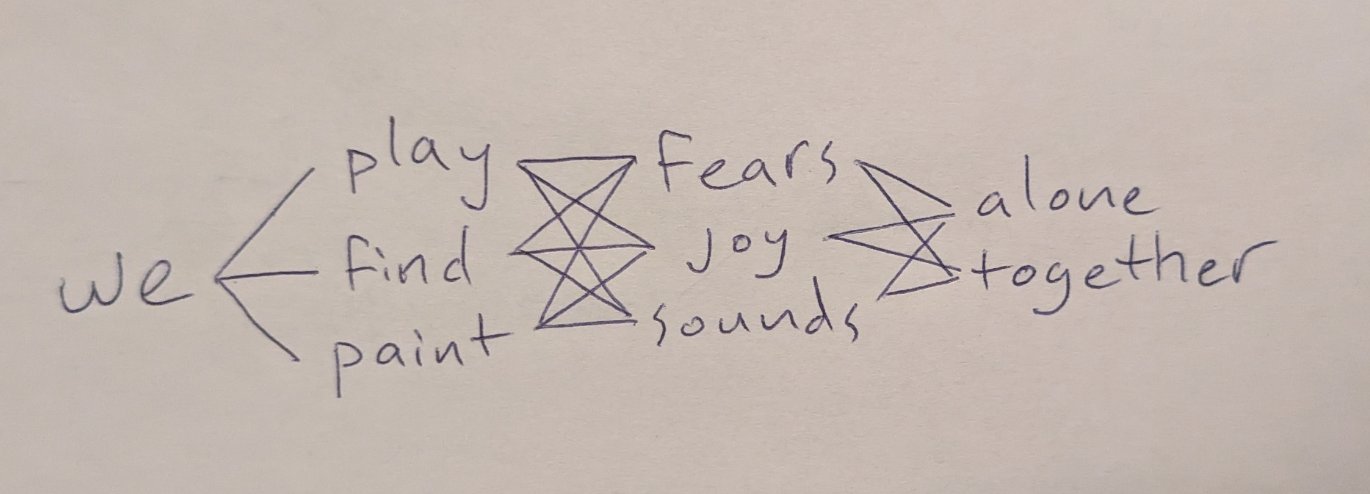
a word web by Ishita Dharap, inspired by her 2023 artwork “grief maps”
a web by Azlan Smith, inspired by Ishita’s 2023 “grief maps.” We made these together, tonight, for this post.

                One of the (many) wonderful things about my friend Ishita Dharap is that I’m not sure how to describe our friendship.
                We’re art friends. That can be drawing or crafting or eye makeup, familiar mediums, but it also means painting words into classes, balancing relationships into museum art exhibits, playing sunlight like you’d play a piano until it sounds sweet. Or maybe being a piano for some sunlight’s silly hands.
                We’re cooking friends. That means we like sharing meals, love standing over the stove and stirring things, love the blur of heat and flavor into time and texture. I think it also means that we’re mischievously aware of ourselves as cooking, too. The idea for this post has been bubbling away on low for years. We make space for one another’s boiling and slow-bubbling.
                We’re quick friends, ever since our first conversation while trees danced outside. Vibes, Ishita says.
                We’re slow friends. Sometimes we don’t talk for a long time. That’s not a turning away or forgetting. It’s a growing— leaves that flicker in their curiosities, and roots that steady in their quiet, hidden curiosities.
                Did any of that make sense? Do you have friendships like that? Or maybe I should say like all these. I’m thinking about manyness. About how in my experience a friendship that is is many things. Ishita’s approach for mapping words into webs is one of my favorite ways to try and write that manyness. You can read in branching threads, following the different connections. People sometimes comment a lot about the linear structure of an English sentence, the sequence of a word then a word, but when I think about anything I’ve read the words are more a web than a line. Are they that for you? A knotted association of the threads above and this thread here and the next threads, and other memories or thoughts that all these threads tie to? They are for me, and Ishita’s word maps are a way of writing toward that web.

459: A Relationship Between Writer and Reader (John Duffy)

                “To say writing involves ethical choices is to say that when creating a text, the writer addresses others. And that, in turn, initiates a relationship between writer and readers […].” -John Duffy, “Writing Involves Making Ethical Choices,” Naming What We Know p. 31

                As a freshman in undergrad, I took Professor Kim Townsend’s class called “Friendship.” I think I picked it because I liked the reading list, and stayed with it because I really liked him. But I was surprised to see that title. At the time I might’ve thought something like, what’s there to study about friendship?
                Although maybe that’s not quite fair to my young me. Two years earlier, my Spanish teacher Bill Churchill commented there was something strange in how people from the USA used the phrase “my best friend.” He said something like, “You’ll ask them, and they’ll say, ‘Oh my best friend lives in Colorado, my best friend moved to New York, I see them once a year.’ But when I say mejor amigo I usually mean someone I see or talk to every day.” Listening, sixteen year old me wasn’t sure what to make of this. I thought about all the different connections that could be understood as “friends.” I was just starting to think about how the USA’s specific cultural setups made space (or did not make space) for adult friends who see each other.
                Today, reading John Duffy, I’m thinking about all the different ways I suggest a relationship between people. So many of them are written (in texts, in emails) or recorded (in the YouTuber’s “Like, comment, subscribe!” or my “It’s been too long!” on a voicemail, suggesting we might get back in touch). So many of them are in person—the different variations of my “let’s go for a walk” (where Dusty and I pose friendship as meandering punctuated by trees, by squirrels) and Ishita’s “I’ll bring eye pens!” (where Ishita and I pose friendship as a play of colors, lines, makeup) and my “I just want to lie on the floor” (where Dani and I pose friendship as an exhausted quietness, side by side as semester’s end shuffles by). I’m glad young me didn’t know all the things friendship might be. That I felt a quiet wow at the possibilities, like looking down into deep water, and still feel that sometimes, before I write or walk or sit down with the eye pens or lie on the floor, hush, lets listen, sinking into hardwood, together.