478: Drawing “What We Cannot Yet See”

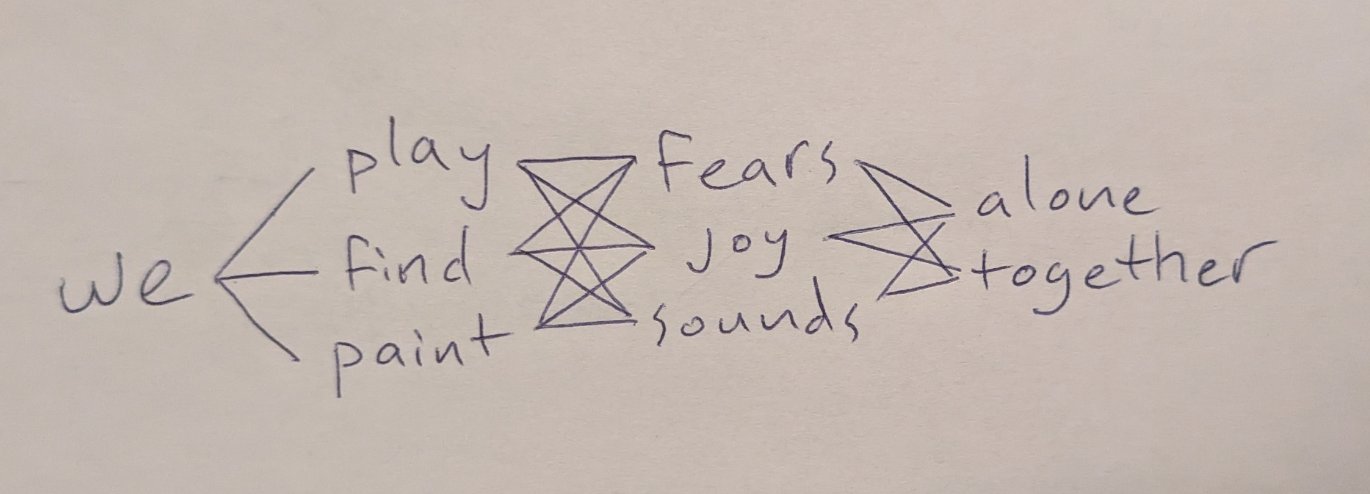
                “How do we draw—or write—the emotions and parts of ourselves that we cannot yet see?”
                -Rachel Gu  my friend!) and Azlan Guttenberg Smith (that’s me!), “Our Monsters, Our Breath,” Experiments in Art Research

                Rachel and I sat next to each other in a grad seminar. Hour by hour, I watched shapes and shades wash out from the colored pens she brought with her. The pattern from a classmate’s shirt. The arrangement of our tables. A few branches, framed by our classroom window, and an abstract shape that was Rachel’s response to a piece of today’s reading.
                I’ve been scared of drawing for a long time. A mark on a page can feel so final, so I tried to put down perfect marks, clear edges, and everything I drew felt stiff, self-conscious, incomplete. And I’m also entranced when I watch people drawing. Smudging. Erasing. Playing out ratios and relationships.
                I started drawing along with Rachel. Class by class period, first with the pens she shared with me, then with colored pencils I brought to share with her. I picked up specific techniques, of course. (She dripped water from her bottle onto the table, and used it to smear her pen’s ink, and I loved it). But more than the specific techniques, I felt the space of drawing opening, the fear I’d felt settling into one tree in this rustling forest of shapes and shades as Rachel ran ahead and I followed—or turned off to wander a different way. Months after Rachel helped me start drawing again, I helped her start writing some poetry. These practices together led to the chapter we wrote for Experiments in Art Research, where you can read some of her poems and our translations. And these practices helped me—I hope us—sketch our way into a version of studying that is a kind of making space to share ourselves and share what we cannot yet see.

477: “It Helps Us Hope” (Ai Weiwei)

                “I think that it doesn’t matter whether poetry is good or bad… / …as long as it helps us hope.” -Ai Weiwei, Elettra Stamboulis, and Gianluca Costantini, Zodiac: A Graphic Memoir

                I want to write poetry the same way I step into the rain. Feeling raindrops scattering. Touched by a sky that whirls and swirls, vast and near, and chuckling along with the wind and the trees and neighbors who are chuckling, too. Which is to say: I want to write poetry the same way I garden, watering seeds, watching shoots grow, noticing shadows and sunlight and moisture. I want to write poetry the same way I cook for you: here, I made this, for us, a little snack. Which is to say: I want to step out into the rain and garden and cook like writing poetry, these little practices of hope.
                I’m less and less interested in good art. In evaluating. (I’m less and less clear about what “good art” means, too, but the question doesn’t draw me). Ai Weiwei and his co-authors put words to this delight of recognizing instead what art can do. My professor played our class a song that one of her colleagues wrote in response to my professor’s poem, posted on facebook. That’s how they became friends, this colleague and my professor. Another time I helped a friend make signs for a community garden: tomatoes, garlic, so volunteers who were planting and visitors who were harvesting could navigate the bursting leaves. Last weekend my partner and I went to the library and drew pieces for a community art project: on one wooden puzzle piece she drew an open door. On another I drew friends beneath a tree. These pieces sit next to kindergarteners’ pieces and neighbors’ pieces and elders’ pieces and strangers’ pieces and librarians’, and the library grows a little more into a place where maybe we meet.

471: “No One Knows It All” (Paulo Freire)

                “Humility helps us to understand this obvious truth: No one knows it all; no one is ignorant of everything.” -Paulo Freire, “On the Indispensable Qualities of Progressive Teachers for Their Better Performance”

                Twelve days ago, when my love and I got married, we didn’t have an officiant. We welcomed people and exchanged vows ourselves. Most of the ceremony itself (before the tamales!) was our family group of 22 sitting in a circle beneath the redwoods. Each person shared a thought or a celebration or a wish, or something else they wanted to say. I loved listening. I loved the branching, rooting, connecting of our voices.
                I love living Freire’s humility and obvious truth, too. It feels so right. At the same time, when I hear someone say “no one knows everything,” there’s usually a kind of sting to the thought. Like it’s embarrassing, or like the statement itself is barbed. I get why. So many of the cultures I live in value a kind of performative knowing and devalue uncertainty, confusion, complexity. I spend a lot of time at a university, and it’s amazing how many professors won’t admit what they don’t know. When I talk to my friends in tech or finance or law or medicine or…well, you get it, and my friends in those spaces say something similar. The not-knowing can be portrayed as a threat. A failure. A weakness.
                I loved that, with our joined families at our wedding, not knowing anywhere close to everything just felt like a celebration. Of course these wonderful people had insights to share that were different from others’ insights. Of course some of them saw things I didn’t see. Sometimes their voices brushed past my thoughts, our worldviews interweaving like roots below the ground, and sometimes our branches reached off in different directions, and all of it was wonderful to share.

470: Receptive Language, & Listening (Alexis Pauline Gumbs)

                “What I want to say to you requires a more nuanced field of receptive language than I have ever spoken. It requires me to reshape my forehead, my lungs. It requires me to redistribute my dependence on visual information. So I will close my eyes and say it: Here. Here I am. Here I am with you. Here is all of me. And here we are.” -Alexis Pauline Gumbs, Undrowned: Black Feminist Lessons from Marine Mammals

                I’m writing this from an airplane. Billowing white clouds outside. The jets thrumming through the wall where I rest my head.
                Last week my beloved and I got married. As part of the ceremony we read Alexis Pauline Gumbs out loud, including the lines above. Gumbs is thinking about the way marine mammals speak and listen across oceans. How the shape of their bodies collects sound, connects songs. Resonates. Now, as we travel back home, I’m practicing listening. A long, slow, lovely practice. I hear my partner chatting with our sweet seat mate. I hear our seat mate’s baby, discovering fingers and red grapes. I hear all the little sounds of people shifting and talking. I hear breathing. I hear keystrokes. All around I hear the wind, threaded through with the jet’s thrum, and I think about the sky as an ocean of air that we all swim through. How precious every breath. How precious the chance to share them. How delightful, my love, to listen, to practice that close-eyed receptive language that sings through oceans. That sings here we are.

467: “The Scale of Breathing” (Alexis Pauline Gumbs)

                “What is the scale of breathing? You put your hand on your individual chest as it rises and falters all day. But is that the scale of breathing? You share air and chemical exchange with everyone in the room, everyone you pass today. Is the scale of breathing within one species? All animals participate in this exchange of release for continued life. But not without the plants. The plants in their inverse process, release what we need, take what we give without being asked. And the planet, wrapped in ocean breathing, breathing into sky. What is the scale of breathing? You are part of it now. You are not alone.”-Alexis Pauline Gumbs, Undrowned: Black Feminist Lessons from Marine Mammals, p. 1

                The other day I was walking after a conversation that left me feeling unbalanced, unsafe. Through beautiful hills, I should add: sundrenched gold grass and oaks holding up the tiny ocean depths of their deep shade. Woodpeckers on the branches. Deer resting. But that conversation had me feeling scared, so I imagined some of the people I’m closest to walking with me. Their feet in these hills. Then I realized they weren’t just walking: one of them was wearing gold pants and dancing. One twirled their fingers, chunky rings glinting in the sun. Some were laughing. Some sad. Some transforming. And all of us were breathing.
                All this has me thinking about Gumbs and the scales of breathing. Because after I started imagining these friends and teachers and guides with me, I felt so much more grounded. So much more possible. My breath possible. My fear possible, too, but not as an ending: as thorny brambles in these sunwashed hills. And then as I pay more attention to these people dancing along with me, I feel how we’re dancing along with the gold grass (dry, now, and shining, and green again when the rains come) and the trees (their roots digging into the earth in a way that teaches holding, while at the same time they tickle and are tickled by sky). And I remember Gumbs. You are part of it now. Breathing and breathed along as skies inhale ocean, exhale summer breeze.

466: A Riddle (Richard Wilbur)

“Long daughter of the forest, swift of pace.
In whom old neighbors join as beam and brace,
I speed on many paths, yet leave no trace.”
-Richard Wilbur’s “Navis,” which is a translation of a riddle by Symphosius

                I’ve been going through boxes in my mom’s garage. Some of them I packed ten years ago, or twenty. Some my mom packed when I was small, and a few have envelopes or little boxes my grandma collected when my mom was small. Today we found my grandma’s birth certificate and coins she saved, complete with a handwritten note to my mom explaining that these would be valuable and they were “for the grandkids.”
                A few days before that I found my college copy of Richard Wilbur. The poem I quoted is from a series of riddle poems. I’m trying not to give away the answer. That way you can go walk around with i if you want. (The implied question in this series is always, What am I? And Wilbur uses the answer, in its original Latin, as a title). Leafing through this book, fifteen years later, I recognize so many of the poems. Looking through these documents and pictures, so many years later, I recognize so many of the moments. I’ve forgotten or never knew so many more. So many of us, joining to brace each other. So quick the way our lives wash through each other. I like how the poem and old handwriting and the act of remembering are all riddles, or could be. Are all inviting me to sit for a moment, or walk along with the image, listening to its hints.

458: “There Will Be A Name” (Marcelo Hernandez Castillo)

                “Because the bird flew before / there was a word / for flight / years from now / there will be a name / for what you and I are doing.”
                -Marcelo Hernandez Castillo, from “Cenzóntle,” Queer Poets of Color

                The birds have been singing in my neighborhood, and I love it. And I know, yes, that’s the kind of thing that people say is cliché—the birds are singing—but it’s delightful to let myself be delighted with all these things that are sometimes called clichés.
                Marcelo Hernandez Castillo helps me here. I love how Castillo (and poetry, and love, and Castillo’s loving poetry) plays back and forth with the meaning of things, and for me, the rhythm of that play washes me at least two different ways. There is the idea I read: how there was flight before the word “flight,” how what we do will become a linguistic possibility because we’ve done it. What you and I are doing becomes a word, a thing we can say. We name we’ve taken up to live with.
                And another way. I can say “the birds are singing,” that old cliché, but the cliché isn’t the specific birds who are right now outside my window. The birds who might be the same ones who sang to my friend and I yesterday evening, as we lay in the grass outside. Those good neighbors. Or maybe they’re new birds, new neighbors. And though I say “the grass outside” don’t think it was only grass, or don’t think grass is simple (a mistake I sometimes make), because as we lay there we noticed so many different leaves, so many different shades of green, so many growing joys in what I could simply call a “field.” There is so much more abundance, so much more life, than my simple namings. And while there will be a name for what we do, another side of that same thought, for me, is that the name for what we do will be part of our doing—maybe a celebration of it, or a reminder, or an invitation—without being all of our doing. Without being the birds or the songs that they’re singing. Which is lovely, isn’t it?

457: “A Lot of Trust” (Joy Harjo)

                “Sometimes when you go into a creative project there’s a lot of trust.”
                -Joy Harjo, in conversation with Jenny Davis at a CultureTalk on April 23, 2024 

                One of my favorite memories from my teenage years is walking through the forests of Oregon at night. We walked through tall trees. The boughs drinking starlight and moonlight. Filling the forest with a perfect darkness and playing tricks with our eyes. The brown needles carpeting the edge of our thoughts, and our little group following a dirt trail by the feeling of our barefoot feet. I did this once a year for seven years or so. Sometimes we lost the trail, and I would crawl on my hands and knees, feeling for smooth dust and the path that led through creaking tree trunks to a creek and then a river where the sky washed down and the water told long stories. I think, for me, that walking where I couldn’t see was a way of practicing—celebrating—growing into—resting into—trust.
                Creative projects are a wonderful place to grow that way. Lately I’ve been working on a novella I started in 2018. I started it as another kind of walking into what I couldn’t see, another kind of feeling for paths that lead toward river stories. In 2018 the project started as a kind of delighted what’s here?, a curiosity that was strong enough (easily!) to wrap roots around the rocks of worry and uncertainty and keep growing. Can I follow this? Find my way to listening a little more? Returning to the project, now, the can I often feels more frightening. I did an MFA. More of my professional life, more of my career, is tied to this idea of being a writer. That means the feeling of losing a path, of fumbling around for smooth dust in the prickly pine needles, is even scarier. “Can I follow this, learn from this?” can become a threat instead of an invitation. Joy Harjo reminds me that this project (like my love for Harjo and Davis’ poetry, their teachings) started with a lot of trust. And with a practice of trust that is a delight, and that gains even more delight through its strong roots, through the long slow growing and creaking of its tree trunk.

455: “Sometimes You Just Miss” (Ross Gay & Jericho Brown)

                “One day last July, feeling delighted and compelled to both wonder about and share that delight, I decided that it might feel nice, even useful, to write a daily essay about something delightful. I remember laughing to myself for how obvious it was. I could call it something like The Book of Delights.” -Ross Gay, in the preface for The Book of Delights

                “Sometimes you just miss.” -Jericho Brown, in a talk at the University of Illinois Urbana-Champaign, November 13th, 2021

                I meant to write my uproar post this morning, and ended up writing a piece of my PhD dissertation and then lying on the couch instead. By which I mean, would you like to try a practice with me?
                One of the lovely things about a practice (Uproar posts once a week, for instance, or a year of daily essays about something delightful) is that they don’t go how I intended them. Jericho Brown is responding to an audience question, maybe “How do you feel when you’re working on a poem and it just doesn’t work” or something like that. He laughed and asked if the audience member ever played basketball. “Sometimes you just miss.” 
                Ross Gay makes it clear in The Book of Delights that the daily essay thing stopped being “daily” pretty quickly. He missed a day. Then another. My own practices are like that: lots of missing the basket, lots of missing a day or three. And the practice makes it clear that this missing isn’t the horror that all these work-habits tips would have me believe. Missing is lovely. It’s another hour in bed. It’s pages of my PhD dissertation that, no, I’m not going to share here, but I might share sometime, and there they are tumbling. Five years ago when I started riding a kick scooter for my commute, I didn’t think about the days I’d be soaked in downpours, the days the wheels would jitter across icy, the snowy days I would carry the scooter instead of the other way around. All those were missing. And finding. And part of it in a way that grew delight. 
                So I’m not inviting you to try out the practice of writing a short daily essay (unless you want to). I’m not even inviting myself to try that, if “inviting” is somehow code for “setting a goal” which starts feeling like “setting in stone.” I’m saying: what’s a practice you’re growing into, a practice different from what you once thought it might be? How do you walk that practice? What do you find, what do you miss, and where (beyond the finding and the missing) do you end up, soaked through with rain or laughing about basketball?

451: “As Long As It Helps Us Hope” (Weiwei & Stamboulis)

                “I think that it doesn’t matter whether poetry is good or bad… / …as long as it helps us hope.”
                -Ai Weiwei and Elettra Stamboulis, Zodiac, p. 154

                Sometimes I sit and listen to the resonance between experiences. Between these three, for example: 1) When I taught high school poetry in the twenty-teens, one of my favorite practices to do with a class was “short order poetry. Each student asks another for a poem (“about the first day of school,” “about a cracked windshield”). Then in ten-ish minutes each writer makes a poem to give back to the asker. This practice positions poetry as community, a gift between friends. The time limit can also help me stop worrying about “how good” the poem is and focus on putting lines together. 2) Some years after those classes, a mentor and I started talking about a teaching moment when you let go of worrying “how good” your classes are, recognize students’ work and interest as so much larger than you, and focus on offering what you can and supporting your students’ work how they ask you to. After that moment, paradoxically, our classes felt “better”—but something else had shifted, too. 3) During the worst years of feeling farther and farther away from my writing, writing felt more and more like a place where I had to perform expertise and less and less like the reach toward community that made me want to write. In the middle of those years I started writing flash fiction. Tiny paragraph- or page-long stories that touched one moment of connection, movement, need, loss. Writing those came to feel—well, like walking down to the beach every day to splash my face with the water. Or like letting the ocean wash its face with me.The practice helped me start finding my way back toward what I love in writing.
                When I finished reading Zodiac, I sat for a while, listening to the resonance between Ai Weiwei’s thoughts and so many of my (shared) experiences and relationships. I think the sitting—the quiet—was a way to turn towards and understand how the question “how good is this?” gets planted almost everywhere around me. And recognizing that planting is also a chance to stop planting, to focus instead, perhaps, on the ground the question grows in. The ground of what we’re doing, together. Of how what we’re doing together weaves our lived experience. How that doing makes it easier (or harder) to hope actively, playfully, courageously, communally.