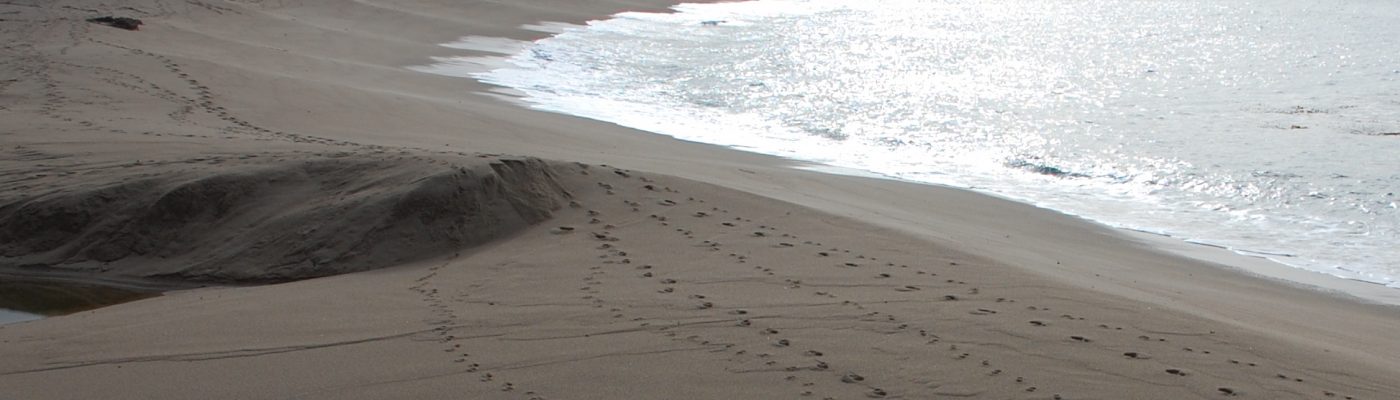
498: “Long-Distance Love” (Ishita Dharap)

                “The Long-Distance Love-Letters program has been rescheduled to take place on Sat, February 22, 2 pm, at Krannert Art Museum.” -Ishita Dharap, in an email sent out this afternoon

                I messaged my dear friend Ishita on December 2nd, inviting her to come over and enjoy dinner and a cozy fire. She was in India with her family, she said, and she sent a picture of a truly delicious dinner that I would’ve loved to share. I met her family once. We talked about joy and rest and becoming an interwoven family as leaves rustled overhead and the stars came out in a deepening sky.
                Ishita and I messaged each other again on January 3rd, looking for a moment to catch up, but we wouldn’t be back in the same town until January 12th. Then things were busy. Now it’s mid February. Whenever we catch up, my friend, it won’t be soon enough—and at the same time, all this—and her email today—has me thinking about how the joy and curiosity and support of our friendship isn’t something put off to that scheduled moment where we can see each other in the craziness of our current political moment. That joy and curiosity and support is already woven all through: long distance love, sweet and playful and sad as we say hello from close and far away.
        I haven’t been to Ishita’s Long Distance Love-Letters museum program. Not yet. But I’ve seen her write about it (in a book and a journal article), I’ve talked with her about it, and in imagining it I’ve felt it. Maybe that’s because I’m thousands of miles away from so many of the people I love. Maybe that’s because the stories I often hear told about “long distance” are about missing, about absence. Ishita’s work makes me think back through all the ways that missing and remembering are kinds of touching and playing and learning and being together. It helps me feel that so many of my beloved absences are presences, day after day, in so many ways.

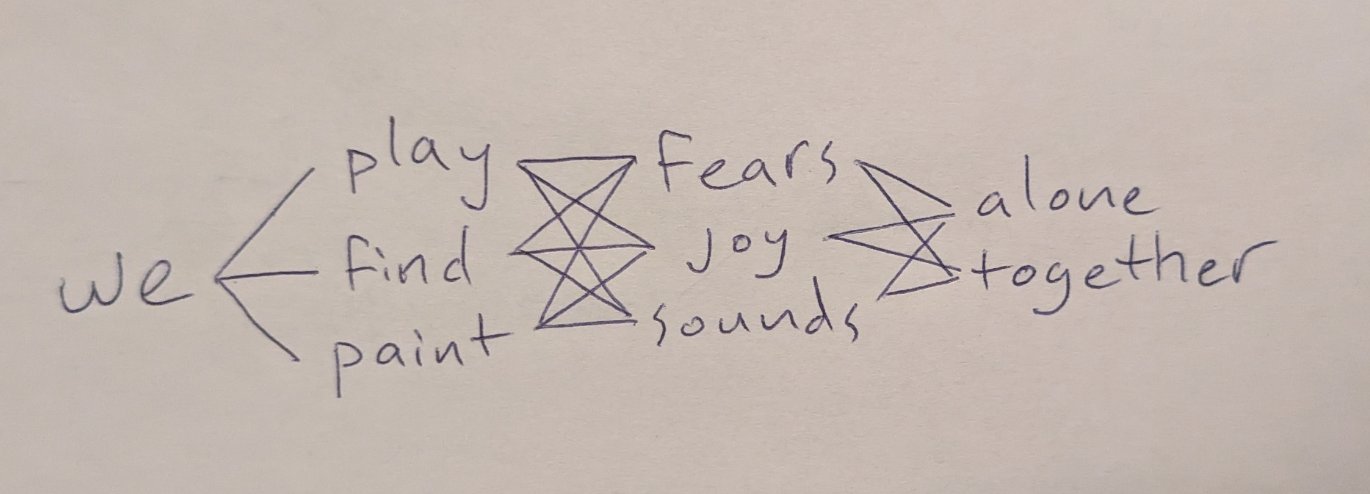
481: Writing Webs (Ishita Dharap)

a word web by Ishita Dharap, inspired by her 2023 artwork “grief maps”
a web by Azlan Smith, inspired by Ishita’s 2023 “grief maps.” We made these together, tonight, for this post.

                One of the (many) wonderful things about my friend Ishita Dharap is that I’m not sure how to describe our friendship.
                We’re art friends. That can be drawing or crafting or eye makeup, familiar mediums, but it also means painting words into classes, balancing relationships into museum art exhibits, playing sunlight like you’d play a piano until it sounds sweet. Or maybe being a piano for some sunlight’s silly hands.
                We’re cooking friends. That means we like sharing meals, love standing over the stove and stirring things, love the blur of heat and flavor into time and texture. I think it also means that we’re mischievously aware of ourselves as cooking, too. The idea for this post has been bubbling away on low for years. We make space for one another’s boiling and slow-bubbling.
                We’re quick friends, ever since our first conversation while trees danced outside. Vibes, Ishita says.
                We’re slow friends. Sometimes we don’t talk for a long time. That’s not a turning away or forgetting. It’s a growing— leaves that flicker in their curiosities, and roots that steady in their quiet, hidden curiosities.
                Did any of that make sense? Do you have friendships like that? Or maybe I should say like all these. I’m thinking about manyness. About how in my experience a friendship that is is many things. Ishita’s approach for mapping words into webs is one of my favorite ways to try and write that manyness. You can read in branching threads, following the different connections. People sometimes comment a lot about the linear structure of an English sentence, the sequence of a word then a word, but when I think about anything I’ve read the words are more a web than a line. Are they that for you? A knotted association of the threads above and this thread here and the next threads, and other memories or thoughts that all these threads tie to? They are for me, and Ishita’s word maps are a way of writing toward that web.