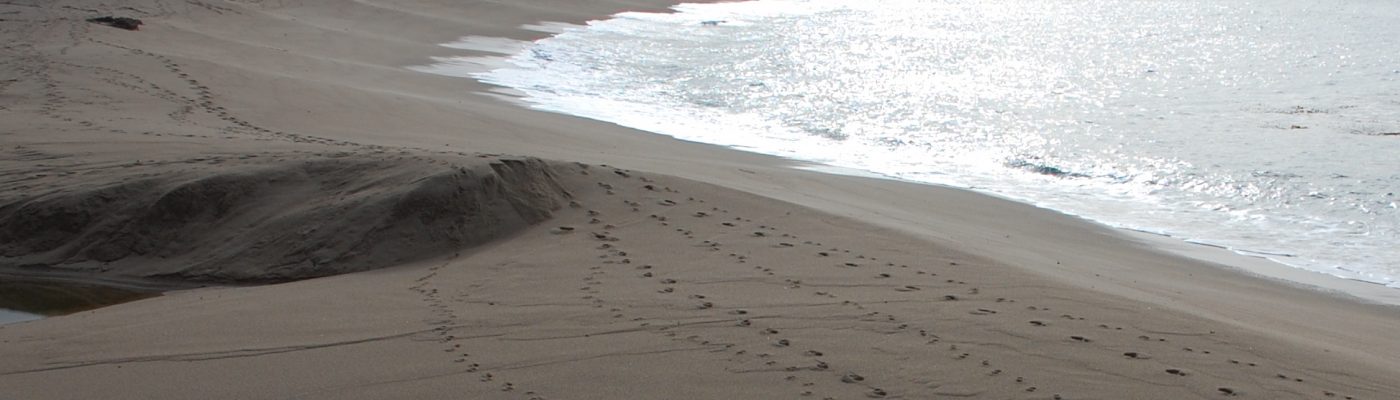
503: “Evade and Avoid” (Alexis Pauline Gumbs)

                “What I know is that I love you. Even if you are not interested in being followed. Even if you show up in disguises. Even if I’m not the one who should know you or name you or classify you at all. And I celebrate your right to evade and avoid me. I celebrate your journey however deep, however long. I respect you as so much bigger than my own understanding. And me too. I don’t have to be available to be eligible for breath.”
                -Alexis Pauline Gumbs, Undrowned: Black Feminist Lessons from Marine Mammals, p. 92

                For a while now (a year? More?) I’ve been wondering where it is that Alexis Pauline Gumbs writes about loving whales, even when they choose to stay out of sight, beneath the surface, far from her. And then today in looking through Undrowned for a different section these lines swam past me. And I thought yes. I felt yes. 
                I think I felt yes because so much of my training, my learning, my community-tending is about learning things. Seeing things. Being introduced to people. But just yesterday a dear friend talked about the peace and joy and life that comes from keeping their distance from certain people that they don’t want to be close to, and I felt, yes.
                I think I felt yes because I’ve been feeling the ocean of the sky blow with lightning and thunder out here in the plains. A little while I tried to imagine how big a storm is. Imagine prairie and forest and hill until it stretched out that far. And then I remembered Undrowned and realized to feel a storm I could step outside. Hear one little breath of blowing, and see the towering clouds washed up, deep beyond my seeing. 
                I think I felt yes because I want more learning and organizing that’s about respecting and celebrating the distances and disguises and evasions that breathing creatures choose.

501: “Writing doesn’t feel linear” (Fin McMahon)

                “I love writing because for me it doesn’t feel linear. It feels like a chance to go around and come back, to think with these pieces, move them around, change them.”
                -Fin McMahon, in conversation on March 3, 2025

                I remember in 2020 when video calls were suddenly a core way that I connected with people. I’d been on plenty of video calls before. But I’d never hung out on a video call, or tried to. And then suddenly there I was, stretching on the carpet while my friend did dishes, because it was easier to do these things with someone else and we hadn’t talked to someone else all day.
                I’m interested in how similar tools, similar practices, can be so different when used in different ways. I often struggle with writing precisely because it does feel linear. Which is related to saying, because so often I’ve been taught to approach writing as a problem with a linear solution. And I’ve learned. What do you need to know first? What comes after that? At the same time, listening to Fin, I luxuriate into all the ways writing feels like sinking down into thick carpet—woven, messy, marked by the way other people have walked across it, soft, solid. To put it another way, for a while now I’ve been telling myself I should go out and pile up some of the dead stalks in my garden so that new things have a chance to grow. I haven’t wanted to. I should. I haven’t wanted to. That’s gone round and round. And then today, a little before a cold drizzle turned to snow, I was out in a gray sky crouching down, my tools wet in my hands, the dead leaves slick, and all of it felt like a kind of saying hello.

490: “Imperfections and Incompleteness” (Sarah Travis)

                “I sometimes worry about the imperfections and incompleteness of it all. […] But maybe it’s supposed to feel unfinished […] In that spirit, I am resisting my urge to polish up this letter too much…”
                -Sarah Travis, “Friendship as Scholarship: a Path for Living Inquiry Together,” Experiments in Art Education, p. 178

                Someone told me once that reading the beginning of a novel is like walking into a room and meeting an author who hands you things: here, a description of a fallen tree. Hold this. Here, a child climbing the fallen branches. Here, a quick pair of fluttering wings. The author’s trick (this someone said) is to have the pieces pull together into a story the reader wants to keep reading before the reader gets overwhelmed or bored by what they’re being asked to hold.
                I see what they’re saying, this someone. They’re right sometimes. And sometimes…

                In my teens I started lying awake at night, thinking back over the day to trace out what I had accomplished. What made this day worthwhile. I started doing that for reasons that made good sense at the time, and it might be an interesting practice, sometimes. And sometimes…

                If you were to give me today, if you were to hand over the trees and the fluttering wings and the thoughts that child-me and older-me and our friends are having, apart and together, it wouldn’t make a very clear story. As a reader I might say why are you giving me that. That’s what I mean, sometimes, when I tell my partner at the end of the day wow today feels so long. Going over to feed Jackie’s cats? That was just this morning. There isn’t a nice finished arc to this today-ness. There’s a warm crackling fire. Ash on my hands. A cold, cold wind. Voices. A delicious mouthful of fish. Clothes scattered on the floor. Imperfect and incomplete. Sometimes like my friend Sarah Travis I worry about that, and sometimes like my friend Sarah I celebrate that, because it—whatever it is—is not ending right now. Oh no. It’s snuggling up with blankets. Then it’s dreaming. Who knows after that.

484: “Your Strangest and Funniest Friend” (Dave Eggers & Amanda Uhle)

                “Find your strangest and funniest friend. Have that strange friend find their funniest and strangest friend.” -Dave Eggers & Amanda Uhle, Introducing Unnecessarily Beautiful Spaces for Young Minds on Fire

                This is going to be a little all over the place, because you know when a child comes running up to you because there’s a cat outside and the cat was climbing a tree and my friend climbs trees and we love plums and did I tell you we’re building a spaceship that might be a garden? Were you that kid, sometimes? Are you still?
                Today my friend Jackie and I were sitting at a table, enjoying the breath of a gentle breeze and squinting through bright electric lights, and trying to work. It happens sometimes. She was working on an application for funding, which would help make possible some of her wildly cool research. I was trying to read Aja Martinez’s Counterstory, also wildly cool, and important for a journal article I’m revising. It’s all work we believe in. And we just didn’t want to do it. Our snacks had helped, fueling a few more keystrokes, but all the snacks were gone.
                So Jackie showed me Nael’s “The Tiger.” You might’ve seen it before—a spark of a little poem, and it jumped through all sorts of social media a couple years ago. The author’s a child. The poem’s full of a wild, brave, world-making excitement. “The Tiger” was published in a collection edited by 826DC, a very cool place that I’m definitely not reading more about (instead of doing my other work). I didn’t know this strange friend but I immediately recognized them as friends with 826 Valencia—a very cool someone, if you haven’t met them, and probably worth some not-reading of your own. And we do love plums. And there is a cat outside. And sometimes in learning from children (of all ages, 6 and 25 and 92) I remember that I’m a strange friend who loves my strange friends and that together we’re definitely making something.

467: “The Scale of Breathing” (Alexis Pauline Gumbs)

                “What is the scale of breathing? You put your hand on your individual chest as it rises and falters all day. But is that the scale of breathing? You share air and chemical exchange with everyone in the room, everyone you pass today. Is the scale of breathing within one species? All animals participate in this exchange of release for continued life. But not without the plants. The plants in their inverse process, release what we need, take what we give without being asked. And the planet, wrapped in ocean breathing, breathing into sky. What is the scale of breathing? You are part of it now. You are not alone.”-Alexis Pauline Gumbs, Undrowned: Black Feminist Lessons from Marine Mammals, p. 1

                The other day I was walking after a conversation that left me feeling unbalanced, unsafe. Through beautiful hills, I should add: sundrenched gold grass and oaks holding up the tiny ocean depths of their deep shade. Woodpeckers on the branches. Deer resting. But that conversation had me feeling scared, so I imagined some of the people I’m closest to walking with me. Their feet in these hills. Then I realized they weren’t just walking: one of them was wearing gold pants and dancing. One twirled their fingers, chunky rings glinting in the sun. Some were laughing. Some sad. Some transforming. And all of us were breathing.
                All this has me thinking about Gumbs and the scales of breathing. Because after I started imagining these friends and teachers and guides with me, I felt so much more grounded. So much more possible. My breath possible. My fear possible, too, but not as an ending: as thorny brambles in these sunwashed hills. And then as I pay more attention to these people dancing along with me, I feel how we’re dancing along with the gold grass (dry, now, and shining, and green again when the rains come) and the trees (their roots digging into the earth in a way that teaches holding, while at the same time they tickle and are tickled by sky). And I remember Gumbs. You are part of it now. Breathing and breathed along as skies inhale ocean, exhale summer breeze.