539: “A Good Recipe” (Lara Pickle)

                “Oh, I love a good recipe!” -Lara Pickle, I Feel Awful, Thanks, p. 11

                Yesterday my partner and I and another friend were over at Hannah’s apartment, making dinner and chatting, chatting and playing games. Hannah moves in January. At the beginning of the night they gestured at their book shelf. “I won’t have space to take those with me. You all should pick what you want.” We felt sad, I think. A reminder of our friend moving away. Repainting the beautiful pink wall of their livingroom with something more common and driving off to another state. And we felt excited. We love books, carrots were roasting in the oven, and Hannah had already made fruit pie. Later that night Hannah said, “I like how books come into your life like pieces of you, and then you give them to friends. Like pieces of them.” I didn’t know how to say that warms my heart. I took a little stack including Lara Pickle’s I Feel Awful, Thanks. 
                Last night for dinner I made cranberry sauce. It’s the time of year where I make that, washing the cranberries, going through them one by one to pick out the ones that are already brown. So it’s the time of year when I remember that I never remember my mother’s cranberry sauce recipe. Much, much less sugar. Much more red chili flakes, ginger, and orange juice. Maybe I don’t remember the recipe because my mom doesn’t really have a recipe. I always reach out and chat with her. We talk about how we’re doing, and I ask about the sauce, and my mom says you can make it lots of ways. Spices are good. She likes red chili flakes. Fresh ginger. Orange juice. Maybe that’s my favorite kind of recipe. Add a book gifted from a friend. Add a livingroom wall, hand painted and still bright pink. Add friends on a winter evening. Add chatting. Add cranberries. Add time. Heat, sir, and let sit.

516: “Emphasis on Personality” (Chana Porter)

                “Trina moved into performance, both sound and video, involving her own body in the practice. She got a little bit famous and had some minor love affairs, made Deeba proud of her celebrity wife. Then she got bored of the art world; of its pageantry, its emphasis on personality.”
-Chana Porter, The Seep, p. 14

                Almost a decade ago (wow! Time sure washes along) I wrote about Julie Lythcott-Haims and the way passions are commodified into something we have to find—and perhaps sell. Six months ago my partner and I read Chana Porter’s The Seep. And I laid in bed, wondering if cults of individuality lead in part to this dead-end emphasis on personality.
                These days that’s often staged on social media: the influencer’s brand, and how whatever else they’re selling—investment software or skincare serums—they’re selling them. Their energy, fast and larger than life, homey and honest. I think it long predates social media: think of Hollywood stars. Think of celebrity artists. Think of politicians. Think of me, a teacher, told to develop my “teacher persona” and consolidate it into something authoritative and approachable and boundaried and wise and easy to understand and consumable. If individuals are so important, the most important thing around, then a distinct personality has to mean something.
                For me, I think, it means very little. I’ve been reading Moses Ose Utomi’s novellas, but I don’t think it’s his personality that I love. In part it’s the way his imagined world pulls at, reveals, and complicates the world I imagine to be true. In part its the sensory rhythm of sounds. And in person—well, is it really my friend’s personality I’m drawn to, the performance of a particular self? I think it’s more specific: this conversation. This walk together. This game. And more general: this shared gentle silence in which we care for each other. It’s at once more action and more being, and less a pageantry of self.

511: “Tears Are Precious” (Moses Ose Utomi)

                “Tears are precious, his mama always said. Don’t waste them on your enemies. Save them for your friends.”
                -Moses Ose Utomi, The Lies of the Ajungo, p. 4

                What this means, in the context of Moses Ose Utomi’s wonderful little novella, is complex. Layered. I’m still tracing all the many things it makes me think. But as I struggle with this year’s worries and fears and sadnesses, the line keeps coming back to me. It’s becoming something of a practice.
                I think most of my daily hurts are also kinds of loves. When my friend says (for instance), There’s so much to do, I’ve been literally slapping myself to stay awake, I hurt for them. Because of how much I care for them, because of the place where I see them to be. And so with my family, with my town, with my country. When I tell someone I’m sorry it’s been a rough day, and they answer, not really rougher than others—it’s just, day by day, I could talk about it, but I usually don’t—it’s hard for me to know what to say. What to do. Especially when I don’t know how to help, and then I feel helpless. Thinking back to Utomi’s lines, while I feel the wrongness of the situation they’re in—or the wrongness of the people who are hurting them—I’ve been wondering what happens if I consciously turn towards this person. My friend. The one I want to help protect, care for, cry for. Or with. This, yes, but more than thisyou.

510: “A Community’s Emotional Lives” (Billy-Ray Belcourt)

                “I would write a book that reflected a community’s emotional lives rather than just my sensory experience of the present. […] In talking to those who came from where I came from, I also hoped light would be shed on the person I was or the person I might become.”
                -Billy-Ray Belcourt (Driftpile Cree), A Minor Chorus, p. 29-30

                I’ve been wanting to write a post on this quote since October or so. And I haven’t been able to. It’s funny: there are few books I’ve picked up and fallen in love with more deeply than Belcourt’s A Minor Chorus, and still, in the months since I started, I haven’t finished. I think that’s because I realized this book would be useful for my research, and that pushed me toward reading to finish it, and that’s not how I’d started reading. Not how I wanted to read. I wanted to respect it as what I first recognized it to be, which might be something like a meeting place.
                All this is on my mind tonight because I just ran over to my friend Vuyo’s apartment to drop off A Minor Chorus and Belcourt’s This Wound is a World. Vuyo’s thinking through some of her own writing, and these will join the conversations on her page. And all of a sudden this book—which stopped feeling alive to me when I wanted to take something from it; which I had gotten far away from, so even as it sat on my bedside table or my bed or my dresser or my kitchen table, I didn’t read it—this book feels really close. I want to read it, just as I’ve left it with my friend. I think it’s because the book’s enmeshed, again, for me, in a community of relationships. Mine. Billy-Ray’s. Vuyo’s. And more than why, there’s a poignant reminder in the nearness and farness, the wish to read at the moment when the book’s with a friend. Maybe some kinds of being apart weaving through some kinds of being together is part of understanding yourself through a living community. Maybe the emotional lives I’m thinking about unfold in the ways we both have and don’t have a touch of one another. Like a book I’ll fall in love with all over again when it comes back, after missing it, after enjoying the thought of it in my friend’s hands, talking with her.

505: “It’s Easier To Do This When You’re Here” (Travis Baldree)

                “No, it’s not that. […] It’s that it’s easier to do this when you’re here. And that makes me feel stupid. Have I been sitting on my tail all this time? Doing nothing because I was pretending I couldn’t? Am I so pathetic that I couldn’t muster the energy to do this without…without a chaperone?”
                -Travis Baldree, Bookshops and Bonedust, p. 73

                A few days ago, my friend (and found family) Fin and I went for a walk, pattering our feet to a nearby park and around beneath the branches. Then we came back as a storm blew in, and pulled up dandelions from a garden bed till big spring drops plopped over us. A week or two ago Fin and I learned about the fuse box in my new house, and turned off electricity so we could repair a light switch and an outlet. Both of those were tasks I’ve been meaning to do for weeks (or months). I was a little worried about doing them with Fin. “I don’t want to put this on you,” I Said, or something like that. Fin, wonderful human that they are, smiled and said, “It’s fun! And we’re learning stuff!”
                As Travis Baldree’s character is learning on page 73, I think it’s easier to do stuff when you’re here. But I’m moving to a place where that doesn’t make me feel stupid. Usually when I say “work” these days, I mean something somewhat ugly, tied up in capitalism and social structures that destroy too much. But work can also be what we do toward the world we want to share. Doing that kind of work with someone makes the effort—and the world we’re moving toward, whatever world that is; the well-lit room with a working light switch where we’ll sit and eat orange slices—feel closer. Taste sweeter. Stay shared.

501: “Writing doesn’t feel linear” (Fin McMahon)

                “I love writing because for me it doesn’t feel linear. It feels like a chance to go around and come back, to think with these pieces, move them around, change them.”
                -Fin McMahon, in conversation on March 3, 2025

                I remember in 2020 when video calls were suddenly a core way that I connected with people. I’d been on plenty of video calls before. But I’d never hung out on a video call, or tried to. And then suddenly there I was, stretching on the carpet while my friend did dishes, because it was easier to do these things with someone else and we hadn’t talked to someone else all day.
                I’m interested in how similar tools, similar practices, can be so different when used in different ways. I often struggle with writing precisely because it does feel linear. Which is related to saying, because so often I’ve been taught to approach writing as a problem with a linear solution. And I’ve learned. What do you need to know first? What comes after that? At the same time, listening to Fin, I luxuriate into all the ways writing feels like sinking down into thick carpet—woven, messy, marked by the way other people have walked across it, soft, solid. To put it another way, for a while now I’ve been telling myself I should go out and pile up some of the dead stalks in my garden so that new things have a chance to grow. I haven’t wanted to. I should. I haven’t wanted to. That’s gone round and round. And then today, a little before a cold drizzle turned to snow, I was out in a gray sky crouching down, my tools wet in my hands, the dead leaves slick, and all of it felt like a kind of saying hello.

481: Writing Webs (Ishita Dharap)

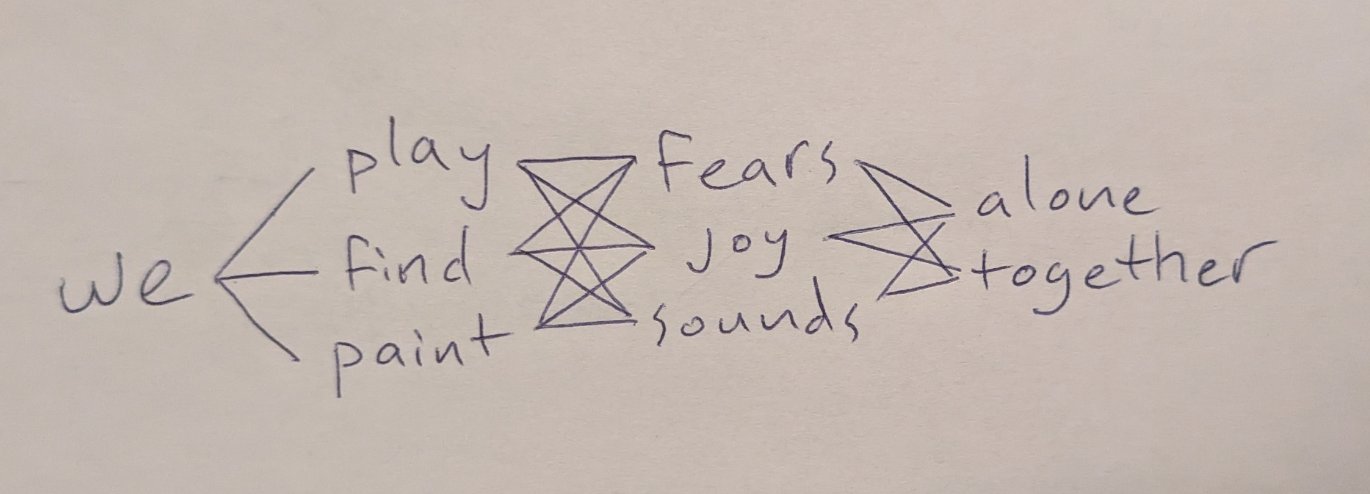
a word web by Ishita Dharap, inspired by her 2023 artwork “grief maps”
a web by Azlan Smith, inspired by Ishita’s 2023 “grief maps.” We made these together, tonight, for this post.

                One of the (many) wonderful things about my friend Ishita Dharap is that I’m not sure how to describe our friendship.
                We’re art friends. That can be drawing or crafting or eye makeup, familiar mediums, but it also means painting words into classes, balancing relationships into museum art exhibits, playing sunlight like you’d play a piano until it sounds sweet. Or maybe being a piano for some sunlight’s silly hands.
                We’re cooking friends. That means we like sharing meals, love standing over the stove and stirring things, love the blur of heat and flavor into time and texture. I think it also means that we’re mischievously aware of ourselves as cooking, too. The idea for this post has been bubbling away on low for years. We make space for one another’s boiling and slow-bubbling.
                We’re quick friends, ever since our first conversation while trees danced outside. Vibes, Ishita says.
                We’re slow friends. Sometimes we don’t talk for a long time. That’s not a turning away or forgetting. It’s a growing— leaves that flicker in their curiosities, and roots that steady in their quiet, hidden curiosities.
                Did any of that make sense? Do you have friendships like that? Or maybe I should say like all these. I’m thinking about manyness. About how in my experience a friendship that is is many things. Ishita’s approach for mapping words into webs is one of my favorite ways to try and write that manyness. You can read in branching threads, following the different connections. People sometimes comment a lot about the linear structure of an English sentence, the sequence of a word then a word, but when I think about anything I’ve read the words are more a web than a line. Are they that for you? A knotted association of the threads above and this thread here and the next threads, and other memories or thoughts that all these threads tie to? They are for me, and Ishita’s word maps are a way of writing toward that web.

475: Talking in Pictures (Bree Paulsen)

                In the last pages of Bree Paulsen’s Garlic and the Vampire, words fall away. We’ve had lots of words in the rest of the book: funny words and sad words, scared words and laughter. But here at the end friendships are growing, gardens and orchards blooming, and all we need is pictures. A bat flying. A community laughing. Seedlings sprouting. A hat for the nice vampire, as he’s sensitive to the sun after all. A cool evening in front of a warm fire, and next morning some more shared joyous work as the characters repot some plants. The book ends with a smile.
                I’ve never managed to make a photo essay that did what I wanted it to do. But reading Bree Paulsen, I wish I could draw this week’s post for you. There would be some deep shade beneath a sycamore, as it was hot today. A couch in our dim livingroom as afternoon relaxed and three of us sprawled together. A glass of water on a coffee table. Fingers typing, but just for a moment, and then a sycamore again, the shadows grown all up around it into full night. Then maybe a pillow. Then the ceiling. Then dark arcs the way artists sometimes draw when the character is closing their eyes. Towards dreams, all these images washing together, and the sweet excitement of hoping that tomorrow I’ll wake up to friends and shared work the same way Garlic and the Vampire does—and that, tonight, I’m going to sleep. Last night’s thunderstorms still swirling through my mind. A bat flying somewhere. Its soft wings.

460: “We” (Brontë, Groot, & Vaid-Menon)

“I am Heathcliff.” -Emily Brontë, Wuthering Heights
“We are Groot.” -Groot, Guardians of the Galaxy
“Becoming ourselves is a collective journey.” -Alok Vaid-Menon, Beyond the Gender Binary

                One of my very close friends is moving to Colorado tomorrow. I’m wonderfully happy for them: it will bring them closer to their partner, to the life and work and community they want to grow. And of course I’m sad. Our routes walking to campus were similar, and from now on, when I see someone walking beneath the magnolias on Oregon Avenue and wonder is that Dusty the answer will probably be no, they moved. They’re walking through other trees now.
                I’ve moved a lot, which means I’ve moved away from a lot of wonderful friends. I’ve had a lot of wonderful friends move away from me. And sometimes we stay in touch. And sometimes we drift apart. But sitting here, tonight, putting together the wonderfully silly collection of Brontë and Groot and Vaid-Menon, I’m struck by how I am my friend. I never thought about Emily Brontë’s line that much (and I’m still not sure about it, sitting how it does in a romantic relationship), but I’m a bit of a gardener in part through gardening with Dusty. I’m a bit of a forager, with plans to visit the redbuds and the magnolias (both delicious!), with Dusty. And while “I am Heathcliff” seems intent on individuals, on separate selves who can be connected or identical, I like Groot’s “we.” We are what we’re becoming together. We are walks through Urbana, following Boneyard Creek through town, pulled along by how the water flows. We are the taste of magnolia blossoms (gingery!) and the thought that my partner and I might plant one, now, and tend to it. Dusty suggested we might. Becoming we.

459: A Relationship Between Writer and Reader (John Duffy)

                “To say writing involves ethical choices is to say that when creating a text, the writer addresses others. And that, in turn, initiates a relationship between writer and readers […].” -John Duffy, “Writing Involves Making Ethical Choices,” Naming What We Know p. 31

                As a freshman in undergrad, I took Professor Kim Townsend’s class called “Friendship.” I think I picked it because I liked the reading list, and stayed with it because I really liked him. But I was surprised to see that title. At the time I might’ve thought something like, what’s there to study about friendship?
                Although maybe that’s not quite fair to my young me. Two years earlier, my Spanish teacher Bill Churchill commented there was something strange in how people from the USA used the phrase “my best friend.” He said something like, “You’ll ask them, and they’ll say, ‘Oh my best friend lives in Colorado, my best friend moved to New York, I see them once a year.’ But when I say mejor amigo I usually mean someone I see or talk to every day.” Listening, sixteen year old me wasn’t sure what to make of this. I thought about all the different connections that could be understood as “friends.” I was just starting to think about how the USA’s specific cultural setups made space (or did not make space) for adult friends who see each other.
                Today, reading John Duffy, I’m thinking about all the different ways I suggest a relationship between people. So many of them are written (in texts, in emails) or recorded (in the YouTuber’s “Like, comment, subscribe!” or my “It’s been too long!” on a voicemail, suggesting we might get back in touch). So many of them are in person—the different variations of my “let’s go for a walk” (where Dusty and I pose friendship as meandering punctuated by trees, by squirrels) and Ishita’s “I’ll bring eye pens!” (where Ishita and I pose friendship as a play of colors, lines, makeup) and my “I just want to lie on the floor” (where Dani and I pose friendship as an exhausted quietness, side by side as semester’s end shuffles by). I’m glad young me didn’t know all the things friendship might be. That I felt a quiet wow at the possibilities, like looking down into deep water, and still feel that sometimes, before I write or walk or sit down with the eye pens or lie on the floor, hush, lets listen, sinking into hardwood, together.