470: Receptive Language, & Listening (Alexis Pauline Gumbs)

                “What I want to say to you requires a more nuanced field of receptive language than I have ever spoken. It requires me to reshape my forehead, my lungs. It requires me to redistribute my dependence on visual information. So I will close my eyes and say it: Here. Here I am. Here I am with you. Here is all of me. And here we are.” -Alexis Pauline Gumbs, Undrowned: Black Feminist Lessons from Marine Mammals

                I’m writing this from an airplane. Billowing white clouds outside. The jets thrumming through the wall where I rest my head.
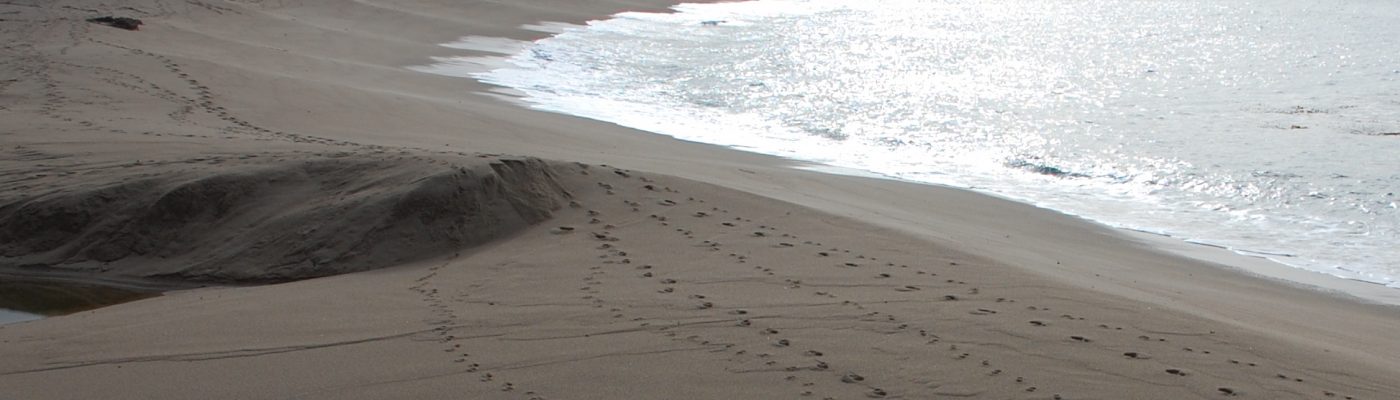
                Last week my beloved and I got married. As part of the ceremony we read Alexis Pauline Gumbs out loud, including the lines above. Gumbs is thinking about the way marine mammals speak and listen across oceans. How the shape of their bodies collects sound, connects songs. Resonates. Now, as we travel back home, I’m practicing listening. A long, slow, lovely practice. I hear my partner chatting with our sweet seat mate. I hear our seat mate’s baby, discovering fingers and red grapes. I hear all the little sounds of people shifting and talking. I hear breathing. I hear keystrokes. All around I hear the wind, threaded through with the jet’s thrum, and I think about the sky as an ocean of air that we all swim through. How precious every breath. How precious the chance to share them. How delightful, my love, to listen, to practice that close-eyed receptive language that sings through oceans. That sings here we are.

463: “Research is my saving grace” (Shelby Criswell)

                “Research is my saving grace, and it led me to every person who inspires me in this book.” -Shelby Criswell, Queer as all Get Out: 10 People Who’ve Inspired Me

                Sometimes I think about the many different things research can be.
                Most of the undergraduate students I teach don’t like “it.” Research papers feel like a threat. Or maybe I’m projecting, because for me, “research papers” often felt like a threat. There was a right way to do it, though people wouldn’t tell you—they’d just tell you what you did wrong. There was a place you were supposed to find in the pile of encyclopedias, library books, search engines, online journal databases. It was like trying to find the right grain of sand on the beach.
                In my classes I’ve started playing two games. The first is a common wikipedia game, the one where you start with some page (this one, for instance) and try to get to a common page (this one, for instance) in as few clicks as possible. (Or as quickly as possible). Then you can play around by talking to people about the different “paths” people took through information. The second is starting with some random page and then clicking along until you find your way to something that interests you. I like hearing people describe their experiences with these two games. Some people say the first is fun, because someone wins: there’s a goal, a finish line, and in a group someone does it the fastest. That gives the game momentum. Some people say the second is fun because there isn’t a goal, a finish line, and in a group no one has to do it the fastest. I get both. And I wonder about what I mean by research, or rather, the many things I could mean, and all the different ways to walk into or excavate or link or challenge or weave together or build with or sing along to the so many ideas washing around us. 
                So it’s fun to stumble across perspectives like Shelby Criswell’s. There are plenty of times I still don’t like “research.” Times I feel intimidated by it, or frustrated by what voices the research-assigner counts as “legitimate” or not, or realize I’m more interested in some question besides the one I’m “supposed” to be focused on. And sometimes I love it. Or even find my way to love through it.

462: “The Height of My Ambition” (Katherine Addison)

                “The height of my ambition at the moment is to make it into bed.” -Katherine Addison, The Angel of the Crows

                I read somewhere that snoozing in the morning doesn’t actually help you get up more rested. I can’t remember the source (probably somewhere I wandered online, and probably not reliable), but the idea was that slipping in and out of sleep doesn’t bring you into REM for that deep rest. So I set out to stop snoozing in the morning. To get up as soon as I woke up. A few years later that changing habit came up in a conversation with my therapist, who said, “Well, but I love that time in the morning. Especially with my partner.” And I was like, huh. I love that time too. The warmth. The skin. The half-awake togetherness, dreams messing around nearby like kids who know it’s time to stop playing but also know it’s still time for playing.
                So I like Katherine Addison’s play with ambition. The ambition to make it into bed. To stay there for a good long time. My to-do list for tomorrow is long-ish, and today’s was long-ish, but maybe I’ll add in a “height of ambition” that’s playing veo veo with my partner (“I spy with my little eye,” in Spanish) or saying hello to the bushes I hurried by today. Touching their textures. Ambitions of a moment, an hour, an afternoon. Some friends and I once spent several years compiling a list of words that are animals and actions (fly, of course, and badger, ferret, duck, ram, wolf—horse if you allow “horse around,” and we disagreed on “shark”). We could’ve googled it but that’s cheating. What a lovely ambition of the moment that was.

461: “Whom To Ask” (Katherine Addison)

                “So many things are a matter of knowing whom to ask.” -Katherine Addison, The Angel of the Crows, p. 305

                One of my favorite things about being in graduate school (and running away from graduate school to meet organizers, activists, librarians, gardeners, poets) is talking to so many different people who think so deeply from so many different perspectives.
                I wonder if one of the reasons scholars/experts get a bad rep in the United States is that there’s this cultural assumption, this pressure, that an expert should see everything. Understanding everything. Like Sherlock in The Adventures of Sherlock Holmes or House in House MD or (yeah, deep cut) Vin Diesel’s Riddick in The Chronicles of Riddick. A bunch of wild unpredictable shit happens, and then Riddick says, totally seriously, “That was my plan.” In the movie we’re supposed to believe him. In real life someone told me “There’s no one stupider than someone smart and sure of himself and outside his understanding.” I believe that more than Riddick. I’ve met lawyers with the most bone-headed takes on linguistics. Linguists with the strangest misunderstandings of language teaching. The list goes on and on. I don’t mean that you can’t learn about linguistics by studying law. I’m sure you can. But anytime someone is sure that their perspective captures and overrides everything, I think back to Riddick.
                So then there’s this delight. The delight of looking at a community garden and talking to an ecologist, and another time a farm organizer, and a gardener, and a birder, and an entomologist, and a local poet, and a painter, and people who are so much more than their one profession. Asking what they see. Sitting with it, and sharing our questions about what our eyes still hide from us.

460: “We” (Brontë, Groot, & Vaid-Menon)

“I am Heathcliff.” -Emily Brontë, Wuthering Heights
“We are Groot.” -Groot, Guardians of the Galaxy
“Becoming ourselves is a collective journey.” -Alok Vaid-Menon, Beyond the Gender Binary

                One of my very close friends is moving to Colorado tomorrow. I’m wonderfully happy for them: it will bring them closer to their partner, to the life and work and community they want to grow. And of course I’m sad. Our routes walking to campus were similar, and from now on, when I see someone walking beneath the magnolias on Oregon Avenue and wonder is that Dusty the answer will probably be no, they moved. They’re walking through other trees now.
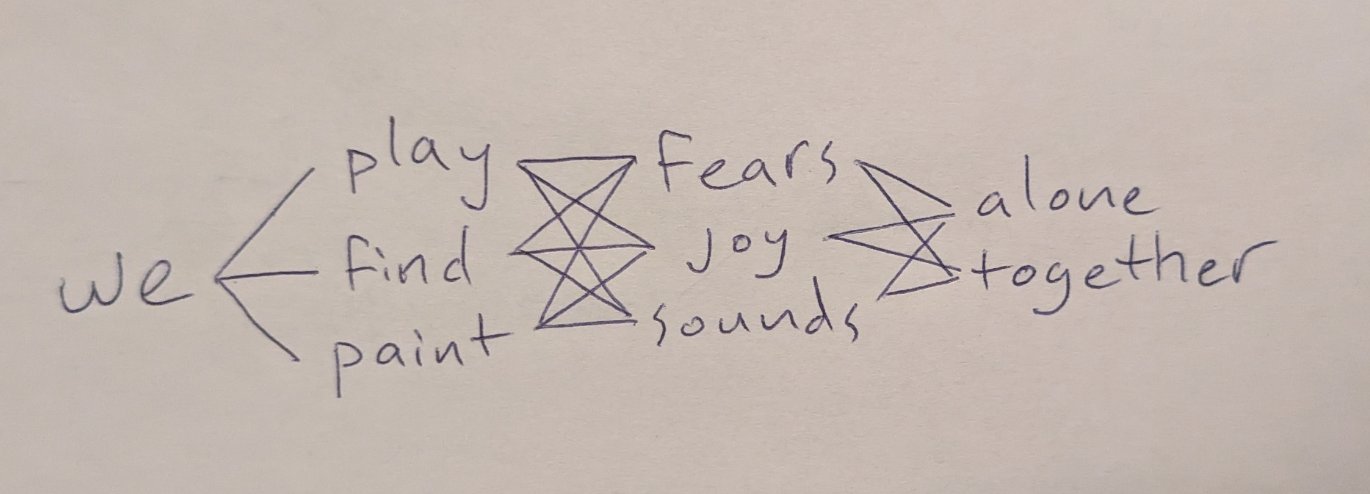
                I’ve moved a lot, which means I’ve moved away from a lot of wonderful friends. I’ve had a lot of wonderful friends move away from me. And sometimes we stay in touch. And sometimes we drift apart. But sitting here, tonight, putting together the wonderfully silly collection of Brontë and Groot and Vaid-Menon, I’m struck by how I am my friend. I never thought about Emily Brontë’s line that much (and I’m still not sure about it, sitting how it does in a romantic relationship), but I’m a bit of a gardener in part through gardening with Dusty. I’m a bit of a forager, with plans to visit the redbuds and the magnolias (both delicious!), with Dusty. And while “I am Heathcliff” seems intent on individuals, on separate selves who can be connected or identical, I like Groot’s “we.” We are what we’re becoming together. We are walks through Urbana, following Boneyard Creek through town, pulled along by how the water flows. We are the taste of magnolia blossoms (gingery!) and the thought that my partner and I might plant one, now, and tend to it. Dusty suggested we might. Becoming we.

457: “A Lot of Trust” (Joy Harjo)

                “Sometimes when you go into a creative project there’s a lot of trust.”
                -Joy Harjo, in conversation with Jenny Davis at a CultureTalk on April 23, 2024 

                One of my favorite memories from my teenage years is walking through the forests of Oregon at night. We walked through tall trees. The boughs drinking starlight and moonlight. Filling the forest with a perfect darkness and playing tricks with our eyes. The brown needles carpeting the edge of our thoughts, and our little group following a dirt trail by the feeling of our barefoot feet. I did this once a year for seven years or so. Sometimes we lost the trail, and I would crawl on my hands and knees, feeling for smooth dust and the path that led through creaking tree trunks to a creek and then a river where the sky washed down and the water told long stories. I think, for me, that walking where I couldn’t see was a way of practicing—celebrating—growing into—resting into—trust.
                Creative projects are a wonderful place to grow that way. Lately I’ve been working on a novella I started in 2018. I started it as another kind of walking into what I couldn’t see, another kind of feeling for paths that lead toward river stories. In 2018 the project started as a kind of delighted what’s here?, a curiosity that was strong enough (easily!) to wrap roots around the rocks of worry and uncertainty and keep growing. Can I follow this? Find my way to listening a little more? Returning to the project, now, the can I often feels more frightening. I did an MFA. More of my professional life, more of my career, is tied to this idea of being a writer. That means the feeling of losing a path, of fumbling around for smooth dust in the prickly pine needles, is even scarier. “Can I follow this, learn from this?” can become a threat instead of an invitation. Joy Harjo reminds me that this project (like my love for Harjo and Davis’ poetry, their teachings) started with a lot of trust. And with a practice of trust that is a delight, and that gains even more delight through its strong roots, through the long slow growing and creaking of its tree trunk.

453: All Ghosts, All Together (Caitlin Doughty)

                Usually when I write I’m scared. Scared of getting enough done, scared of how long it’ll take, scared I’m not good enough or funny enough or fast enough. It’s like that game where kids carry an egg on a spoon and try to walk faster faster but my egg is already smashed. Smeared on my spoon. Clear and yellow pulp crunchy with eggshells. And any moment someone will notice I’ve always already failed.
                I wish when I wrote I was talking to you. I wish we were together at the lake with the first hints of the storm ruffling the surface, and maybe we’ll go in soon, before the rain really hits, but for now you say I keep thinking about the horror of having a body and I say I think about broken bones, the way they twist, the way all bones are broken bones that haven’t broken yet and you say I read this essay from a mortician who’d held a skull that day, a complete skull, cooked clean by the cremation chamber, and she was looking at the skull, holding this which used to hold a person, though now it was covered in ash and scorch marks and she was thinking about how sometime every part of her will be something that somebody else holds, and she’ll come apart, and she realized it’s important to sit sometimes with the fact that none of us are the center of the story, or at least not the center of the story for very long, and while we might be stardust, the iron in us literally made in the furnace of stars, we are also borrowed stardust, we are iron that was earth or roots, that was something else, and will be something else and I say wasn’t that Caitlin Doughty and you say yeah, I think it’s in Smoke Gets In Your Eyes and then you pause and you say the rain’s really starting to come down. And for a little while we’re sitting there, you, me, and Caitlin Doughty, all ghosts, all together, this together we’ve made as the surface ripples a reflection of the clouds and the trees.

451: “As Long As It Helps Us Hope” (Weiwei & Stamboulis)

                “I think that it doesn’t matter whether poetry is good or bad… / …as long as it helps us hope.”
                -Ai Weiwei and Elettra Stamboulis, Zodiac, p. 154

                Sometimes I sit and listen to the resonance between experiences. Between these three, for example: 1) When I taught high school poetry in the twenty-teens, one of my favorite practices to do with a class was “short order poetry. Each student asks another for a poem (“about the first day of school,” “about a cracked windshield”). Then in ten-ish minutes each writer makes a poem to give back to the asker. This practice positions poetry as community, a gift between friends. The time limit can also help me stop worrying about “how good” the poem is and focus on putting lines together. 2) Some years after those classes, a mentor and I started talking about a teaching moment when you let go of worrying “how good” your classes are, recognize students’ work and interest as so much larger than you, and focus on offering what you can and supporting your students’ work how they ask you to. After that moment, paradoxically, our classes felt “better”—but something else had shifted, too. 3) During the worst years of feeling farther and farther away from my writing, writing felt more and more like a place where I had to perform expertise and less and less like the reach toward community that made me want to write. In the middle of those years I started writing flash fiction. Tiny paragraph- or page-long stories that touched one moment of connection, movement, need, loss. Writing those came to feel—well, like walking down to the beach every day to splash my face with the water. Or like letting the ocean wash its face with me.The practice helped me start finding my way back toward what I love in writing.
                When I finished reading Zodiac, I sat for a while, listening to the resonance between Ai Weiwei’s thoughts and so many of my (shared) experiences and relationships. I think the sitting—the quiet—was a way to turn towards and understand how the question “how good is this?” gets planted almost everywhere around me. And recognizing that planting is also a chance to stop planting, to focus instead, perhaps, on the ground the question grows in. The ground of what we’re doing, together. Of how what we’re doing together weaves our lived experience. How that doing makes it easier (or harder) to hope actively, playfully, courageously, communally.