475: Talking in Pictures (Bree Paulsen)

                In the last pages of Bree Paulsen’s Garlic and the Vampire, words fall away. We’ve had lots of words in the rest of the book: funny words and sad words, scared words and laughter. But here at the end friendships are growing, gardens and orchards blooming, and all we need is pictures. A bat flying. A community laughing. Seedlings sprouting. A hat for the nice vampire, as he’s sensitive to the sun after all. A cool evening in front of a warm fire, and next morning some more shared joyous work as the characters repot some plants. The book ends with a smile.
                I’ve never managed to make a photo essay that did what I wanted it to do. But reading Bree Paulsen, I wish I could draw this week’s post for you. There would be some deep shade beneath a sycamore, as it was hot today. A couch in our dim livingroom as afternoon relaxed and three of us sprawled together. A glass of water on a coffee table. Fingers typing, but just for a moment, and then a sycamore again, the shadows grown all up around it into full night. Then maybe a pillow. Then the ceiling. Then dark arcs the way artists sometimes draw when the character is closing their eyes. Towards dreams, all these images washing together, and the sweet excitement of hoping that tomorrow I’ll wake up to friends and shared work the same way Garlic and the Vampire does—and that, tonight, I’m going to sleep. Last night’s thunderstorms still swirling through my mind. A bat flying somewhere. Its soft wings.
474: Puzzle Piece Dreams (Vivid Collection: Sky Roads)

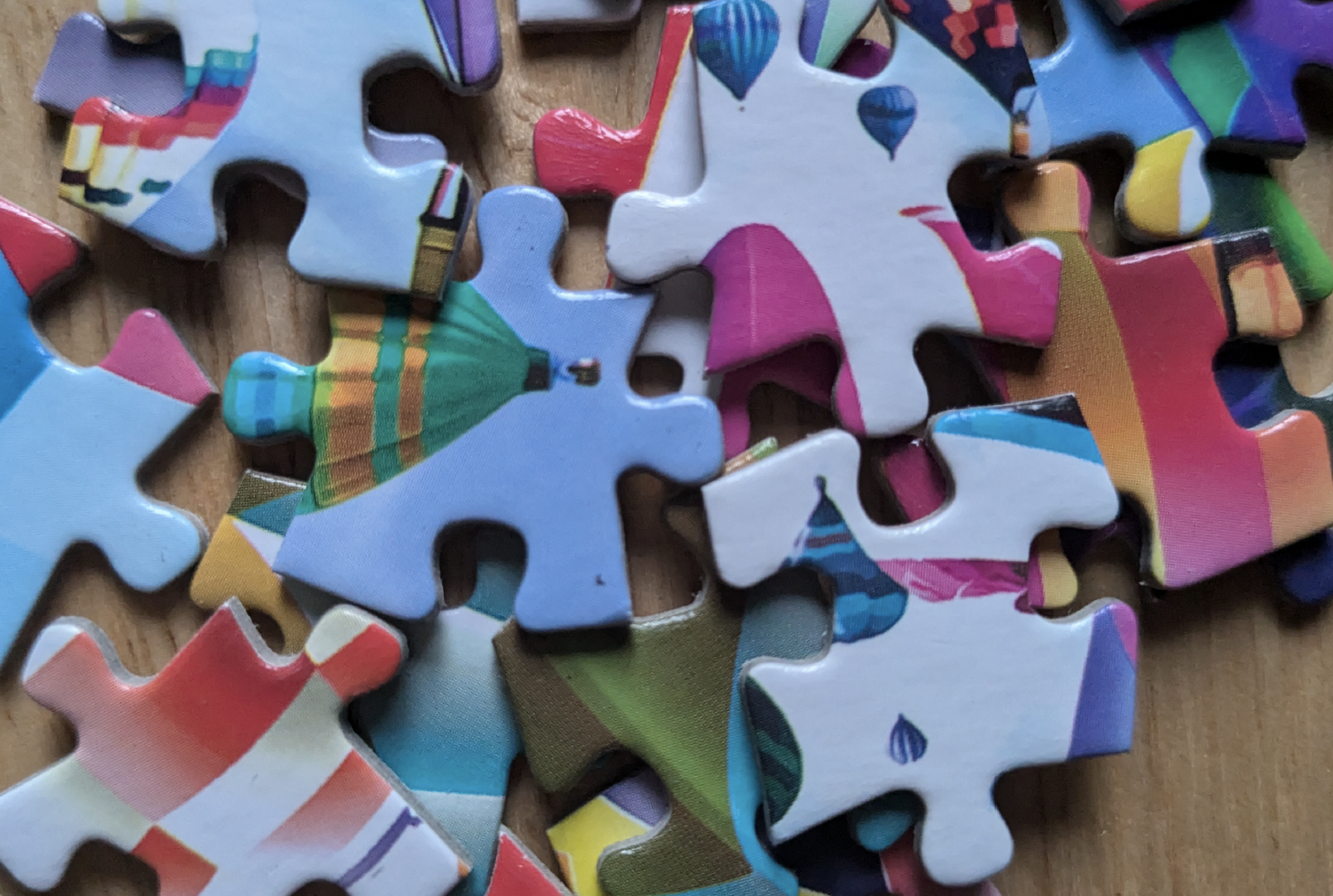
                A few nights ago I dreamed of puzzle pieces. And not just any ones: these puzzle pieces, which I put together on Sunday in one long rush with my partner and our friend Natalie. It was a lovely afternoon of of cheese, crackers, and sliding the colors around. Feeling how they clicked together, how they didn’t. Not here a puzzle piece says. And then eventually it chuckles yep.
                Thinking about that dream, I’ve been sitting with how my mind fills up with what I turn my eyes and ears and hands to. I’m the kind of TV watcher who will be washing dishes, sometimes years after seeing a story, and find myself repeating lines I remember and lines I could imagine characters saying, instead, if the story went a different way. Do you do that? It’s not a habit I talk about much—just like the puzzle piece dreams aren’t something I talk about much—and there it is. Like I’m a glass brimful of what I’ve been drinking. Bump into me and out splashes mixings from what’s inside.

473: “Olfactory Memory” (Feurat Alani)

                “Olfactory memory is the hardest kind to erase. It’s the most emotional, the most arbitrary. It opens the doors without knocking.” -Feurat Alani (trans. Kendra Boileau), The Flavors of Iraq: Impressions of My Vanished Homeland, #728

                My love and I are moving into our new home. Today we were gardening in the yard together, weeding around the echinacea and watering the rhubarb and finding a tomato plant nestled in tall grass (hurray!). The smell of all these leaves and stems and soils wash through me.
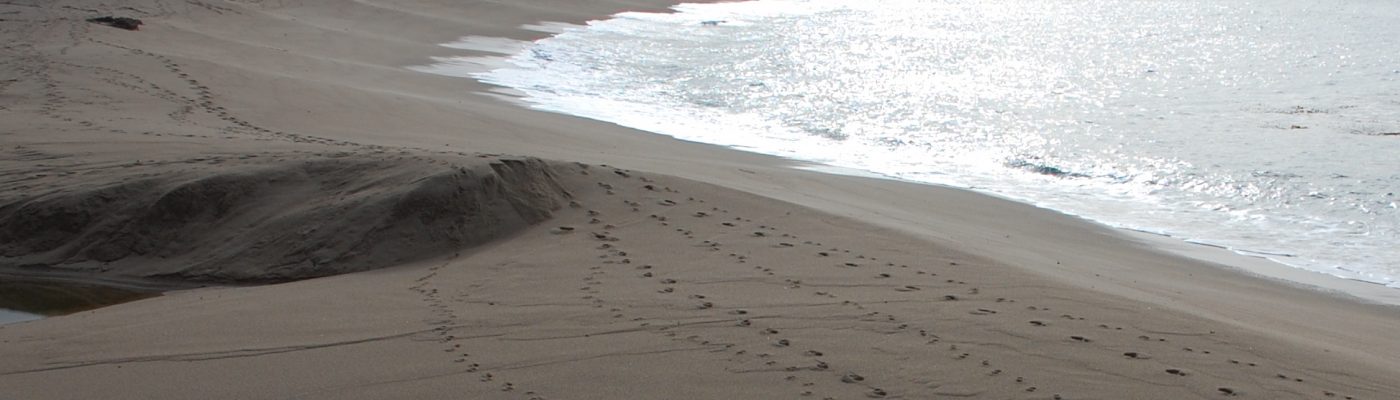
                What are my olfactory memories that open the door without knocking? So many—and sometimes like a burst of wind they’re here and then gone, hard to locate, impossible to pin down. But a burst of sea air: sometimes I step outside a car near the coast and childhood moments in sand dunes and surf burst around me. Bay trees. And eucalyptus trees, their scent curling like their dropped bark. Beeswax from making candles. Sweat, the smell of bodies, of hiking up into mossy forests. I love the way smells pick me up and carry me, not a flood to lift my heavy body but magic to turn me into mist, swirling here to somewhere else. I love being pulled away from myself which is also being pulled back. 
                I wonder what these olfactory memories are for you. Not the ones you might think of, now, if you tried to remember, but the next one that pushes all through you without knocking on the door.

472: “Collage is a method of care” (Tim Abel)

“Please read these as invitations:

Collage looks easy.
Collage is surprising. 
[…] Collage happens before, inside, during, after an artmaking/learning moment.
Collage is really about being open to detours.
[…] Collage is a method of care.”

-Tim Abel, “How Is Learning a Collage?” (p. 31) in Experiments in Art Research

                I’m writing this late today, because today’s been a flurry of writing a journal article (due soon!) and setting up our new house with my partner and running off to campus to meet with a friend and continuing some other university work and then having other friends over. The light slowly fading outside. The trees shifting. The dishes clinking into a stack after dinner. Sometimes on a flurried day I wonder, how do all these pieces fit together?
                Tim’s a good friend, an inspiring colleague, a caring teacher/student/companion. His article’s on my mind because I co-edited Experiments in Art Research, which came out this summer. My copy arrived today. I didn’t spend long looking at it, but behind everything else I’ve been thinking about all the wonderful friends who collaborated in writing. About Tim Abel and Ishita Dharap and Sarah Travis and Catalina Hernández-Cabal and Jorge Lucero and Rachel Gu and so many others. I’m thinking about us all as a collage, a coming together of relationships. Lives interspersed. 
                “Collage is a method of care.” Of caring how one piece sits next to, connects to another. A method of approaching the relationship between my research and my friends and the washing dishes and all the interweaving questions and researches and lives unfolding around me. Through me. Maybe today I wondered how do all these pieces fit together, but today, luckily, I also felt how all these pieces are already together. Tim’s “method of care” reminds me that all these pieces are growing together in easy, surprising, open ways.

471: “No One Knows It All” (Paulo Freire)

                “Humility helps us to understand this obvious truth: No one knows it all; no one is ignorant of everything.” -Paulo Freire, “On the Indispensable Qualities of Progressive Teachers for Their Better Performance”

                Twelve days ago, when my love and I got married, we didn’t have an officiant. We welcomed people and exchanged vows ourselves. Most of the ceremony itself (before the tamales!) was our family group of 22 sitting in a circle beneath the redwoods. Each person shared a thought or a celebration or a wish, or something else they wanted to say. I loved listening. I loved the branching, rooting, connecting of our voices.
                I love living Freire’s humility and obvious truth, too. It feels so right. At the same time, when I hear someone say “no one knows everything,” there’s usually a kind of sting to the thought. Like it’s embarrassing, or like the statement itself is barbed. I get why. So many of the cultures I live in value a kind of performative knowing and devalue uncertainty, confusion, complexity. I spend a lot of time at a university, and it’s amazing how many professors won’t admit what they don’t know. When I talk to my friends in tech or finance or law or medicine or…well, you get it, and my friends in those spaces say something similar. The not-knowing can be portrayed as a threat. A failure. A weakness.
                I loved that, with our joined families at our wedding, not knowing anywhere close to everything just felt like a celebration. Of course these wonderful people had insights to share that were different from others’ insights. Of course some of them saw things I didn’t see. Sometimes their voices brushed past my thoughts, our worldviews interweaving like roots below the ground, and sometimes our branches reached off in different directions, and all of it was wonderful to share.

470: Receptive Language, & Listening (Alexis Pauline Gumbs)

                “What I want to say to you requires a more nuanced field of receptive language than I have ever spoken. It requires me to reshape my forehead, my lungs. It requires me to redistribute my dependence on visual information. So I will close my eyes and say it: Here. Here I am. Here I am with you. Here is all of me. And here we are.” -Alexis Pauline Gumbs, Undrowned: Black Feminist Lessons from Marine Mammals

                I’m writing this from an airplane. Billowing white clouds outside. The jets thrumming through the wall where I rest my head.
                Last week my beloved and I got married. As part of the ceremony we read Alexis Pauline Gumbs out loud, including the lines above. Gumbs is thinking about the way marine mammals speak and listen across oceans. How the shape of their bodies collects sound, connects songs. Resonates. Now, as we travel back home, I’m practicing listening. A long, slow, lovely practice. I hear my partner chatting with our sweet seat mate. I hear our seat mate’s baby, discovering fingers and red grapes. I hear all the little sounds of people shifting and talking. I hear breathing. I hear keystrokes. All around I hear the wind, threaded through with the jet’s thrum, and I think about the sky as an ocean of air that we all swim through. How precious every breath. How precious the chance to share them. How delightful, my love, to listen, to practice that close-eyed receptive language that sings through oceans. That sings here we are.

469: “Here In My Heart” (Moana)

“I will carry you here in my heart, you remind me
That come what may—I know the way—”
                –Moana

                Tomorrow I’m getting married!
                Tonight I just finished watching Moana with my partner, my siblings, my nieces, and my mom. This morning uncles and cousins and friends and family came together in a park to chat and meet and celebrate. (And eat delicious food). As one of my cousins was leaving, we paused in the parking lot, talking just a little more. I commented that when I moved away—to Massachusetts for college, at seventeen, then to India and Oklahoma and Illinois for work—I didn’t quite understand that moving meant all my people back here would be relationships I had to visit from far away. Of course I knew that. But I didn’t understand. 
                My cousin laughed and said something casual about here we were, though, chatting. Still connected.
                Tonight, one of my favorite parts of the movie is Moana running to hug her grandmother’s spirit. In lots of movies, the animators might depict the spirit as incorporeal—Moana’s hands could pass right through. A spirit could become a light to guide or talk but not to touch. Instead Moana throws herself forward and her grandmother’s spirit catches her. Holds her. The two leaning together. I love how real we are to each other, across whatever seas. I love how we love.

468: “After A Time” (Katherine Addison)

                “After a time, he felt a deeper rhythm, the rhythm of the stone and water, not the rhythm of his words and heartbeat. He breathed into this deeper rhythm, let it teach him a new mantra, a wordless mantra that waxed and waned, ebbed and flowed, moon and stars and clouds, river and sun, the wordless singing of the earth beneath it all like the world’s own heartbeat.”
                -Katherine Addison, The Goblin Emperor, p. 138

                Yesterday over dinner we talked about words, and how words open the space for new kinds of understanding. For example, two years ago I didn’t know what poison hemlock looks like. Then someone taught me, gave me a name for what I was seeing, and now I notice it along streets in Illinois or behind the sand dunes in California. And this evening, sitting beneath a big oak, I heard a squirrel scurrying. Saw the bobbing grass. Listened to the bark against my hand. The pauses in between my partner and I talking, and the touch, as we sat closer, of earth to root to sap to bark to skin to air to leaf to squirrel.
                I almost forgot to post to Uproar today. I forgot because I was outside, looking at a bright star, wondering if it was a planet. Because the night felt so cool after the hot day. One of my favorite parts of Uproar is the rhythm of it, the practice of turning towards a quote that means a lot to me, and sitting with those words. And tonight in the almost-forgetting I’m delighted by losing track of Wednesdays. By listening to sunset, tasting the day’s heat melt into coolness, and breathing towards these rhythms. Sometimes words help me get ‘there,’ but often the words themselves are not where I’m going.

467: “The Scale of Breathing” (Alexis Pauline Gumbs)

                “What is the scale of breathing? You put your hand on your individual chest as it rises and falters all day. But is that the scale of breathing? You share air and chemical exchange with everyone in the room, everyone you pass today. Is the scale of breathing within one species? All animals participate in this exchange of release for continued life. But not without the plants. The plants in their inverse process, release what we need, take what we give without being asked. And the planet, wrapped in ocean breathing, breathing into sky. What is the scale of breathing? You are part of it now. You are not alone.”-Alexis Pauline Gumbs, Undrowned: Black Feminist Lessons from Marine Mammals, p. 1

                The other day I was walking after a conversation that left me feeling unbalanced, unsafe. Through beautiful hills, I should add: sundrenched gold grass and oaks holding up the tiny ocean depths of their deep shade. Woodpeckers on the branches. Deer resting. But that conversation had me feeling scared, so I imagined some of the people I’m closest to walking with me. Their feet in these hills. Then I realized they weren’t just walking: one of them was wearing gold pants and dancing. One twirled their fingers, chunky rings glinting in the sun. Some were laughing. Some sad. Some transforming. And all of us were breathing.
                All this has me thinking about Gumbs and the scales of breathing. Because after I started imagining these friends and teachers and guides with me, I felt so much more grounded. So much more possible. My breath possible. My fear possible, too, but not as an ending: as thorny brambles in these sunwashed hills. And then as I pay more attention to these people dancing along with me, I feel how we’re dancing along with the gold grass (dry, now, and shining, and green again when the rains come) and the trees (their roots digging into the earth in a way that teaches holding, while at the same time they tickle and are tickled by sky). And I remember Gumbs. You are part of it now. Breathing and breathed along as skies inhale ocean, exhale summer breeze.

466: A Riddle (Richard Wilbur)

“Long daughter of the forest, swift of pace.
In whom old neighbors join as beam and brace,
I speed on many paths, yet leave no trace.”
-Richard Wilbur’s “Navis,” which is a translation of a riddle by Symphosius

                I’ve been going through boxes in my mom’s garage. Some of them I packed ten years ago, or twenty. Some my mom packed when I was small, and a few have envelopes or little boxes my grandma collected when my mom was small. Today we found my grandma’s birth certificate and coins she saved, complete with a handwritten note to my mom explaining that these would be valuable and they were “for the grandkids.”
                A few days before that I found my college copy of Richard Wilbur. The poem I quoted is from a series of riddle poems. I’m trying not to give away the answer. That way you can go walk around with i if you want. (The implied question in this series is always, What am I? And Wilbur uses the answer, in its original Latin, as a title). Leafing through this book, fifteen years later, I recognize so many of the poems. Looking through these documents and pictures, so many years later, I recognize so many of the moments. I’ve forgotten or never knew so many more. So many of us, joining to brace each other. So quick the way our lives wash through each other. I like how the poem and old handwriting and the act of remembering are all riddles, or could be. Are all inviting me to sit for a moment, or walk along with the image, listening to its hints.