Nine months ago I talked with the wonderful faculty of my PhD Committee for my PhD Fields Exam. We talked about lots of things, including some of the community organizing work I facilitate. And I said something like, “It’s hard for me to say ‘I do this’ and ‘I do that’ to organize things, because everything I do is woven through with what so many other powerful people are doing. And there’s a long history of people (especially white men) saying I did this as a way to take credit for or hide all the other work that other wonderful people are doing. The work they themselves are relying on.”
Jenny Davis, a Chickasaw scholar, poet, and educator, told me that was one way people use “I.” Another way is to say Here I am. Here is my place in my communities. Here I recognize and choose to live up to the responsibilities and duties of our interwoven lives. I’ve been thinking about that ever since. What I’m sitting with today, what I’m wondering about and mourning and, yes, celebrating, goes all the way down to what I mean by “I.” What we might mean by “we.” Because here I am, and I choose to work to recognize and live up to the responsibilities and duties that flow through this wonderful web of living things of which I’m a part. That can feel heavy. That can feel joyous. That’s the “I” I practice.
Author: Azlan
484: “Your Strangest and Funniest Friend” (Dave Eggers & Amanda Uhle)
“Find your strangest and funniest friend. Have that strange friend find their funniest and strangest friend.” -Dave Eggers & Amanda Uhle, Introducing Unnecessarily Beautiful Spaces for Young Minds on Fire
This is going to be a little all over the place, because you know when a child comes running up to you because there’s a cat outside and the cat was climbing a tree and my friend climbs trees and we love plums and did I tell you we’re building a spaceship that might be a garden? Were you that kid, sometimes? Are you still?
Today my friend Jackie and I were sitting at a table, enjoying the breath of a gentle breeze and squinting through bright electric lights, and trying to work. It happens sometimes. She was working on an application for funding, which would help make possible some of her wildly cool research. I was trying to read Aja Martinez’s Counterstory, also wildly cool, and important for a journal article I’m revising. It’s all work we believe in. And we just didn’t want to do it. Our snacks had helped, fueling a few more keystrokes, but all the snacks were gone.
So Jackie showed me Nael’s “The Tiger.” You might’ve seen it before—a spark of a little poem, and it jumped through all sorts of social media a couple years ago. The author’s a child. The poem’s full of a wild, brave, world-making excitement. “The Tiger” was published in a collection edited by 826DC, a very cool place that I’m definitely not reading more about (instead of doing my other work). I didn’t know this strange friend but I immediately recognized them as friends with 826 Valencia—a very cool someone, if you haven’t met them, and probably worth some not-reading of your own. And we do love plums. And there is a cat outside. And sometimes in learning from children (of all ages, 6 and 25 and 92) I remember that I’m a strange friend who loves my strange friends and that together we’re definitely making something.
483: “And Watched The Heart” (Aliette de Bodard)
“Thuỷ stood in her cabin in The Goby in the Well, her bots arrayed on her shoulders and clinging to her wrists, and watched the heart of the nebula.”
-Aliette de Bodard, “Mulberry and Owl,” We’re Here (and also here in Uncanny Magazine)
I almost always write about a quote from something I’ve finished reading. Or at least, I often think of it that way, which is weird, because I’ve never actually finished reading any of the stories that I love most. They swirl and come back, less single events and more waves & eddies & seaspray & quick sips & long drinks. In any case, tonight, I’m thinking about de Bodard’s line because I’m just starting to read “Mulberry and the Owl.” Half a page in something pulled me away. And there’s something lovely about story beginnings, something that connects to why I like fiction and speculative fiction in particular.
Years ago I heard Stanford neuroendocrinologist Robert Sapolsky lecture about human interest in “newness.” One of his suggestions was that an individual’s interest in newness tends to wear out overtime— if an American hadn’t tried sushi by their early twenties, his research found, the odds were they never would. If they didn’t have a piercing by their early twenties the odds were they never would. Similarly his research indicated that Americans tend to set their taste in music by their teens or weary twenties. One interesting nuance: Zapolsky said that if you set out to be a beginner in anything—pick up the harp, which you have no idea how to play, and deeply start learning—your interest in newness across the board tends to go up. A regular, purposeful practice of being a beginner brings you back to new beginnings.
Like short story opening lines. Like all opening lines, maybe, if you read them that way. I start reading and I’m a beginner in this world, because Thuỷ has bots arrayed on her arm. (What kind of bots, I wonder?). Because I’ve never looked at the heart of any nebula. (What does Thuỷ see?). Because reading this I’m listening, wondering: who is this? What community web do they live in? What matters to them, and as we gaze into this nebula, what’s possible?
482: “All The Water” of Us (Sayaka Murata)
“‘[…] there’s a different air about you.’”
[…] Yukari was right I thought. After all, I absorbed the world around me, and that’s changing all the time. Just as all the water that was in my body last time we met has now been replaced with new water, the things that make up me have changed too. When we last met a few years ago, most of the store workers were laid-back university students, so of course my way of speaking was different then.
‘I guess. Yes, I have probably changed,’ I said with a smile, not elaborating.” – Sayaka Murata, Convenience Store Woman
Earlier today my sister-in-law, Fa, and I ended up chatting over the different ways we see ourselves in our friends and family. She told me about meeting one of her roommate’s sisters: “Just wait,” the roommate said, “meeting my sister is going tell you so much about me.” And it did. In their mannerisms, their phrases, their playfulness, Fa recognized the sisters by seeing them together.
I often feel that way. There’s a kind of American individualism that’s really attached to an inner, essential, solitary self, and I’ve spent a lot of time thinking about that—but sitting here now, what I feel is the wash of water as different people fill me. My parents, of course, and my siblings. Even from thousands of miles away I was looking at a palm tree today, and the way I looked at it came in part from my dad. I said hello to someone who passed and my mom’s phrasing washed through me. And then there’s my spouse, my spouse’s siblings, my friends, the other people I meet. In the last few days I’ve met a lot of my partner’s cousins, uncles, and aunts, and already I hear new phrases on my tongue. I find myself making new jokes. It’s fun.
I used to love jumping into puddles. The splash. The reflection. The game. I’d stand and watch the changing water, too, the rippling tree branches and the sky. Sitting here I splash and reflect and play, my own little puddle self. Smiling, just like Sayaka Murata’s character.
481: Writing Webs (Ishita Dharap)

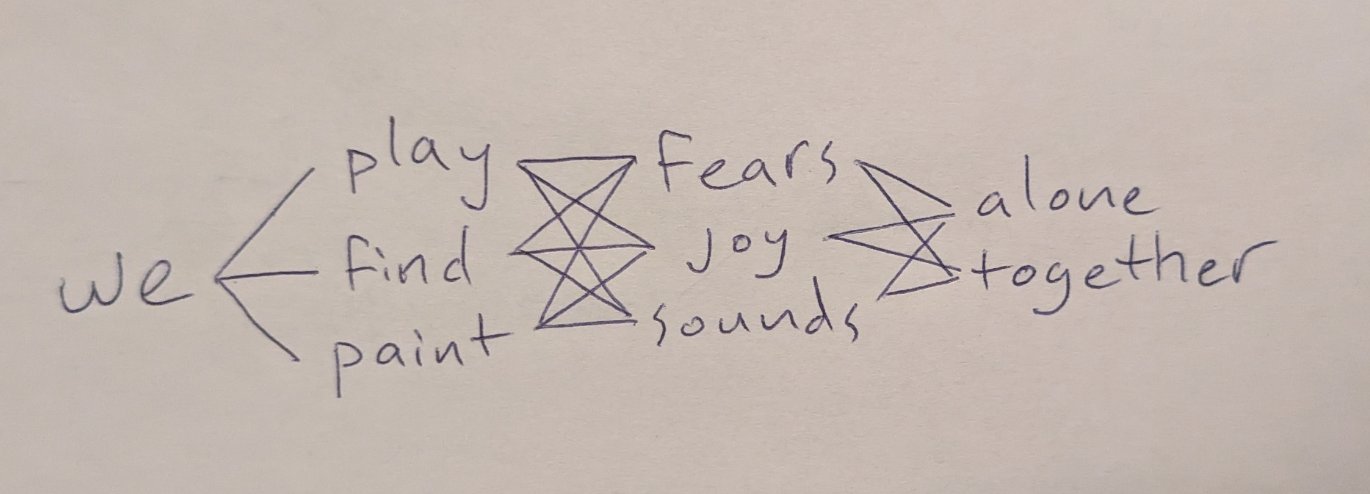
One of the (many) wonderful things about my friend Ishita Dharap is that I’m not sure how to describe our friendship.
We’re art friends. That can be drawing or crafting or eye makeup, familiar mediums, but it also means painting words into classes, balancing relationships into museum art exhibits, playing sunlight like you’d play a piano until it sounds sweet. Or maybe being a piano for some sunlight’s silly hands.
We’re cooking friends. That means we like sharing meals, love standing over the stove and stirring things, love the blur of heat and flavor into time and texture. I think it also means that we’re mischievously aware of ourselves as cooking, too. The idea for this post has been bubbling away on low for years. We make space for one another’s boiling and slow-bubbling.
We’re quick friends, ever since our first conversation while trees danced outside. Vibes, Ishita says.
We’re slow friends. Sometimes we don’t talk for a long time. That’s not a turning away or forgetting. It’s a growing— leaves that flicker in their curiosities, and roots that steady in their quiet, hidden curiosities.
Did any of that make sense? Do you have friendships like that? Or maybe I should say like all these. I’m thinking about manyness. About how in my experience a friendship that is is many things. Ishita’s approach for mapping words into webs is one of my favorite ways to try and write that manyness. You can read in branching threads, following the different connections. People sometimes comment a lot about the linear structure of an English sentence, the sequence of a word then a word, but when I think about anything I’ve read the words are more a web than a line. Are they that for you? A knotted association of the threads above and this thread here and the next threads, and other memories or thoughts that all these threads tie to? They are for me, and Ishita’s word maps are a way of writing toward that web.
480: Performing Card Tricks (Jean Hugard & Frederick Braué)
“We cannot emphasize too strongly that knowing the secret of the trick is not the same as knowing how to perform that trick.” -Jean Hugard & Frederick Braué, The Royal Road to Card Magic
It’s a long way, maybe, from this book on learning card magic to the workshop my partner and I joined last Sunday. And in another way they’re close. In their joyfulness. Their serious playfulness. Their habit of being lost (and found) in the movement itself, and not the knowledge of it.
Last Sunday’s workshop built on body mapping. We lay on the floor and traced one another’s shapes onto two large pieces of paper. Then we drew around and with our shapes: our hands, our legs, the messy cloud of our hair. We started by tracing with black markers. As soon as I got up I reached for colors. Purples. Pinks. Golds. Next to me my partner started growing roots, up from beneath her feet and into her legs. Watching her roots became drawing my roots. Drawing our roots became twining these roots together, weaving them, our papers and our hands and our colors playing together. At the end of the workshop we were invited to share about what we’d drawn, and I realized I didn’t want to say anything. It’s not that I hadn’t liked the workshop: I’d love it. But I’d felt something and learned something in the drawing, the time together, the crawling on the floor to find my colors, and I didn’t (not then, at least; not yet) want to put any of it in words.
I know the secret for a few card tricks. At one point I knew how to perform two—how to push a card through the table, maybe, which was always a delight to share on a bored afternoon when we’d forgotten why talking had once felt exciting. Beyond the tricks (or through them?) there’s this playful wonder. This magic. The what? The how? Too often, in thinking, I can mistake the secret of the trick for the practice of its performance, but it’s in the performance that I’m always falling in love.
479: “To Keep My Secrets” (Jean Arasanayagam)
“You allowed me to live the way I wanted to, always.
You allowed me to keep my secrets.”
-Jean Arasanayagam, from “Portents: For my mother” in The Colour of My Mind, p. 31
Today I’m celebrating secrets.
This morning, on my way to work, a bird fluttered at the edge of eyesight. Disappearing into a bush. I looked around, trying to see them behind the bobbing branch they’d left behind, but they wanted not to be seen. I realized I wanted not to disturb or disrupt them more than I wanted to see their wings. I could have gone looking, pushing back greenery. I’ve done that before: in looking for birds, in asking my friends questions that they’re turning aside, in demanding (as a classroom teacher) that a student explain why they’re late. I’ve felt like I was supposed to do that, sometimes. And the demanding, asking, looking has felt icky even as I did it. Jean Arasanayagam’s lines help me understand why. It’s wonderful to share, it’s important to ask and support, and it’s also wonderful to have my secret perch in the foliage. To have a family that celebrated that for me, not pushing back the leaves.
So tonight I’m enjoying the secret stars behind the clouds. The secret movements of small secret feet in the trees. The secrets inside and behind and beneath and running through my conversations and walks with people I love.
The secrets you want to keep: I’m glad you have them. I don’t want to disturb them. They have their sheltering leaves, their strong branches, their flash of wings.
478: Drawing “What We Cannot Yet See”
“How do we draw—or write—the emotions and parts of ourselves that we cannot yet see?”
-Rachel Gu my friend!) and Azlan Guttenberg Smith (that’s me!), “Our Monsters, Our Breath,” Experiments in Art Research
Rachel and I sat next to each other in a grad seminar. Hour by hour, I watched shapes and shades wash out from the colored pens she brought with her. The pattern from a classmate’s shirt. The arrangement of our tables. A few branches, framed by our classroom window, and an abstract shape that was Rachel’s response to a piece of today’s reading.
I’ve been scared of drawing for a long time. A mark on a page can feel so final, so I tried to put down perfect marks, clear edges, and everything I drew felt stiff, self-conscious, incomplete. And I’m also entranced when I watch people drawing. Smudging. Erasing. Playing out ratios and relationships.
I started drawing along with Rachel. Class by class period, first with the pens she shared with me, then with colored pencils I brought to share with her. I picked up specific techniques, of course. (She dripped water from her bottle onto the table, and used it to smear her pen’s ink, and I loved it). But more than the specific techniques, I felt the space of drawing opening, the fear I’d felt settling into one tree in this rustling forest of shapes and shades as Rachel ran ahead and I followed—or turned off to wander a different way. Months after Rachel helped me start drawing again, I helped her start writing some poetry. These practices together led to the chapter we wrote for Experiments in Art Research, where you can read some of her poems and our translations. And these practices helped me—I hope us—sketch our way into a version of studying that is a kind of making space to share ourselves and share what we cannot yet see.
477: “It Helps Us Hope” (Ai Weiwei)
“I think that it doesn’t matter whether poetry is good or bad… / …as long as it helps us hope.” -Ai Weiwei, Elettra Stamboulis, and Gianluca Costantini, Zodiac: A Graphic Memoir
I want to write poetry the same way I step into the rain. Feeling raindrops scattering. Touched by a sky that whirls and swirls, vast and near, and chuckling along with the wind and the trees and neighbors who are chuckling, too. Which is to say: I want to write poetry the same way I garden, watering seeds, watching shoots grow, noticing shadows and sunlight and moisture. I want to write poetry the same way I cook for you: here, I made this, for us, a little snack. Which is to say: I want to step out into the rain and garden and cook like writing poetry, these little practices of hope.
I’m less and less interested in good art. In evaluating. (I’m less and less clear about what “good art” means, too, but the question doesn’t draw me). Ai Weiwei and his co-authors put words to this delight of recognizing instead what art can do. My professor played our class a song that one of her colleagues wrote in response to my professor’s poem, posted on facebook. That’s how they became friends, this colleague and my professor. Another time I helped a friend make signs for a community garden: tomatoes, garlic, so volunteers who were planting and visitors who were harvesting could navigate the bursting leaves. Last weekend my partner and I went to the library and drew pieces for a community art project: on one wooden puzzle piece she drew an open door. On another I drew friends beneath a tree. These pieces sit next to kindergarteners’ pieces and neighbors’ pieces and elders’ pieces and strangers’ pieces and librarians’, and the library grows a little more into a place where maybe we meet.
476: A “Pot of Bright Paint” (Isaac Williams)
“Pot of bright paint.”
“Wire bent into the shape of a moth.”
“Dried five-leaf clover, carefully folded.”
-possible starting items in Isaac Williams’ Mausrítter, where everyone plays as a mouse
I think one of my favorite things about storytelling games (often called roleplaying games, but I prefer “storytelling”) is that little quirked smile of an invitation. Imagine this is you. Imagine, in Mausrítter, that you’re a four-inch tall mouse on the way back from the mushroom forest you help tend, and carrying a pot of bright paint. Why a pot of bright paint? That’s a good question. Why indeed?
Imagine this is us. A game focuses on a little group, and we each make up a character with stories unfolding between us. If you’re Mangolia, the paint-carrying mushroom minder, maybe I’m Shale, a hedge witch with a scrap of wire bent into the shape of a moth. Maybe we grew up along the same creek. And I wonder who Shale is. What moth the wire is modeled on. Whether I like moths, or am afraid of them, or if I’m entranced by their dusty wings. I wonder who Magnolia is. How your mushrooms are doing. And why you have that paint. Were you making signs for the mushroom forest? Or repairing your house for winter? A storytelling game is a playful chance to remember, re-imagine, and recommit to who we are together. To wonder why in the world our friend is carrying a dried five-leaf clover. To delight in all these you sees and mushroom forests and wes.
 Azlan Guttenberg Smith