98: A Wonder of the World” (Jo Walton)

                “She said they can get anything published in Britain, ever, it doesn’t matter about out of print. […]
                Interlibrary loans are a wonder of the world and a glory of civilization.”
                                -Jo Walton, Among Others

                Lately I’ve been borrowing books from the library. Most of them weren’t even in the building when I first looked: I clicked away online, and someone far away put them on a truck and sent them over just so I could read them. Soon I’ll give them back and someone else will read them, or a kid will stack them into a fort somewhere around G in the Fiction shelves. Which, by the way, is another way of respecting books, and should be encouraged. But keep an eye out near Fiction.
                When I think about civilization, I think about roads and pyramids, laws and technologies, rights and representatives and spaceships and fortunes. Those things are powerful. They’re important to think about. But civilization is quiet, too, and unremarkable unless you look closely. The chance to quietly learn from each other, and to help each other learn; the chance to hear voices from across the world and down through time; the help of a librarian typing an interlibrary loan; these are wonders of the world. When I think about the world I want to work for, I think about a girl going to the library. I think about a librarian listening to what she wants to learn, having a sip of his tea, and making sure it gets to her.
                Glory’s a funny word. What should make us famous? What makes a civilization splendid? What makes us proud? I imagine King Arthur, holding up Excalibur. And then I imagine Jo Walton’s child, holding up her library card.

97: “Like Sleep” (Lawrence & Lee)

                “I tried to escape. But escape is like sleep. And when sleep is permanent, it’s death.”
                        The Night Thoreau Spent In Jail, Jerome Lawrence and Robert Edwin Lee

                There’s that question: “What d’ya want to do with your life?” I don’t know what to think about it, but the earliest answer I remember giving is, “I want to be friends with Reepicheep.” To be honest, I still do. When I got old enough (or something enough) to think I needed an answer that involved a career, I imagined helping to run a school. The school would be somewhere beautiful, where students could study and then hike off through the hills to climb mountains, make friends, read poetry, get lost, and do some finding. Listening to all that, my friend Mike said, “You want a haven. A wild, safe place for people to grow up without some of the concerns they’ll face when they’re older.”
                I thought about that.
                “Yeah.”
                I still want that: for myself, for others. I want a spring of water where we can drink for a moment, and remember the simple wonder of drinking. I want a safe, warm fire. I want cliffs to climb with new friends. I want a little grotto where we can rest–and wake up. I think we can find that place. In the play, Thoreau finds it at Walden. He finds it in jail. Last week I found it (a glimpse of it) at Rodeo Beach.  I think we can make that place, for ourselves and for each other. I go back there when I laugh with my brother, or move rocks in the creek with my dad, or make art with my mom. There’s a “real world” out there, but this place of wonder, this wild, safe haven, this place is real, too.
                Mike pointed out that, sooner or later, students would have to leave school and go into a place where politics are what they are, and hunger is what it is. And they will. As long as there are politics and hunger, they should, because we need their help. But I think it’s important, sometimes, to step back into sanity. To step back into safety. To step back into the magic world of young wonder, family love, and friendship like a creek laughing. We shouldn’t sleep forever–we should sleep sometimes. It’s how we put together yesterday’s lessons, and prepare for tomorrow.
                We talk about an escape, but maybe it’s not an escape at all. Maybe it’s our well: we lower ourselves down, and hoist ourselves up, a bucket brimful of water gathered beneath the ground. Brimful of something to give.

96: “Wait For A Time” (Saint-Exupéry)

Screen Shot 2017-05-31 at 5.24.05 PM                “And, if you should come upon this spot, please do not hurry on. Wait for a time, exactly under the star. Then, if a little man appears who laughs, who has golden hair and who refuses to answer questions, you will know who he is.”
                -Antoine de Saint-Exupéry, The Little Prince

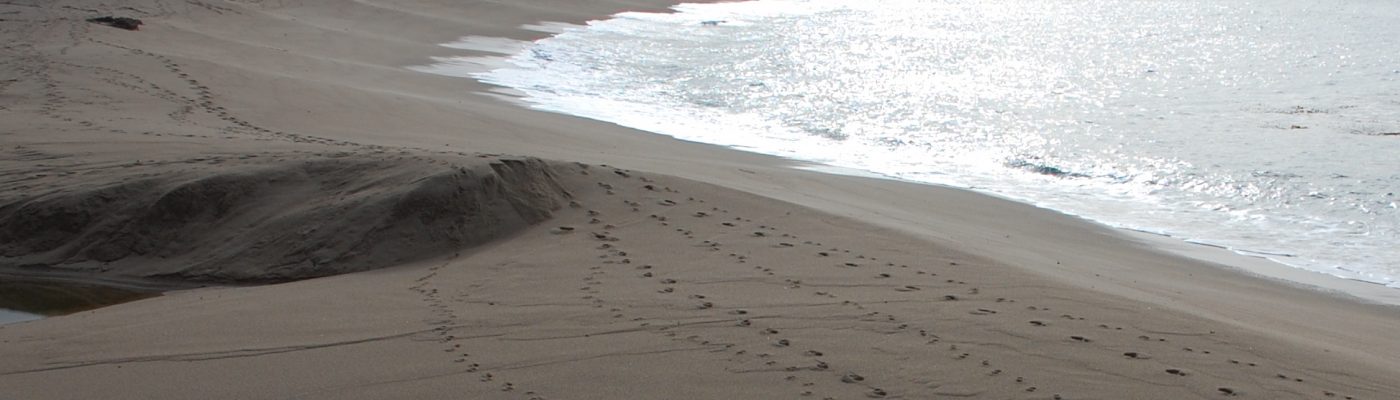
                Rodeo Beach lies just north of the Golden Gate. Yesterday, for a moment, I saw it. I saw the varied black of the sea stacks, the changing white of the spray, the deep blues of the surging ocean, the dappled greens of the field above the bluffs, the shadowed orange of the flowers. Such colors are probably always there, but for a moment I learned to drink them.
                After reading it, my students often say they want to remember The Little Prince and reconnect with their own creativity, imagination, and sense of wonder. They say the little prince is wholly, fully himself, and reminds us to be ourselves. They say they want to remember “what makes them happy.” And that’s wonderful. But I don’t think we should stop there.
                The book sings childhood, and childhood isn’t only about itself. A kid wants to be included, wants to be cared for, wants a stick that can be a sword or mud that can be a pie, but whenever I’ve watched a child really playing, the game isn’t about her. It’s about the friends around her, or the tree she’s climbing, or the creek she’s directing. It’s science and magic and love. Near the beginning of the story, when the pilot draws a crate with three air holes, the little prince can see the sheep inside. For the whole book, he cares whether the sheep is awake, or asleep, or hungry. He cares about others’ lives. He walks across new earth. His imagination shows him life beneath the surface.
                The little prince reminds us to connect with our own hearts, with what gives us joy and makes us question and play–but out heart, in turns, connects us to the world. By approaching with curiosity, joy, and awe, the little prince sees the stars and the desert, and drinks from the secret well hidden in the dunes. He learns from everyone, and shares his heart with everyone. He makes friends with a fox.
                So if you come to this spot–the spot just beneath a star; the spot with a horizon in front of you; the spot with someone else who might be a friend–please do not hurry. Wait for a time. Wonder gives us the world.

95: “The One You Feed”

                “The One You Feed” -Entirely Unclear

                There’s a story that gets passed around, often as a Cherokee legend. Most recently I saw it on Zenpencils.com. (Which, by the way, is excellent). In the story, an old wise man describes the two wolves fighting inside his heart. One is anger, guilt, false pride, and arrogance; the other is kindness, peace, humility, and compassion. One is often black, the other white. The wise man ends by telling his student, “The same fight is going on in your heart.” The student asks, “Which one will win?”
                “The one you feed.”
                Sometimes I find myself being too critical in my response to narratives. At one point, I could have gone on at great length about why, specifically, I thought the Harry Potter falls short of exploring human hearts. To kill a few more darlings, I’m also deeply troubled by Cameron’s Avatar, Tarantino’s Inglourious Basterds, and America’s favorite To Kill A Mockingbird. Just typing that, I’m tempted to dive in and explain why. I think that’s a useful thing to do. We need to look for what’s wrong, what’s skewed, what’s thoughtless or prejudiced or shallow in the stories we tell.
                As the same time, I think all the stories I named (even–sigh–Basterds) have something important in them. They touch on real emotion, or share a useful perspective. So which do I look at? Do I read a story to learn what it can tell me, or to recognize where it leads me astray? Once I realized that was my question, the answer seemed a little clearer: both.
                The wolf story is almost certainly not a Cherokee legend. One famous version comes from the evangelical Christian Billy Graham. The sentiment looks Western: there’s God and the Devil, Good and Evil at war. The Native American teachers I’ve heard speak are less quick to pick up that story. In any case, I find it troublesome on several levels. First, there’s the question of why (if it’s not a native American myth) we keep casting it as one. Second, there’s the identification of black with evil and white with good. I’ll get out of the way while Muhammad Ali takes a swing at that one. He makes me smile and he makes me think. Third, I don’t think you can divvy up emotions or even characteristics into “goods” and “bads” like that. I’ve felt anger when a student disrespected and hurt another student–and I don’t think that was bad. I think my anger was useful, important. And guilt? Someone without guilt would be scary. While it’s uncomfortable (and can get out of hand), guilt, respected and given its place in the garden, leads us back when we’ve started stepping on growing things. Try it for yourself–think of an emotion, a “bad” one and a “good” one, and ask yourself if the same thing could be useful, could help (or hurt) if you held it in a different way in a different situation. Looking through my own garden, I haven’t found any evil plants. Some are poisonous and some are sweet, some have thorns and some are soft, but poisons can be important medicines, and thorns can teach us respect.
                And there is still something beautiful in that wolf story. I think we do become the habits we make. We do “feed” different perspectives, different identities, different ways of being in the world. We grow into who we choose.
                So I’m troubled by the story, and I like it. I push it away, and I follow it.

94: “Emotional Granularity” (Lisa Feldman Barrett)

                “Your brain, it turns out, in a very real sense constructs your emotional states — in the blink of an eye, outside of your awareness — and people who learn diverse concepts of emotion are better equipped to create more finely tailored emotions.
                This is why emotional granularity can have such influence on your well-being and health: It gives your brain more precise tools for handling the myriad challenges that life throws at you.” -Professor Lisa Feldman Barrett

                Last August, my classes and I read a short article from Psychology Professor Lisa Feldman Barrett as we sailed off into poetry. I think we should be careful about dividing thought into departments: sure, there are different fields with different landmarks, but all these fields share the same soil and a playing child runs happily between them.
                The article’s about “emotional granularity:” the ability to precisely identify and describe your own emotions. Someone with low emotional granularity might sometimes feel ‘happy’ or ‘sad.’ Someone with high emotional granularity might sometimes feel ‘joyous,’ ‘content,’ ‘accomplished,’ ‘fortunate,’ ‘determined,’ ‘frustrated,’ ‘worn thin,’ or ‘thespian,’ to name a few. And all of those would be different. (And yes–you can definitely feel thespian. I work with drama kids, and some of them feel thespian an awful lot).
                Professor Barrett claims that our brains actively construct emotions, which serve as tools to help us through the day. Emotions are the horses that pull our intellectual cart: they’re also the guardian angels that bring out flaming swords when our loved ones are threatened, and the little fairy-lights (“hope”) that dance ahead of us, encouraging us to keep trying. If you practice feeling, differentiating, and understanding different emotions, then your brain has all different characters to send to your side. You have lots of different emotional tools. If you don’t practice all that, then you have a screwdriver called happiness and a hammer called sadness, and whenever you run across a bolt, a rivet, or an unhappy child, you hit it with the screwdriver or the hammer and wonder what’s wrong.
                I don’t mean to use science to prove art–as far as I’m concerned, they both have legs to run with. I do mean to point out another way that they play together. According to Professor Barrett’s research, increased emotional granularity improves your health–and not just your psychological health. Physically, your body operates better when you know and can experience different emotions. The health benefits don’t just come from “good” feelings, either: even a more nuanced experience of “negative” emotions is good for you. (Soon I want to think about this separation of “negative” and “positive” emotions, because the more I think and feel about it, the less it makes sense). But for now, we can bring art into the dance and realize that the average school kid has felt this for years. Almost everyone I know who likes music seeks out all different kinds of melodies: hopeful, harrowing, haunting, hyper, hilarious, and maybe even some that don’t start with h. These kids know (or maybe feel) that feeling is healthy–that it deepens us, and opens the fullness of what we are.
                Lately I’ve been feeling sad, and hurt. I don’t know if the purpose of emotions is to be used, but I do believe that every laugh, every year, and every fear can help. I haven’t just been feeling sad: I’ve been feeling hopeful, too, and kind. And in fact, the hurt I feel is a response to what I see, it’s a kind of ‘why do we do this to each other’ hurt, and it helps me to see where I can help. (More h’s). That doesn’t mean I’ll give up and sit here in the hurt. It does mean that the hurt has something to offer. It does mean, I think, that storms rolling in carry your power, lightning shines your light, rain has water for you to drink, and warm twilight’s share your peace. You are someone who can dance with all of that and more.

93: “Make Room For What You Are” (John Scalzi)

                Who you are has always had to make room for what you are.” John Scalzi, Zoe’s Tale
                “‘If that’s true, then the thing’s been using you all this time, Mr. Holloway,’ Soltan said. […] ‘It doesn’t bother you?”
                “‘Not really,’ [Holloway said].” -John Scalzi, Fuzzy Nation

                In Zoe’s Tale, the alien Obin have intelligence but no consciousness. (The Obin were created by the Consu, a species so advanced that they sometimes act like gods and almost never wait around to explain anything). The Obin can make space ships, but they don’t enjoy (or fear) flying. They can communicate, but they don’t have that much to say to each other. They don’t mind living, or dying. If a mind means a framework of preferences, values, and relationships, they don’t seem to have minds at all.
                Somehow they feel that they’re lacking something, and they set out to find it. At their insistence, a human scientist creates devices that allow Obin brains to have consciousness. As a species they flip the switch, and then realize they have a lot of learning to do. They don’t know how to deal with thinking, and feeling, and caring. So the entire species turns to Zoe, the young daughter of the human scientist, as a kind of Goddess-Guide-Child. Two Obin caretakers live with Zoe (and her human adopted parents), and record their experiences with her. They share those recordings with the entire species, and the entire species learns how to feel, how to care, love, hate, be hurt, and heal by “growing up” with Zoe.
                A big part of Zoe’s Tale is about the pressure and demand of growing up for a whole species as well as for yourself. It’s about the responsibilities that land on Zoe because of what she is: the Obin’s symbol for consciousness, and their leader in learning what it is to be alive. Scalzi sets up  tension between that and who she is: her own wants, her own perspectives. While most of us might not have the Obin beside us, we all do have responsibilities because of what we are: responsibilities because we’re a father, or a son, a teacher, a lawyer, or a cook. To Zoe, who’s often wise and kind, these responsibilities feel heavy.
                In Fuzzy Nation, the adorable cat-monkey Fuzzies don’t have a chance against the humans who are destroying their plant. They can’t even get the humans to recognize that Fuzzies are conscious creatures–until “Papa” Fuzzy uses a man named Holloway to understand more about humanity, and to push humanity to understand more about the Fuzzies. Papa is using Holloway from their first interaction; after a while, Papa likes Holloway, and he keeps using him. Papa has a planet to protect, a species to save. When Holloway figures out he’s being used, he does something wonderful. He understands, and doesn’t mind, and keeps on trying to help.
                Sometimes we’re in a place to help something larger than ourselves. Come to think of it, we’re always in that place. It’s a good place to be. I was just talking to a student, and he said it’s strange how we always tell young people to “look inside” and “find their passion.” He doesn’t know what his passion is–at least, he doesn’t have some overriding dream. But he doesn’t think he needs one. Instead of looking inside to find this “passion,” he wants to look around: he wants to see who’s struggling, and what kind of help they need. He wants to look for what he can do that the world needs, and then he wants to do it.
                I think it’s important to remember ourselves, respect ourselves, and value our own talents. And I think that “living for yourself,” even if it becomes the catchphrase of a culture, can lead toward sadness and loneliness for you and uncaring disconnection for the community. So I’ll live for me–for me, for you. And when who I am (my wants, my preferences) had to take a back seat for what I am (a person with jumper cables when the other guy’s battery is dead; a teacher; a brother), I’ll smile.
                It doesn’t bother me. It’s good work if you can get it.

92: “I’ll Meet You There” (Rumi)

“Out beyond ideas of wrongdoing and rightdoing,
there is a field. I’ll meet you there.

When the soul lies down in that grass,
the world is too full to talk about.
Ideas, language, even the phrase “each other” doesn’t make any sense.” -Rumi

                Pick up a stone that fits inside your hand. Feel the weight of it. Feel its touch.
                For ninety-one weeks, in words and words and words, I’ve been trying to figure something out. I’ve been trying to help. I’ve been trying to solve problems, provide answers, offer support and understand. And there’s something wonderful in all of that.
                But there is also quiet.
                A breath.
                Pick up a stone. Any stone. Feel it. Sometimes that is my doorway to the field. I don’t find healing there, but I do find a pattern larger than all my hurts. I find something like peace and strength. I find being.
                There is quiet.
                A breath.
                Out beyond ideas of wrongdoing and rightdoing, there is a field.
                I’ll meet you there.

91: “Nothing But The Night” (A. E. Housman)

“Now hollow fires burn out to black
And lights are guttering low:
Square your shoulders, lift your pack,
And leave your friends and go.

Oh never fear, man, nought’s to dread,
Look not left nor right:
In all the endless road you tread
There’s nothing but the night.”
                -A. E. Housman, A Shropshire Lad

                I love how Housman tells us not to be afraid of walking out into the black, not because we’ll find a light, but because “in all the endless road you tread / There’s nothing but the night.” Well, isn’t that what we were afraid of? Aren’t we afraid of wandering our whole lives through an empty landscape, alone, beneath the distant stars? Yes, I suppose we are–but Housman says we don’t need to be. The very things we’re afraid of, the things we fear–we can turn and step into them. We can realize that those things are here.
                As a child I was terrified of the dark. Sometimes I would pull my blanket up over my face, hiding from the monsters I made up. Then I would imagine a face (it was usually something like Ridley Scott’s alien; I hadn’t seen the movie, so maybe Scott had seen my fears?) staring back at me, just on the other side of the blanket. My fear would build and build and build. I would feel like I just couldn’t pull the blanket down and look. And when, finally, I did, the fear would stop washing over me and become something I could handle. And more: my monster came from my imagination. In the years since then, my imagination has helped me learn and connect, laugh and discover. The fear I felt (and feel) may not be pleasant, it might not be fun, but it is important. When I open the door to allow it in, it’s not as bad as it was behind the blanket. I find that it hurts, but it also helps.
                When I stop running and start walking, and the night’s a kind enough place to be.

90: “The Pattern That Everything Makes” (Jo Walton)

                “Fairies are more in the magic than in the world, and people are more in the world than in the magic…And God? God is in everything, moving through everything, is the pattern that everything makes, moving. That’s why messing with magic so often becomes evil, because it’s going against that pattern. I could almost see the pattern as the sun and clouds succeeded each other over the hills and I held the pain a little bit away, where it didn’t hurt me.” –Among Others, Jo Walton

                Among Others is a love song to libraries and friends, a conversation between hundreds of different science fiction books, and a lost girl finding that she isn’t lost at all. (I’ve just finished reading it, including a little nap before the last ten pages. Honestly, I think the nap was as much a part of reading it–pouring my mind through it, and learning from the flow–as anything else). At the heart of it is a way of being in the world. Maybe that’s at the heart of most things.
                Nietzche talks about “will to power” as the fundamental human experience: he sees ambition, the effort to reach a higher position. A lot of us live like that. Jo Walton talks about a pattern: a pattern that is inside all things and between all things, a pattern we’re a part of. In a way, those are both foundational psychologies; in another way, those are different approaches to the idea of living.
                It reminds me of an old Jewish story: young Abraham comes out from a cave (funny, the connections you see–Buddha, Plato). The sun shines above him, and he falls to his knees, saying, ‘Surely you must be the Most Powerful, bright eye of the sky, and I will worship you.’ So he worships the sun for a little while–until sunset, actually, when the sun sets and the moon rises.
                After thinking it over, he drops to his knees in front of the moon, saying, “You must be the Most Powerful, white eye of darkness, and I will worship you.” So he kneels again, and prays, and prays–and clouds cover the moon. So he worships the clouds, until the sun comes up and the clouds go away, and then he thinks, “You must be the…Wait.” So he thinks, and he thinks, and he thinks that things come and go in their own cycles. He decides there must be a power above them all, a power arranging them. He decides to worship that power, and calls it God. That’s one idea: a hierarchy, a creator and creations.
                Walton’s God isn’t above, but within. Her character’s goal isn’t to master patterns, and control them, but rather to fit inside them. To be part of them. To let things be what they are, and be herself what she is, and feel the connections. In the end, that makes sense for a character who loves libraries so much–it’s the life equivalent of reading a book, and making sure it ends up back on the shelf, unbroken, so someone else can come along and find it. I’d like to live that way.

89: “Irreverence” (Mary Ruefle)

                “Irreverence is a way of playing hooky and remaining present at the same time.” -Mary Ruefle

                Today, while playing my Storytelling game with some students, one of my students started teasing me. I responded by getting more serious about the story we were telling. He responded by teasing me more. We both ended up a little hurt and a lot confused about how things had gone. We’re good friends, so after all of that we spent a bit of time alone to think things over, and then we came together to talk things through.
                He started by apologizing. I responded by apologizing. After that we could get down to work. Had he been finding my weak places, and pushing them? (Why do people like pushing exactly where someone is vulnerable?) Had I been taking myself too seriously? I’ve been told that before–once, notably, by a young woman who went by the name Goose, because of the helmet she liked to wear. (It was covered in feathers).
                We talked around it, over it, and through it, and came up with an idea. Reverence means “respect, awe;” in the end it comes from the Proto-Indo European wer- “to become aware of, perceive, watch out for.” I was being reverent–I was insisting that the choices we make, even the choices in telling a story, matter. They carry weight. They’re something we should watch out for. I think reverence is important–there is a lot in the world that we should respect.
                Etymologically, irreverence should be the opposite of reverence–but I’m not sure that’s true. The opposite of reverence is not perceiving, not watching out, not being aware. Irreverence, as Ruefle reminds us, often works by being aware of something else. It works by questioning, by challenging why we give weight to the things we do. After all, we’ve respected a whole lot of silly things over the years. Sometimes we need to play hooky from our “responsibilities” in order to notice the things that actually require more of a response from us. Sometimes an afternoon in the river (or a conversation with a friend) has more to offer than a worksheet on a desk.
                For what it’s worth, I think the balance lies, not in melding these two together, but in remembering that they work together. It’s easy for reverent people to get insulted by irreverent people, and it’s easy for irreverent people to think reverent people are sticks in the mud. Still, a carpenter who doesn’t respect the hammer is going to end up with lots of hurt fingers, and a carpenter who doesn’t question things is never going to build a better house. Those things that actually deserve respect can probably stand up to a little teasing, and the best teasing usually includes a little respect.