243: “Listen Harder” (Samuel Beckett)

                “At last I began to think, that is to say to listen harder.” -Samuel Beckett

                Today I feel like I don’t have that much to say. The rain is falling. Cars go past outside. I wonder if I can hear that there are less of them. Hear people staying in, staying home.
                Listen harder.
                Years and years ago, in a rough semester of college, I decided what I needed to do was make my voice heard: speak up, and join the conversation. “The powerful play goes on, and you may contribute a verse,” says Whitman. Then again, there’s Milton: “They also serve who only stand and wait.”
                Listen harder.
                It was an excited, hopeful, silly thing, my decision in college: or at least, it was only a piece of an idea. Lately, in learning to dance, I’ve found myself enjoying following more than leading. Whichever role I take up, I used to think the challenge was knowing what to do. Now it seems more about hearing what there is. When I watch people who really dance, there’s something—call it the music, call it the beat, call it the world—moving through them. Of course, when I ask them how they do what they do, that’s exactly what they’ve been telling me: “I feel it.” The “it” isn’t something they’re saying. It’s something they’re hearing.
                I like hearing. I like speaking. I don’t think there’s anything wrong with having an idea, but perhaps Beckett means that there is something shallow about the idea until you’re listening to more than just it. “At last I began to think, that is to say, to listen harder.” If speaking is a sketch then maybe listening is the page. If doing is a kind of dancing then maybe listening is the music.
                Just now, I don’t feel like I have very much to say. I think that’s okay. I’m telling myself,
                Listen.

242: “Where To Go” (Jennifer Hayden)

“It was Friday, and I had no idea where to go with my emotions.”
                -Jennifer Hayden, Underwire

                In recent years, I’ve gotten more and more interested in short, immediate art—not quite “unedited,” but less rehearsed. That brings me into “short order poems,” which respond to a word or phrase someone gives me, and into flash fiction. It helps when I’m feeling stuck. It helps when I don’t know where to go, because I am somewhere, I’m feeling something, and when I listen that pushes toward somewhere. What happens when I’m quiet for a moment? What happens when I’m inside the confusion, or exhaustion, or excitement, or gratitude, or relief—or inside the mix I’ve found? What if you let it be weird, or sharp, or you?
                In my case, it’s often something wild. In my case, it’s sometimes something new. Once, it was something like this:

                “Sometimes”

                It undressed itself, sometimes, took off its skin, washed its muscles away in the rain, laid out its tendons on low bushes and its bones in the ground, and slipped, soaked down, slept its way into the aquifers it remembered, breathed itself out with a last sigh past old teeth to a sky—it went somewhere it didn’t know how to say and didn’t need to name, and sometimes, too, it came back, it walked up from the ground, a wisp of shape, collecting minerals, layering them, breathing earth and gathering breath and reaching out with its hands to see how it was held by hills and clouds and the tree that leaned out over the creek and the stardust that, listening, it could see.
                A he, for a moment.
                A she. 
                A they.
                A them.
                A we.
                And he, and she, and they, and them, and we, we danced a little while, and then went home, unbuttoning knuckles, unknotting skin, whispering marrow to what it’d been.

241: “The Heart You Were Given” (Meagan Cass)

                “—if you fear you have made a mistake, remember: we were not born to sit on couches, content. To be human is to test your limits, to push yourself, to move beyond the body and the heart you were given.”
                -Meagan Cass, ActivAmerica

                In the last months—and the last years, really—I’ve been trying to shift my head around so that I can value myself without valuing myself for my work. I have a long history of the “for my work” thing: as a student, I valued myself for my classes, my contributions; as a teacher, I’ve tended to think that I was good when my classes were good; as a writer, I’ve put a lot of my self-worth on how many pages I’m producing, and whether those pages could mean something. This isn’t the first time I’ve tried to move away from a “I’m worthwhile because of this thing I do” mindset: I noticed it in my teens, convinced myself it was a good thing, wondered if it was hurting me, talked with friends about it. All the same, this time feels the most complete. It’s not one conversation or a week of conversations: it’s something I keep coming back to.
                A while after I started, I realized I was cheating: I was playing at resting, playing at noticing myself and taking care of myself, so that afterward I would go ahead and work. Part of me is scared that, without the goad of fear and self-recrimination, I’ll stop writing, stop working, stop putting in the effort to be a good teacher. I think that’s silly, but I get it: I’ve used that goad a lot. It’s familiar. I’m used to reaching for it. I also have years and years of data suggesting that, in fact, I tend to give back more when I’m connected to myself than when I’m shoving myself forward/ I write and teach and think better when there’s some grounding in hope and love, for myself, the world, others, than when I’m only trying to keep ahead of the fear of not doing (not being) enough. But that’s a cheat, too. I don’t want to shift my head around this way just so that I finish my book. Sure, I’d like to finish it, but if doing this makes me work less, that’s okay. This whole reimagination project is about seeing myself in different terms. What kind of work is it, anyway, that gets its traction in a fundamental mistrust and hate for here and for me?
                The kind of work I see a lot, to be honest. That’s what Cass is pointing out. Her book plays with how we try to transform ourselves and escape ourselves and recreate ourselves and our families through sports, but I think those sports show something deeper. They show how terrified we seem to be of contentment. I’ve been scared of contentment. Hamilton: “I’ve never been satisfied.” Cass’s story shows that cultural emphasis on going beyond, on competing and proving, as it leads parents into tearing their children and then themselves apart. And I don’t want that. And the truth is, I have felt content. I have felt at peace. I have felt connected. That doesn’t mean I don’t get up and move, that doesn’t mean I don’t hope and reach, but it does mean that I’m choosing the heart I was given.

240: Being, Becoming, & Turning (Yu and Bechdel)

                “Once upon a time, there was a man whose therapist thought it would be a good idea for the man to work through stuff by telling a story about that stuff.”
                -Charles Yu, “Fable”

                “I was plagued then, as now, with a tendency to edit my thoughts before they even took shape.”
                -Alison Bechdel, Are You My Mother?

                Sometimes stories help me ground into here, so that my thoughts and my feelings can happen. They help me be. Sometimes stories help me direct my thoughts and feelings, channeling them in a direction I choose. They help me become. Sometimes they help me imagine a different possibility, a different future, that I could move toward instead. They help me turn. Yu and Bechdel help me see how different those three steps are, and how well they can work together.
                I can get stuck at any one of those steps. For the last few weeks I haven’t wanted to write. Or work in general, really. I kept putting myself in front of my computer, kept coming up with reasons or explanations as to why every task I picked up felt dead. A few years ago, when a friend told me she wasn’t “feeling motivated,” we ended up talking about what she was (un)motivated toward. What direction was she going in? How had she chosen that? Was she sure she wanted to go that way? We talk a lot about remembering to do something valuable, but I think it’s just as important to remember that some of what we’re tasked with isn’t valuable. Not everything our systems say we “have to do” or “should do” makes sense. Rejecting one path makes room for others. My friend suggested that might be where she was actually stuck: it’s not that she didn’t care, it’s that she was trying to make herself care about something she didn’t believe in. Her struggle was with the third of these story-steps. She believed in other things, and once she noticed that, she could turn. I’ve had a lot of trouble realizing I’m in the same place: I kept picking up the same tasks, kept trying to do the same way, and I thought my stuckness was the problem. I thought I was in the second step, trying to get myself to move, but looking back it seems like I was in the third—I needed to turn, and I didn’t see that. To put it another way, one of my friends insists that “writer’s block” is usually just trying to write the wrong thing.
                In the last few years, I think I’ve ignored the first step the most. It’s the step Yu and Bechdel both emphasize: the outpouring of words, the letting yourself take shape. I get caught up in directing the outpouring into the channels I’ve chosen. I get caught up with wondering what channels to choose. When I’m caught up in those and can’t figure out what’s happening, different things seem to help me happen. I can go for a walk. I can talk to someone, honestly and deeply. I can sit quietly. I can write a poem, letting word give way to word, letting moments drift into an unfolding now.
                I can be. Then become. Then, sometimes, turn. I get stuck in plenty of ways, and different kinds of stuck open up to a different kind of step, but stories give me three different steps to try.

239: “Beyond One’s Grasp” (Alex Shakar)

                “That’s what it was like, this experience—infantile. Freeing, joyous, but also regressive, narcissistic, less about opening himself than opening everything else to him. He wondered if the urge to return to this stage of innocent containment of everything was the very root of his and everyone’s problems, of the lifelong compulsion to consume and append and incorporate and be all and end all in a world ever more maddeningly beyond one’s grasp.”
                -Alex Shakar, Luminarium

                Sometimes I try to understand by bringing in, and sometimes by going out. Shakar makes me realize how different those two can be.
                In Luminarium there’s a device that technologically induces something like meditation by knocking out the brain’s ability to distinguish between self and not-self. The first time Fred tries it, he feels transcendent: he expands to include the room he’s sitting in and the other people nearby and the city beyond them. The second time, the time I quoted, the experience feels shallow. It feels locked inside “the smallness of his own mind.” 
                Remember the first episode of Star Trek: Voyager? A powerful alien sweeps the Voyager and its crew through the cosmos. Instead of traveling to travel, this alien brings others to it. At first that seems like the opposite of what we humans do, but as I sit here turning it over, it starts feeling more familiar. My (first) tendency is to set a book down on my desk, to put a flower I’m trying to draw on my table and copy down the image I see in my notebook. How many of my interactions start with me trying to move the other into a space I consider mine? Or to put it another way, the Star Trek crew might seek out “new life and new civilizations,” but they spend a lot of time on their own bridge, behind their own view screens and computers and phasers, don’t they? Isn’t that how our society so often travels?
                Maybe some of that is inevitable. I don’t know how to start except from behind my own eyes. Most of the time Captain Kirk couldn’t go from here to there without getting on the Enterprise. All the same, Shakar says, once we meet someone, once we stand somewhere, we could stop trying “to consume and append and incorporate and be all.” We could do something else: we could be a little piece of something larger, instead of trying to make all those somethings into little pieces of us. What if we didn’t use “grasp” to mean understand? What if, instead, we tried to cast our little minds out into the largeness, to meet the newness on newness’ terms—what if connecting was a matter of going out instead of bringing in, and instead of saying “she had a good grasp of physics” we said “she’s found a way to let physics hold her?”

238: “Prepared To See” Differently (Emerson)

                “Elliot Cabot’s paper on “Art” has given emphasis to one point among others, that people only see what they are prepared to see.” -Ralph Waldo Emerson (Journals)

                Last week’s entry wasn’t a meditation on references to references as references, but maybe it should have been. Isn’t that one way we muddle along, trying to make meaning?
                I can’t write anything funny unless there’s more than one character on stage. For humor to get up and play around, I need different perspectives, different minds creating different interpretations of what’s in front of them. If I were to try humor with only one character—with a monologue, like this—I think I would try to play with the reader as a character, play with my guess at the reader’s experience and expectations. Now I’ve gotten myself into a trap, because I don’t know what different things make writing funny. Inside my head I’m trying to get out of the trap: I’m reaching for references. Jim Carrey in Man on the Moon. The opening of Confederacy of Dunces. I ask myself, how are those things funny. I try to make meaning by understanding these other sources and bringing their lessons over here. Then they could be references: “In Man on the Moon…” I do that a lot.
                I have an image of a man waddling along, a gigantic sack of polaroids balanced on his back. When he finds something, he opens the sack and starts making comparisons. That’s what I do when I try to describe to someone a food they’ve never eaten, a place they’ve never been. “It’s like an apple.” “It’s like the Sierra mountains, but the granite feels older.” In some ways, I suppose, you could say that’s what Uproar does: it attempts to make polaroids, and then make them useful. And it doesn’t work. What happens when the man finds something he’s never seen before? What happens when he tries to twist what’s it front of him, to make it match this and that, even though each reference only gives him one (flawed, incomplete) viewpoint? I think I want to see the selfness of things. So it doesn’t work, but it works, too. I don’t think I’ve ever met something that doesn’t remind me of something else. I sit with an eraser, I sit with a leaf: they feel like something in my hand, and they pull toward something. Towards other things. I don’t know how to balance the tension. I don’t know how to learn from what I’ve seen, and still see new things I don’t know how to use yesterday’s lessons while remembering that tomorrow need not only be today. Besides, Uproar isn’t only making polaroids: it’s also sitting with something, and wondering what it is.
                Azlan says Emerson says Cabot says “that people only see what they are prepared to see.” With polaroids and comparisons, with stillnesses and curiosities, with not quite knowing, can we prepare ourselves to see past our expectations?

237: “Prepared To See” (Ralph Waldo Emerson)

                “Elliot Cabot’s paper on ‘Art’ has given emphasis to one point among others, that people only see what they are prepared to see.” -Ralph Waldo Emerson (Journals)

                A few weeks ago, on my way into the kitchen for a bowl of cereal, I passed my housemate watching TV.
                “What’s that?” I asked.
                “Parks and Rec. You seen it?”
                I trotted out a line I’d said before: “I tried, but I was teaching high school, so by the time I got home I didn’t want any more awkward.”
                They laughed, and told me if I ever started, I shouldn’t start with the first season.
                Somewhere in This Boy’s Life, Tobias Wolff points out how hard we all work to make other people see and agree with our version of reality. We interpret the kid who fell asleep in class as lazy and disrespectful, or exhausted, and then try to convince each other that our interpretation is the one that matches what’s ‘out there.’ We’re not just saying what the kid did: we’re constructing who we understand him to be.
                My thought about Parks and Rec falls apart as soon as I actually look at it. For one thing, I didn’t know much about the show: I might as well have been describing the social habits of wallabies. For another, the word “awkward” troubles me—I still can’t pin down a definition, and as a concept “awkward” seems to make connecting with people harder, not easier. Most importantly, if I try to apply the vague definitions of “awkward” people have explained to me, it doesn’t fit highschoolers any more than people in their 20s. Or 30s. Or 50s. If anything, I think calling highschoolers awkward might be one way our society shoves aside young people’s worries and experiences, their hurts, and the possibilities they push for. When I look at what I was saying, I don’t like it at all. So why was I repeating it?
                Comfort, I suppose. I pick up and defend reality-constructions for all different reasons. Sometimes it’s because I’ve carefully thought about something, and come up with a perspective that I think is useful or accurate or important. Sometimes it’s because I’m too scared to consider another possibility. Sometimes it’s because I want to be part of a group, and my group believes this way. Sometimes it’s because I’ve never stopped to wonder about it. Sometimes it’s because I want the world to be simple, to be as I’ve said, so my choices make obvious sense and I can skip past thinking and get some cereal. That’s strange, and ever since the conversation, I’ve been turning it over.
                Oh, and I’ve started watching Parks and Rec.

236: “One’s Own Motives” (Sharon Traweek)

                “Development of insight into one’s own motives and actions is thought to be a diversion of time and attention better spent on science.”
                -Sharon Traweek, “Pilgrim’s Progress: Male Tales Told during a Life in Physics,” 1999

                Traweek is describing the culture of American physicists in the ‘90s, but I feel what she’s pointing to around me. How much do we focus on motivating ourselves and acting, and how much on examining our motivations and actions? I’ve certainly heard people say, “Wow! Way to do the thing!” more often than I’ve heard “Wow! Way to  really understand why you were doing the thing!” I hear the same thing directed inward: I “need to find the motivation,” or “learn to motivate myself,” or “get myself to keep working.” Those conversations often skip over what I’m working towards, as though motivation is a singular thing, as though the direction I’ve already picked is of course a good one for me to be moving. As though if I just keep acting I’ll get there. Wherever there is.
                That’s not to say I never make a mistake the other way. I make all kinds of mistakes. As a senior at Amherst, I finished applications for jobs I certainly didn’t want because they seemed Cool, I knew cool people who Wanted them, and I imagined being Cool, too. Eventually someone I loved pointed out to me that the dream I was asking for wasn’t mine. I thought it over and realized I was acting, but had very little insight into my actions. Then again, when I considered applying to graduate school, I wanted to make sure that my motivations were right. I kept going over why I wanted to do this: to learn? To have time to focus on writing? To step out from my habits, and see what else I found? To join a community that emphasized scholarship and exploration? Was it just stupid pride? All those and more, it turned out, and the fact that part of me wanted to go for pride really bothered me. I didn’t apply. Then someone pointed out, ‘Look, of course that’s there, but that doesn’t mean it’s your only motivation, or even your main one.’ Another example: I’m twenty-three, moving toward the final draft of a poem I might really like, and I look up to realize that I’m scribbling and rescribbling variations of the same sixteen lines. It’s been eight hours. In the story about applying to graduate school, I might have been tripping on what I did with insights, not on the insights themselves—knowing part of me is envious and proud is useful. I want to remember it, and remember not to give it the steering wheel. In the second story, though, I’m glad that (for the day, at least) I didn’t worry too much about why I was scribbling these lines. They felt important, and I followed them.
                I think Traweek might agree with all of that. She’s not saying the answer is always “reexamine your motivations” and never “do what you’ve decided.” She’s saying that, culturally, we’re told stories of action much more than we’re told stories of understanding our motivation and purpose with those actions. We’re pushed to value dramatic moves over attentive insights. I hear that, recognize it, and wonder why it is. When I asked my students, “Why do you do what you do,” most of them said something like, “to do the best I can” or “to be successful.” Then some of them started laughing, because they realized they’d skipped the question I meant to pose: what do you mean “best,” what do you mean “successful,” why did you choose those definitions. When and where (and why) did we teach them to keep running before we taught them to think carefully about what they’re running towards?

235: “She Reaches Over / To Me” (Janet Wong)

“Before we crash
I reach over
and place my right arm
against Grandmother’s chest

the very moment

she reaches over
to me.”
                -Janet S. Wong, Behind the Wheel

                I keep coming back to that moment: a woman reaching out to protect her grandmother, a woman reaching back to protect her granddaughter.
                There are so many people who need help. Taking care of children shows that: little humans totter along wonderfully, but my niece would totter in dangerous directions without anyone else nearby, and she doesn’t pack her own snacks. Paying attention to my heart shows that: I used to have this American individualist idea that I should be able to sit alone and Be Great, but that never worked out. Whatever’s strong in me is a response to those around me. Looking around shows that: I keep seeing people who so obviously need a hand reaching out to them. I find myself wondering, so who?
                If you squint at human history, maybe it starts looking like experiments with that question: who gets support, who offers it, and how is it given? Are kids raised by parents, or governesses, or the community? Are grandparents taken care of by paid professionals (if the grandparents can pay), or by their children, or by the community? The apples from that tree—who gets them? Angeles Arrien comments somewhere that healthy adults will be fine in most societies, so the measure of a society is how its people takes care of those who aren’t healthy adults.
                All this can get pretty transactional: the school counselor is responsible for this group, but not that one. My professors can choose to help me, but should not ask for help from me. I’m socially bound to help my housemate with the sink, but not with his tears. Those rules are set up for a reason, or at least for different reasons: so the people make the rules get as much as possible, so we don’t have to be uncomfortable about asking for or offering support, or so support is offered fairly and equally and safely. Some of those rules have their place. Adults take care of kids because kids need it. Kids grow up and take care of others, because then it’s their turn. Lives have stages, and if we get the gears right, maybe all these lives can fit together, tic tic, like a good clock.
                All the same, I keep going back to Wong’s image. If we need rules to make sure that everyone is offered support, maybe we need poems to remind us how offering that support could feel. A woman reaches out to her grandmother. A woman reaches out to her granddaughter. Someone’s just coming into their time of leading, of taking care of the garden we share. Someone’s been leading for a long time, and her hands are probably tireder than once they were. They protect each other, or support each other, or share the wish of support with each other. It’s not a trade or a transaction. It’s not taking turns. It’s vulnerable and tender. Perhaps we could call that kind of support love, and living.

234: Building Sandcastles (Alison Bechdel)

                “Of course, the point at which I began to write the story is not the same as the point at which the story begins. You can’t live and write at the same time.” 
                -Alison Bechdel, Are You My Mother?

                Well, certainly—and yet I do seem to try to, don’t I? 
                I recently came back from a visit to my family in California. There are plenty of things that’re oof about living 2,000 miles from people you love, but there are things that’re helpful, too: for instance, when I visit and then have to go, there’s a shortened time frame in which I’m reminded to reach out. Living close to someone, I can get caught up in the idea that there’ll be time—more time, and more time—to be there, to say the things I want to say, to listen and make space and stay in it. Having to go reminds me, now.
                That timeframe can be a good push forward. It can also be a distraction. If I’m sitting on the couch, thinking I really want to be connecting right now, I’m not connecting. I suppose one ideal might be to let the push move me forward, and then let being there take over; right now I’m looking at the example of trying to do two contradictory things at the same time. Bechdel can’t write about her relationship with her mother and live her relationship with her mother at the same time. The second (usually, at least?) is back-stepping, it’s an attempt at sense-making; the first is just making, or being. It doesn’t have a pen in its hand. In the same way, though you can move from one to the other, I’m not sure wanting to be available to connect is the same as being there with someone.
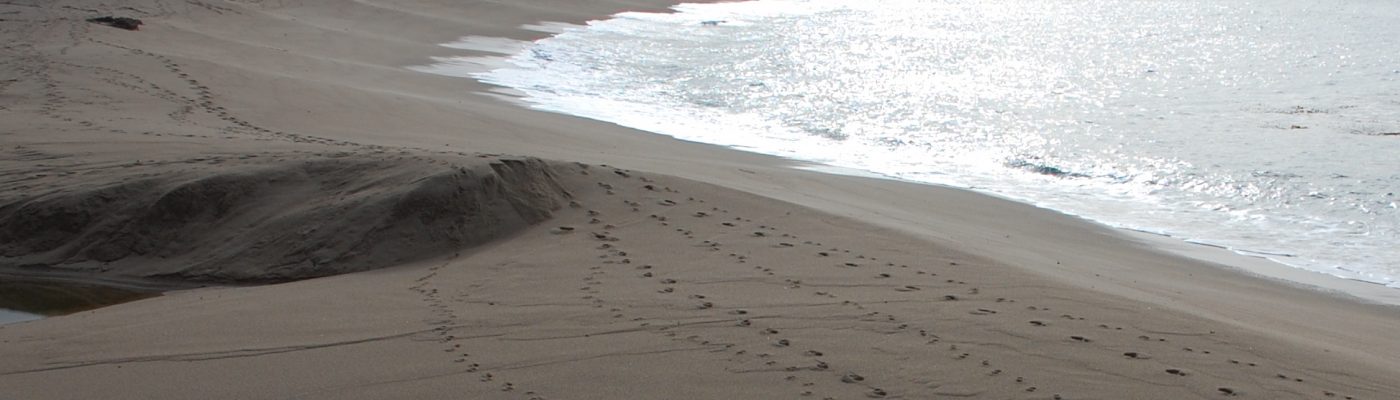
                On New Year’s Day we went to the beach, toes in sand and a cold wind blowing, and jumped into the Pacific. Like I was fourteen again, I spent a long time (I’ve no idea how long, really) building a big windbreak for our group to sit behind. It worked pretty well. There are so many wonderful things about wet sand, but the one I’m following here is what it’s like to build with. I needed stuff for my sand wall. I could pick it up in handfuls, or push it over, but I needed to pile up lots of sand, messy and flying, somehow in my smiling teeth, somehow in my hair. Then I needed to pat it down, shape it, compress it so it stayed in place. Maybe some master sand-castler will one day tell me a simpler way, but conceptually, I like those two stages: the moving, and the firming up. The coming together, and the settling. The collecting, and the shaping. Sometimes I try to collapse them all into one step, I try to create and understand all at once, to raise and pat down in one motion, but it doesn’t work very well. Of course it doesn’t. You can’t live and write at the same time.