305: “Unsaid” (Ursula K. Le Guin)

“Listen, listen, a lesser voice,
a whisper of the wind on stone
along the river’s drouth-white bed,
the shadow of the word unsaid.”
                
-Ursula K. Le Guin, from “Talk Shows”

                Lately I’ve noticed myself feeling quiet. And I’ve noticed that, with how often I look for meaning through words, I’ve tried to find words for my quiet. I’ve looked for a story to explain my storyless-ness. Words and sentences are what I turn to first when I’m trying to work something out, when I’m trying to build a stage where a voice can speak. What about when the speaker isn’t a speaker, and doesn’t want to say anything at all.
                Listen. Listen. Or maybe we can even go past listening, and sit with the sky and the dry riverbed instead of the river. Before I left Illinois, I went for a long walk with a good friend. We watched birds. We talked. We sat in a meadow. I have this image of my mind as a high plateau. Along the edge of it, on those down slopes, is where I channel water into whatever work I try to do. It’s where I gather momentum toward projects and ideas. Up on the plateau is sky and earth. Rain, sometimes. None of it has a purpose yet. I described that to my friend, and said I wanted to spend more time letting the water gather. That way, later, I would have something to direct. My friend said that sounded nice, but they added it didn’t need to be that way. Maybe there would be water. Maybe there would be sun. And all this, this here, there already was.
                The first time I wrote this, I tried ending with describing something we sat with in that meadow. Then I tried asking you for something—a glimpse of what you’re sitting with. But that’s me looking for words again. Maybe you don’t need to tell me. Maybe we’ll just sit.
304: “To Arrive Where We Started” (T. S. Eliot)

“We shall not cease from exploration
And the end of all our exploring
Will be to arrive where we started
And know the place for the first time.”
                -T. S. Eliot, from “Little Gidding”

                I’m back near where I grew up. It’s lovely. Today I was back in Annadel State Park, back in the rolling golden hills, back beneath moss covered oaks. Watching a woodpecker. Yesterday I was back with a dear friend, back sitting on the floor together, reading poetry together from a book we found together years and years ago. On Sunday I was back at the coast, back watching the horizon hatch into sea and sky. Back with family. Back on roads I remember, the ones that lead up to the hills, to a creek and plum trees and back home.
                I used to focus on the last bit of that passage from T. S. Eliot. And know the place for the first time. Now I find myself focusing on the line before that—to arrive where we started. To come back. It feels so sweet to come back. I’m not sure if I know all this any more, but there’s a softness, a joy, to arriving at the hills I’ve walked so many times, to sitting next to someone I’ve loved for so long, to feeling a bit of wind, new-old, blowing.

303: Sculpting Touch (Pedro Reyes)

Reyes Picture

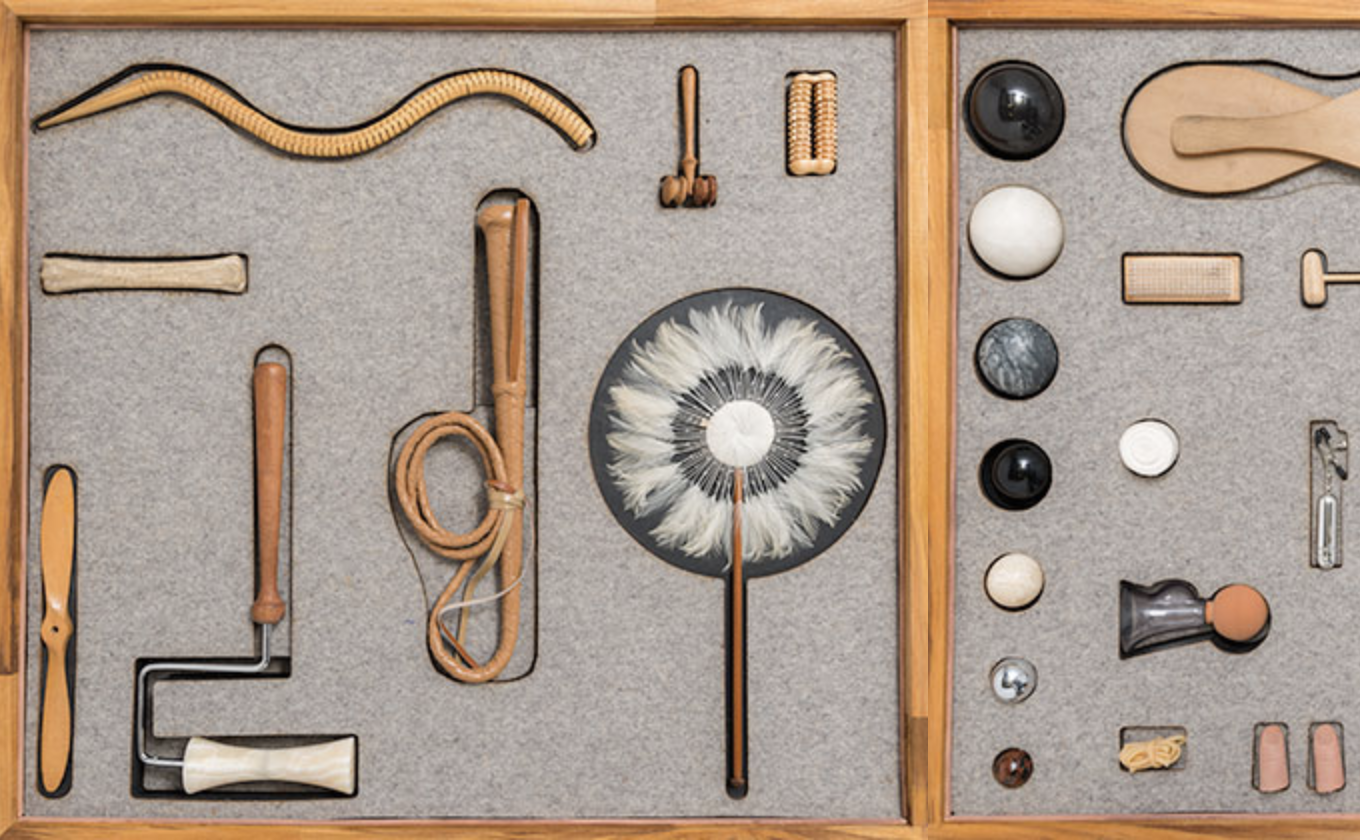
                “This sculpture may entertain the eye but is meant to be felt and touched. […] [It is a] participatory device one uses to “sculpt” a series of tactile sensations with someone else.”
                -Pedro Reyes, in describing his artwork “Cuerpomatico

                It’s getting hot in Illinois. Earlier today I went off for a last few errands before flying out to visit family tomorrow morning. As I drove, windows open, I worried about this post. There were a number of ideas I’ve been playing with, but none of them felt quite ready. Sitting at a stoplight I searched back through my ideas, shuffling them like cards, disliking each image. And then a few fingers of the afternoon breeze slipped through my open window and brushed past my arm.
                I spend so much time thinking about the world. And to go along with thinking, I spend so much time looking: at my computer screen while I type, at pages while I read, up into a tree when I hear a squirrel but can’t quite see where it is. Reyes’ sculpture brings me out of my eyes and back to my fingertips, my arms. My toes on the carpet. My elbows on the desk. But it’s not just for me: the sculpture’s something two people might do together. You could roll a ball up your friend’s arm, and then trace around their wrist with the wooden propeller. The first time I hugged someone after a long period of sheltering in place alone, I remember something that felt like, yes. This. That’s a little like what happened with the breeze at the stoplight. This. Maybe that’s what happens when, reminded by skies or friends, we go back to the way we’re always touching and being touched by the world.

302: “Touchy” (Eva Lingairi)

Silent Creeper
Touchy and firm
Your angelic smile
Comes to my Island
Lies upon my horizon
                
-from “Sunset,” by Eva Lingairi, published in Mi Mere: Poetry and Prose by Solomon Islands Women Writers

                This poem gives me back its words, but they’re new, and awash in seawater. I’ve always heard “touchy” as a bad thing. Oversensitive. Easy to offend. I think Eva Lingairi means touchy like related to touch: the sunset on the horizon, the last sips of light on the water, on the sand, on her. Her feet on the island, and her poem brushing past me.
                
I’m so grateful to have a touchy world. In these last months, in harder moments, I’ve lay down on the floor, running my fingers over the carpet. In light movements I’ve walked barefoot on grass, opened my hands to sunlight. I imagine Lingairi might have done something similar: held the last bit of the day as it held her. “Touchy” came to mean touchy, how we use it, because we blurred words together: etymonline suggests “tetchy” and Shakespeare’s “teachie” were influenced by the familiar “touch,” and here we are. But what if brushing past each other—being aware of brushing past each other—wasn’t framed as an aggravating thing. What if it was angelic, what if it was sweet, what if it was sunset and the island.
                
I’m going outside to hold a leaf. A rock. It’s sunset where I am, which feels like a gift Lingairi’s giving. So there are a last few sips of light, and then there’ll be the softness of twilight and the dark.

301: “What Remains” (Emily St. John Mandel)

                “There is a sort of randomness about what remains.”
                -Emily St. John Mandel, author of Station Eleven, commenting on what stays around in history (and in her novel)

                On my desk, as I write this, there’s a bowl from today’s lunch, and an acorn hat, and a rock, and a twig with dry white flowers—I’m not sure what kind, but a week ago the wind brought down a branch and I brought home this twig.
                A few weeks ago, after I heard some scholars talking about archives, I started wondering how much of what we do is archivistry. This and this go together. These ideas go together. These words go together. “This” and “go” and “together” go together. These sentences and the list of things on my desk go together. This question about how we make archives, make sets, might’ve encouraged me to pick up the twig in the first place: these little flowers and I go together, for at least a little.Emily St. John Mandel’s novel, Station Eleven, is about what’s left. What we gather. When Mandel spoke (virtually) at my school, I found myself thinking about her novel more deeply than I ever had before. Part of that was because of things she said, like this line I’ve quoted (and lots of other good ones). Part of that was just from talking with her. That happens a lot: I’m attached to things because of where I picked them up, because they’re attached to someone I’ve talked to.
                Because of the randomness of what remains. In the last year I’ve tried to do a lot of meaning-making, of habit-shaping, a lot of imposing order on what is. These words go together. In the last few weeks I’ve tried to step away from some of that. At first I had the image of a hand relaxing around its tools, around the stuff it’s “working with,” and just opening to whatever falls into it. But I’d rather stop thinking about hands. Ears don’t open and close. I’ve been trying to listen to whatever sounds wash up around me. I suppose I could say there is a pattern to them, larger and deeper than the patterns I was thinking, or I could say with Mandel that there’s a randomness to what remains, moment to moment, from what we’ve built and who we were. What was. Either way. For now I’d rather sit and listen.

300: “Every Leaf” (Emily Brontë)

Every leaf speaks bliss to me
Fluttering from the autumn tree.
                -Emily Brontë, “Fall, leaves, fall”

                Two things happened this morning while I was waking up. Well, I suppose a lot more than two—clouds blew and cats stretched and you woke up, too, unless you were already up or you kept on sleeping. But the two things I have in mind are a sense of peacefulness, of connection, and a line that floated through my head and seemed like something for a poem. I don’t remember the line. The sense of peacefulness has drifted nearby all day, sometimes closer, sometimes farther.
                During COVID isolation, I’ve spent a lot of time thinking about routines. I’ve tried to go for a walk almost every day, and do a series of stretches before I go to bed. Over winter break when my housemate was gone (with the cat!), I bonded with a basil plant. And of course, there have also been routines around work: the habit of reading at this time, writing at that. I wanted a pattern that would “get me through.” Then, for the last weeks, I haven’t wanted to work on my novel. Then, as a surprising, what-if choice, I’ve let that be okay.
                I wonder if my mind is deciduous. If leaves open, and drink light while I grow roots a little deeper, and then flutter down to thread through air. Sewing a quiet moment. I often ask myself to be evergreen: to wake up and have ideas, and be ready, be ready, be ready, just like yesterday and just like tomorrow. I wouldn’t ask that of someone else. I’d be more likely to ask if you could trust your bare branches. Your bursts of leaves. Your quiet buds.

299: “As Big For Me” (John Kendrick Bangs)

I met a little Elf-man, once,
Down where the lilies blow.
I asked him why he was so small
And why he didn’t grow.

He slightly frowned, and with his eye
He looked me through and through.
“I’m quite as big for me,” said he,
“As you are big for you.”
                -John Kendrick Bangs, “The Little Elf”

                When my little brother was six or seven we started saying that poem back and forth to each other.  Though we said it differently: it might have been the book we got it from, or our own twist, but the second stanza started “He smiled at me.” I like that. I can still see my brother, grinning mischievously as he trades line for line. And the poem feels like a smiling thing. I guess the frown makes more sense if you think about the elf being mistaken for something he’s not, but as we said it, six-year-old to twenty-something, it was more about each of us starting where we were, in our own reference of bigness or smallness, and then moving (like the poem does) to a different measure.
                In the last few weeks I’ve been thinking about this post, wondering what I would say in it. And every now and then I’ve found myself stopping to smile at something. The bug that lands on my hand. The bank building with its many stories. A street lamp. A tuft of grass. They all seem to look back, to look me through and through. I feel myself like a little stick figure, drawn into the margins. I feel myself like a kind of fog, floating low. They’re all as big for them, they say, as I am big for me.

298: “The Unexpected Word” (Max Ritvo)

                “I worry that as contemporary poets we have this pressure to always be moving forward. To always be elliptical and surge ahead, for every line to floor us with the unexpected word or image or turn.”
                -Max Ritvo, in a Divedapper interview

                Sometimes I feel that pressure to keep moving forward. I can feel that in my teaching: I need another lesson that’s perfectly balanced, that’s funny and accessible and community building and possibly has covid-safe cupcakes for covid-safe sharing. Through the zoom screen, I mean. Somehow. I can feel that way with my writing: there’s that story about the man carving beautiful, lifelike ducks because he takes a block of wood and then cuts away everything that’s not the duck, but then I feel like I better be paring away, all the time, at least a little, at least more, to get to that wooden duck that’s so perfect you’ll see it and think wow. What a duck.
                I think, for me, that pressure breathes fear. My fear of falling behind, of not living up to wherever I am. But lots of the poems I love, lots of the moments I love, don’t have anything to do with flooring me. The other day I lay on the floor, running my fingers across the carpet, feeling the texture of it. I listened to a leaf blow along the street. I sang the same silly song with a friend. Reading Ritvo, I’m not thinking about enjoying the little things. I’m thinking that some writing moves forward, and some brings us back home. And sometimes a moment, like a bell ringing slowly into silence, doesn’t move at all. It’s here. Or almost here. It’s changing, so quietly. I can’t tell where it’s going, or where it stops.

297: “The Best Definition” (Jane Goodall)

                “I had been told from school onwards that the best definition of a human being was man the tool-maker—yet I had just watched a chimp tool-maker in action.” -Jane Goodall
                “Now we must redefine tool, redefine Man, or accept chimpanzees as humans.” -Louis Leakey

It’s been more than a year since my first shelter-in-place, and sometimes I wonder what doing okay means. Does it mean I got through the readings and assignments for my graduate classes, or that I was prepared for the classes I’m teaching? Does it mean I was kind in interacting with my housemate, or that I was “productive,” or that I remembered to water the basil? Does it mean I stayed in to make sure I don’t help the pandemic spread? Yes, I suppose. And that makes me think: a definition does two things. It offers me a way to understand the world, and it privileges some things over others.
                Take “technology.” What counts? A few weeks ago I had some fun conversations as I asked people that. If I hit you with a rock, knowing that’ll do more than hitting you with my hand, am I using technology? What if I use the same rock as a weight while I dive for abalone? If I think of technology as a modified object, maybe it’s not technology until I figure out how to tie the rock to me, leaving my hands free. If I think of technology as a way of doing something, the object doesn’t seem central—singing a sea shanty to synchronize our heave ho starts to look like technology. Once we talk about “technological advancements,” I get even more confused. Does using less fossil fuels count as a technological advancement?
                And there’s Jane Goodall, reminding me that all my examples so far are human. I think there’s a reason for that: a habit of thought, of what’s important and what’s not, that I’ve picked up from my culture. At first I wasn’t tempted to include beavers’ dams, even though they could keep water on the landscape, recharge aquifers, and prevent forest fires. I didn’t include trees, processing carbon and sharing oxygen. I might have included plastic-eating bacteria, but that’s probably because I read about a “tech company” that’s working with them. So now I’m asking: what’s technology? What’s doing okay?And inside that question I’m wondering, what are my definitions set up to ignore?

296: “I Create My Works” (Eduardo Kac)

                “I create my works to accept and incorporate the reactions of and decisions made by the participants…[I] make a concerted effort to remain truly open to the participants’ choices and behaviors, to give up a substantial portion of control over the experience of the work…”
                -Eduardo Kac, “GFP Bunny,” 2003

                Eduardo Kac is the “transgenic” artist who, along with geneticist Louis-Marie Houdebine, was involved in making an albino bunny that glowed green under the right light because of a spliced gene from fluorescent jellyfish.
                Lately I’ve been thinking about the patterns I “print” on the world: the conceptual frameworks by which I make meaning. It’s fun to start tracing them out, and once I look, they’re everywhere: or rather, they’re what I’m looking through. It’s my identity framework that has me answer “I teach” (instead of “I lie on the floor with a cat sometimes”) when asked “What do you do,” and it’s my capitalistic framework that defends bodily autonomy by insisting that each of us “owns” our own body. The frameworks in my head each seem to have undergone a similar process: at first I constructed them from experiences I had, from things I was told, from patterns that were suggested to me. Then I started going around, applying them outward. At some point in childhood, I largely transitioned from asking “What is that” to having a stamp and ink and , consciously or unconsciously, putting my seal of “this” on what I saw. This is a job (and by the way it’s how you define yourself). This is property. This is a blog post. In all of these, I pull experience and action through the frameworks of my concepts, and that’s how I start to understand. I wonder if I can flip that system. Instead of “printing” my conception of reality onto the world, of imposing my pattern outward, can I think of myself as a participatory part of patterns beyond what I understand? When I think, can I understand myself as “printed on” by the world?
                In some ways, the quote from Kac takes a step in the direction I’m fumbling toward. He talks about “giving up” control, about being “truly open” to others’ decisions and behaviors. I wonder if the wish he’s acting from is similar to my wish. At the same time, the structure of his thinking still seems to assume that he has the control to give up. You can’t give up what’s not yours. To put it another way, he starts with “I create my works…” What happens if we start with, “Look at all this, me included, that this world is creating…”